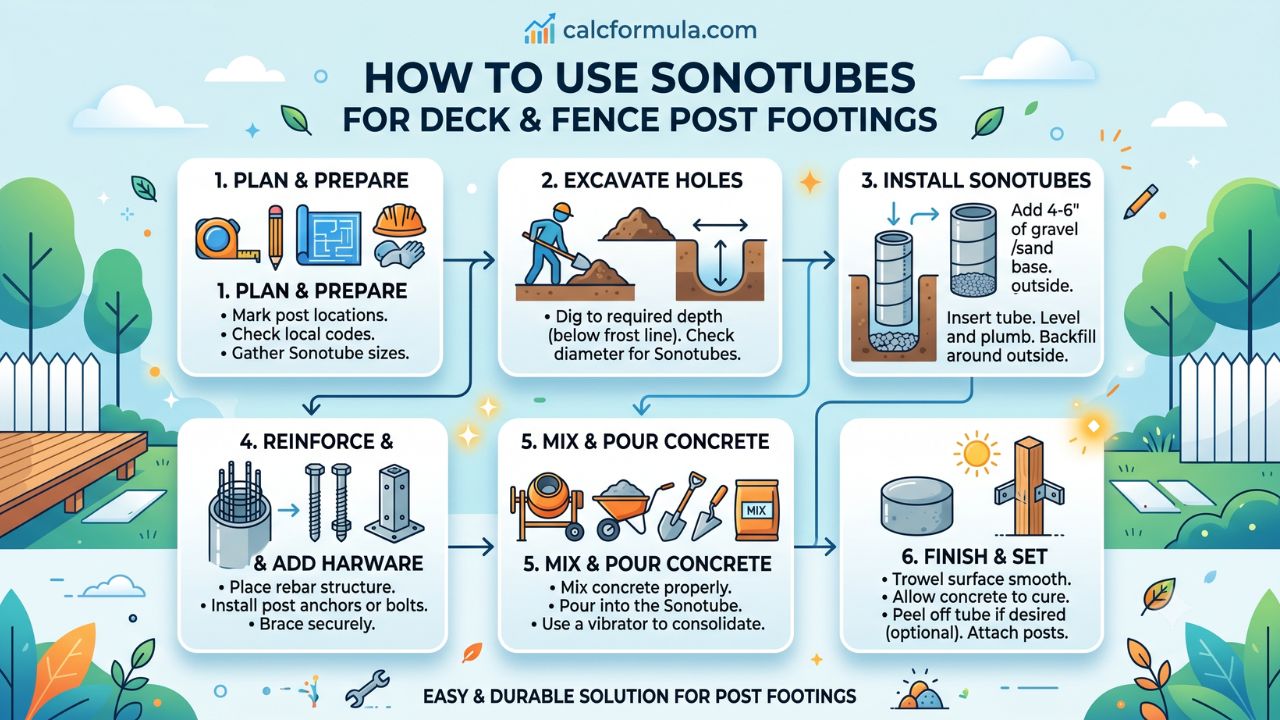
Sonotubes are deceptively simple tools — cardboard tubes you fill with concrete. But get the sizing, depth, or mix wrong and you end up with a footing that heaves every spring, cracks under load, or fails a building inspection. After years of deck builds and permit submissions, here’s the complete guide: the engineering logic behind footing design, how to correctly size a tube for your actual structural loads, what the International Residential Code (IRC) actually requires, and how to pour footings that last 40+ years.
Quick Answer: Volume Formula and Bag Count
If you’re already confident in your tube size and depth and just need the concrete volume:
Volume (cubic feet) = π × r² × h
- r = inside radius in feet (diameter ÷ 2 ÷ 12 if working in inches)
- h = total tube height in feet
Worked example — 10-inch tube, 48 inches deep:
- Radius = 5 in = 0.417 ft
- Volume = 3.1416 × (0.417)² × 4 = 2.18 ft³
- 80 lb bags (yield ≈ 0.60 ft³/bag): 2.18 ÷ 0.60 = 3.6 → buy 4 bags
For multi-footing projects or non-standard depths, skip the arithmetic and use the Sonotube Calculator — enter diameter, depth, and quantity, and it returns total concrete volume and bag count.
Why Footings Fail: The Two Root Causes
Before sizing a single tube, understand why deck and fence footings fail. Almost every failure traces back to one of two causes:
1. Frost Heave
Water in soil expands roughly 9% when it freezes. If that expansion occurs beneath or alongside your footing, it exerts enormous upward or lateral force — easily enough to lift a 4,000 lb deck or torque fence posts completely out of plumb. The fix is extending the footing below the frost line, where soil temperature stays above 32°F year-round. Above the frost line, frozen soil can push on the sides of the footing; below it, the footing is anchored in stable, non-freezing ground.
This is not optional. The IRC (Section R403.1.4) mandates footings be placed below the frost line in all jurisdictions that adopt it. Your local amendment may be stricter — municipalities in Minnesota or Maine routinely require 60 inches.
2. Inadequate Bearing Capacity
Concrete is strong in compression, but it can only transfer load to soil as fast as the soil can accept it. If your footing base area is too small for the load above it, the footing sinks — slowly at first, then suddenly under seasonal saturation. The relationship is:
Required Base Area (ft²) = Total Load (lbs) ÷ Soil Bearing Capacity (lbs/ft²)
Typical soil bearing capacities:
| Soil Type | Bearing Capacity |
|---|---|
| Soft clay / wet silt | 1,000–1,500 lbs/ft² |
| Sandy loam / firm clay | 2,000–3,000 lbs/ft² |
| Dense gravel / compacted fill | 3,000–5,000 lbs/ft² |
| Bedrock | 12,000+ lbs/ft² |
Most residential designs assume 1,500–2,000 lbs/ft² as a conservative baseline unless a soil test (geotechnical report) says otherwise. Many inspectors will ask you to justify your footing diameter against this number.
Sizing the Tube Correctly: Load Path and Tributary Area
The biggest mistake DIYers make is picking a tube diameter based on the post size — not the structural load. An 8-inch tube under a 4×4 post looks proportional but may be wildly undersized for a 20-foot deck span.
Calculating Tributary Area
Each footing supports a “tributary area” — the portion of the deck’s surface area whose weight flows down to that specific post. For a simple rectangular deck, divide the deck into zones centered between posts:
Example: 16 ft × 12 ft deck, 6 posts
- Deck area = 192 ft²
- Per-footing tributary area ≈ 192 ÷ 6 = 32 ft² (corner posts carry less; interior posts carry more — use your actual framing plan)
Calculating Footing Load
The IRC uses design loads of:
- Dead load (the structure itself): 10–15 lbs/ft²
- Live load (people, furniture, snow where applicable): 40–60 lbs/ft²
- Combined total: typically 50 lbs/ft² for non-snow-load zones, 70–80 lbs/ft² for snow regions
Total load per footing = Tributary Area × Design Load
For our example in a non-snow zone:
- 32 ft² × 50 lbs/ft² = 1,600 lbs per footing
Minimum Footing Diameter
Rearranging the bearing capacity equation with 1,500 lbs/ft² soil:
- Required area = 1,600 ÷ 1,500 = 1.07 ft²
- Required diameter = √(Area ÷ π) × 2 = √(1.07 ÷ 3.1416) × 2 = 1.17 ft = ~14 inches
That’s why a 10-inch tube (base area = 0.54 ft²) is undersized for a moderately loaded deck in typical soil. For this load, you’d use a 12-inch tube minimum — or design a bell-bottom footing (see below) to spread the base.
For precise calculations across all your footings, the Concrete Column Calculator handles volume and diameter checks once you’ve determined your load per column.
Sonotube Types, Sizes, and Specifications
“Sonotube” is a brand name owned by Sonoco Products Company. Generic equivalents exist (Quik-Tube, Quik-Form, etc.) but the sizing and use is identical. Here are the specs you need on the shelf:
Standard Tube Sizes (Residential)
| Diameter | Common Use | Base Area | Max Load (1,500 lb/ft² soil) |
|---|---|---|---|
| 8 inch | Light fence posts, gate posts | 0.35 ft² | 525 lbs |
| 10 inch | Fence corner posts, light deck posts | 0.54 ft² | 810 lbs |
| 12 inch | Standard deck footings | 0.79 ft² | 1,185 lbs |
| 14 inch | Heavy deck footings, pergolas | 1.07 ft² | 1,605 lbs |
| 16 inch | Large structures, multi-level decks | 1.40 ft² | 2,100 lbs |
Tube Types
Standard (brown): Single-wall fiber tube. Fine for most residential applications. Peel the above-grade portion after 24–48 hours of cure.
Wax-coated: Inner surface has a wax release coating that produces a smoother concrete finish and resists moisture intrusion during pouring. Worth using in wet soils or when pouring during light rain.
Heavy-duty (multi-wall): Thicker walls that resist deformation under deeper pours or when backfill pressure is applied before the concrete sets. Recommended for tubes extending more than 48 inches below grade.
Finish tubes: Larger diameter decorative tubes (16″+) designed for exposed above-grade applications like porch columns. Not the same product as footing tubes — don’t confuse them.
Frost Line Depth by Region
Using the wrong frost depth is the most common code violation on residential deck permit applications. These are general guidelines — always verify with your local building department:
| Region | Typical Frost Depth |
|---|---|
| Florida, Gulf Coast, Hawaii | No frost requirement (verify locally) |
| Pacific Coast (CA, OR, WA) | 12–24 inches |
| Mid-Atlantic, Southeast | 18–30 inches |
| Ohio Valley, Mid-South | 30–36 inches |
| Great Plains, Midwest | 36–48 inches |
| New England, Great Lakes | 48–54 inches |
| Upper Midwest (MN, WI, ND) | 54–66 inches |
| Canada (varies widely) | 48–72+ inches |
Add your above-grade height (typically 2–6 inches for deck footings) to the frost depth to get your total tube length.
A 48-inch frost line plus 4 inches above grade = 52-inch tube. Buy the next standard length up (usually 48″ or 96″ tubes are sold — cut a 96″ tube to length with a utility knife).
Step-by-Step Installation: What the Instructions Don’t Tell You
Step 1 — Permits and Layout
Pull your permit before digging. Most jurisdictions require a footing inspection before the concrete is poured. Show up without a permit and you may be required to excavate and expose cured footings for inspection — an expensive mistake.
Lay out footing centers using batter boards set 2–3 feet back from the deck perimeter. String lines cross at each footing center. Drop a plumb bob to mark the exact center on the ground. This precision matters: a footing shifted 3 inches off layout creates alignment problems across every beam, joist, and rail post above it.
Step 2 — Excavation
Match your auger diameter to the tube plus 2–3 inches clearance for leveling. A 12-inch tube needs a 14–15 inch auger. Renting a 2-person gas auger is worth every dollar for more than 3 holes — hand augers are brutal in clay.
Watch for: In clay soil, the auger often creates a smooth, glazed hole wall that reduces soil-to-concrete friction (skin friction). Roughen the walls with a spade or use a larger-diameter tube to compensate.
In rocky ground: Stop the auger before you hit rock. Do not try to auger through boulders. Hand-dig around the obstruction and confirm your frost line depth is met by an alternate path — or call an inspector for guidance. Pouring directly onto bedrock is actually ideal, but the tube still needs to reach below frost.
Step 3 — Set the Tube
Drop the tube into the hole. Check plumb on two perpendicular faces with a 4-foot level — a tube that’s 1 inch out of plumb at 48 inches translates to a post that’s visibly leaning before you’ve framed a single joist.
Backfill around the tube with the removed soil in 6-inch lifts, tamping each lift with a rod or the handle of a shovel. This is what holds the tube in position during the pour. For tubes extending more than 4 inches above grade, cross-brace with two stakes and scrap lumber.
Cut the tube to final height now, before any concrete goes in. Score around the circumference with a utility knife and snap. Trying to cut cardboard around hardened concrete later is messy and risks chipping the footing edge.
Step 4 — Add a Gravel Base (When Required)
In poorly draining soils (heavy clay, high water table), add 3–4 inches of compacted crushed stone at the bottom of the hole before placing the tube. This creates a drainage layer that prevents hydrostatic pressure from building under the footing. It also gives you a clean, level bearing surface instead of disturbed loose soil.
In well-draining sandy soils or if your hole bottom hits undisturbed native soil, a gravel base is optional but never harmful.
Step 5 — Calculate Your Concrete and Buy Correct Quantity
Use the volume formula or the Sonotube Calculator for every tube — don’t assume one bag count fits all. Tubes vary in depth across a site (post locations at different grades, for instance), and even a 4-inch difference in depth changes the bag count noticeably.
Buying strategy: Round up to the nearest full bag, then buy one extra bag per 5 footings as a buffer. Returning an unopened bag is easy. Running short mid-pour, especially in summer heat when concrete sets fast, is a real problem.
Bag sizes: 80 lb bags are the most cost-efficient but heavy. On uneven terrain or if you’re solo, 60 lb bags are easier to manage without sacrificing strength — they use the same mix ratio.
Step 6 — Mix and Pour
Use a minimum 3,000 PSI concrete mix (often labeled “High Strength” or listed as ASTM C387 Type S or Type N). Do not use sand mix or mortar mix — these aren’t designed for structural footings.
Mix consistency: Aim for a stiff consistency where you can form a ball in your gloved fist and it holds shape without slumping. Overly wet concrete shrinks more as it cures, reducing strength and creating voids. The “just add water until it pours easily” instinct produces 2,500 PSI concrete at best.
Pour in 2–3 lifts, rodding (stabbing with a length of rebar or a broom handle) through each lift to consolidate the mix and eliminate air pockets. Voids in footings create stress concentrations and, in wet climates, freeze-thaw spalling over time.
Cold weather: Do not pour concrete when the ambient temperature is below 40°F or forecast to drop below 32°F within 24 hours. Concrete that freezes before it achieves initial set is permanently damaged — it will never reach design strength. Use heated enclosures, insulating blankets, or hot-water mix in cold conditions, or wait for a warmer window.
Hot weather: In temperatures above 90°F, concrete sets faster, reducing your working time. Mix smaller batches and pour quickly. Have your anchor bolts and templates staged before you begin.
Step 7 — Install Anchor Hardware
While the concrete is in its “plastic” state (roughly 30–60 minutes after pouring, depending on temperature and mix), set your post base anchor bolt or standoff connector.
Use a string line or layout template to position each anchor bolt relative to the beam centerline — not just by eye from the tube center. Beam centerlines and tube centers sometimes need to offset by 1–2 inches to account for framing geometry.
Twist the anchor bolt slightly as you press it in to consolidate concrete around the threads. Set depth per the manufacturer specification (typically 3–6 inches of embedment). Check alignment again after setting all bolts before the concrete firms up.
Step 8 — Cure, Strip, and Inspect
- 24–48 hours: Peel the above-grade cardboard portion. Moisture trapped between cardboard and concrete softens the exposed footing edge over time. Below-grade cardboard can stay — it decomposes within a season.
- 7 days: Safe to set posts and begin light framing.
- 28 days: Full rated strength. This is the curing benchmark referenced in ACI 318 for structural concrete.
Call for your footing inspection before proceeding with framing if your permit requires it. Inspectors look for: correct depth (they may probe with a rod or review your depth documentation), correct diameter, and proper anchor bolt placement.
Bell-Bottom Footings: When You Need More Base Area
When your load calculation exceeds what a standard Sonotube diameter can handle — but you can’t use a wider tube due to site constraints — a bell-bottom footing is the answer. Using a specialized expanding base form (like a Bigfoot Systems base), you pour a flared, wider base at the bottom of the tube that dramatically increases the bearing area without requiring a wider hole all the way up.
Example: A Bigfoot BF20 base (20-inch diameter) attached to a 10-inch tube multiplies the bearing area from 0.54 ft² to 2.18 ft² — allowing the same tube to carry 3,270 lbs in 1,500 lb/ft² soil. This is a common solution for soft soil sites where the required standard-tube diameter would be impractically large.
Common Mistakes That Cause Failures
Ignoring the tributary area calculation and guessing on tube diameter. Load path math isn’t optional for permitted structures. It’s also what separates footings that work from footings that don’t.
Relying on the frost depth from a neighboring state or a general internet search. Frost depths are hyper-local. Even within a single county, elevation and microclimate can shift the required depth by 6–12 inches. Your local building department has the adopted design frost line for your jurisdiction on file.
Pouring concrete directly against disturbed loose soil at the hole bottom. Always tamp the base or add a gravel layer. Loose soil compresses under load; undisturbed native soil does not.
Leaving the above-grade cardboard in place. It looks fine at first. Within 1–2 seasons, moisture infiltration softens it, and you get a crumbling footing top edge right where your post base hardware is anchored.
Not accounting for hole volume when estimating excavated material. If you’re digging 8 holes at 10 inches diameter by 48 inches deep, that’s nearly 17.5 cubic feet of material to haul away. The Round Hole Volume Calculator gives you this number instantly — useful for rental trailer sizing and disposal planning.
Setting anchor bolts by eye. A bolt 1 inch off-center can prevent a post base from installing correctly, requiring grinding or — in the worst case — demolishing and re-pouring the footing.
FAQ
What is the minimum Sonotube diameter required by code for a deck footing?
The IRC itself doesn’t specify a minimum diameter — it requires that footings be designed to support the applied loads on adequate bearing area. However, many local codes and inspectors effectively enforce a 10-inch minimum for single-story decks and 12-inch minimum for two-story or larger structures. Always check your local amendment and justify your diameter with a tributary area calculation.
How do I know if my soil is suitable for a standard footing design?
If you’re in doubt, dig a test pit to the footing depth. Firm, stable soil that doesn’t shift when you press it with a shovel handle is generally suitable for 1,500–2,000 lbs/ft² assumptions. Wet, silty, or highly plastic clay that deforms easily should be assumed at 1,000 lbs/ft² or less, which means larger diameter footings or an engineered solution. When in doubt, pay for a one-hour consultation with a local geotechnical or structural engineer — it’s far cheaper than a failed footing.
Can I use Sonotubes for footings in areas with expansive clay soil?
Yes, but with modifications. Expansive clay (common in Texas, Colorado, and parts of the Southeast) shrinks and swells dramatically with moisture changes. This exerts lateral pressure on footings independent of frost. In highly expansive soils, consider wrapping the tube in a compressible sleeve material (polyethylene foam) to allow the soil to move without transferring pressure directly to the footing. An engineer familiar with local soil conditions is worth consulting here.
What concrete mix is best for Sonotube footings?
Use a minimum 3,000 PSI mix — Quikrete 5000, Sakrete High Strength, or any mix labeled “structural” or “high strength.” In freeze-thaw climates, use an air-entrained mix if available, which incorporates microscopic air bubbles that give the concrete room to expand without cracking when water inside it freezes. The slight reduction in compressive strength from air entrainment is far outweighed by the freeze-thaw durability benefit.
How long do Sonotube footings last?
A properly designed, properly poured Sonotube footing in stable soil should outlast any wood structure built on top of it — 50 to 100 years or more is realistic. The limiting factors are soil chemistry (highly acidic or sulfate-rich soils attack concrete over decades), improper mix water ratio (weak concrete), and freeze-thaw cycling in footings that were poured too wet. Get the installation right and the footings become a permanent foundation.
Do I need rebar in a Sonotube footing?
For standard residential deck and fence footings under roughly 15 inches in diameter, rebar is typically not required by code. The footing acts as an unreinforced concrete pier in pure compression, which concrete handles well. Where rebar is beneficial: footings larger than 16 inches in diameter (to prevent diagonal tension cracking at the base), footings in expansive soils, and any footing where the engineer’s design specifies it. If you’re in a seismic zone, your local code may require vertical rebar with hooks at the base.
What’s the difference between a deck footing and a fence post footing in terms of design?
Deck footings carry compressive loads only — the weight of the deck structure bearing straight down. This is what Sonotubes excel at. Fence post footings, particularly for tall privacy fences or gates, also carry lateral (bending) loads — wind pushing against the fence transfers a moment force into the footing that tries to rock it back and forth. This is why fence post footings sometimes need to be deeper than the frost line would strictly require: extra embedment depth provides the lever arm to resist wind without the post rocking. The IRC addresses this through Table R301.2(2) and the associated lateral earth pressure tables for fence posts.
Calculators for This Project
These free tools handle the math so you can focus on the build:
- Sonotube Calculator — Concrete volume and bag count for any tube size, depth, and quantity.
- Concrete Column Calculator — Ideal for multi-footing deck projects; enter all your columns at once and get a total material estimate.
- Round Hole Volume Calculator — Calculate excavation volume for spoil disposal planning or to confirm your auger size is matched to your tube.
Always verify footing design requirements with your local building department before beginning construction. Frost line depths, minimum footing dimensions, and inspection requirements vary by jurisdiction.