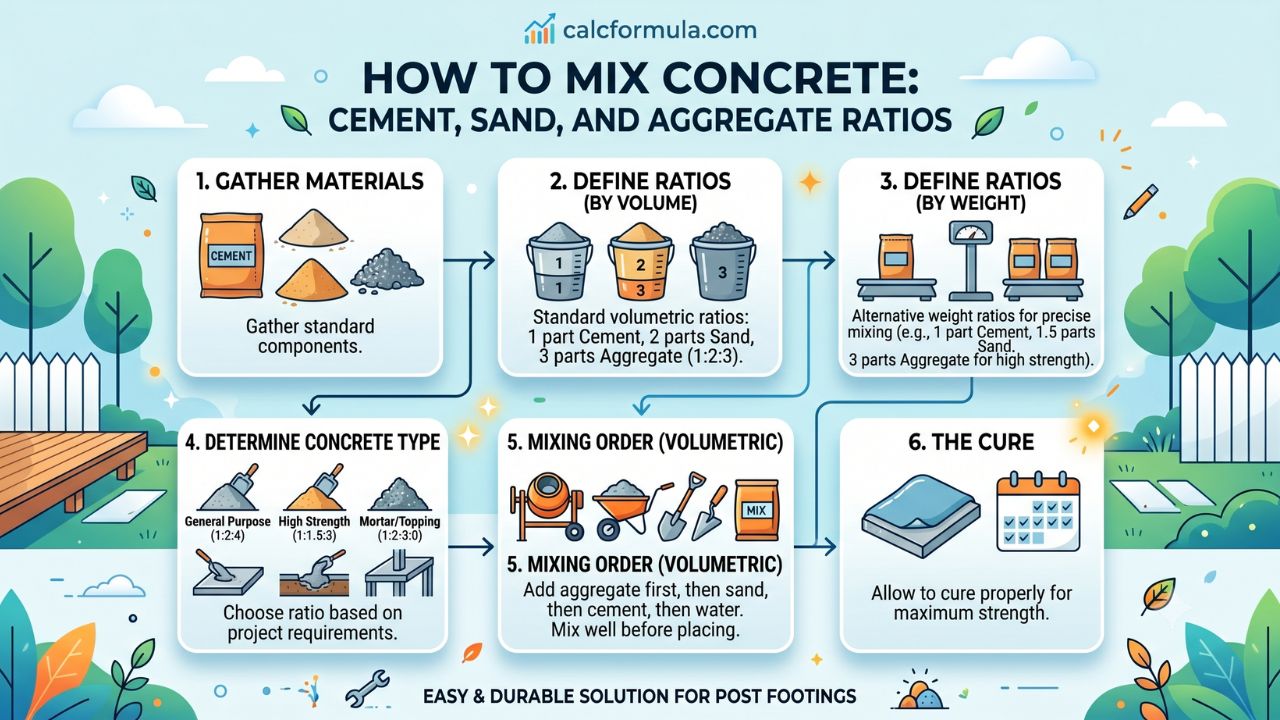
Whether you're pouring a backyard patio, setting fence posts, or laying a foundation slab, knowing how to mix concrete correctly is the difference between a structure that lasts decades and one that cracks within a season. The ratio of cement, sand, and aggregate you use directly controls the strength, workability, and durability of your mix. This guide breaks it all down - from the formula to a full worked example - so you can get it right the first time.
How to Mix Concrete: Quick Formula and Ratios at a Glance
The standard concrete mix ratio for general-purpose use is 1:2:3 - that's 1 part cement, 2 parts sand, and 3 parts coarse aggregate (gravel), by volume. Add water at roughly 0.45-0.60 of the cement weight (the water-to-cement ratio).
Here's a quick reference table for common mix grades:
| Mix Grade | Cement : Sand : Aggregate | Typical Use |
|---|---|---|
| M10 | 1 : 3 : 6 | Lean concrete, blinding |
| M15 | 1 : 2 : 4 | Pathways, non-structural fills |
| M20 | 1 : 1.5 : 3 | Most residential slabs, beams, columns |
| M25 | 1 : 1 : 2 | Structural elements, driveways, heavy loads |
| M30+ | Design mix required | Bridges, commercial foundations |
Quick rule of thumb: For most DIY concrete projects - patios, garden paths, footings - the M20 mix (1:1.5:3) hits the sweet spot between strength and workability.
What Affects the Concrete Mix Ratio Calculation
Understanding the variables behind any concrete mix ratio for slabs or structural work helps you adapt when real-world conditions change.
1. Water-to-Cement (W/C) Ratio
This single variable has more impact on final strength than anything else. A lower W/C ratio (0.40-0.45) produces stronger, denser concrete. A higher ratio (0.55-0.60) makes the mix more workable but reduces compressive strength. Never add extra water just to make mixing easier - it's the most common mistake made on site.
2. Cement Type
Ordinary Portland Cement (OPC 43 Grade or 53 Grade) is standard for most projects. Blended cements (PPC, PSC) may require adjusted ratios and extended curing times. The grade of cement changes how much binder is available per kilogram.
3. Aggregate Size and Grading
Coarse aggregate is typically 10 mm to 20 mm nominal size. Larger aggregate reduces the volume of cement paste needed but can affect surface finish. Well-graded aggregate (a range of particle sizes) fills voids more efficiently, requiring less cement for the same strength.
4. Intended Load and Use
A garden path bears foot traffic. A garage floor bears vehicles. A column bears structural loads. Each demands a different compressive strength (measured in MPa), which is what the mix grade (M10, M20, M25) directly specifies.
5. Environmental Conditions
Hot, dry, or windy weather accelerates evaporation, effectively increasing your W/C ratio after placement and causing surface cracking. Cold weather slows hydration and can permanently weaken concrete if it freezes before curing.
Use the free Cement Calculator at CalcFormula to quickly determine how much cement, sand, and aggregate you need before buying materials - enter your slab dimensions and mix ratio, and it does the rest.
Step-by-Step: How to Mix Concrete by Hand (Worked Example)
Let's say you're pouring a concrete path 3 metres long × 1 metre wide × 0.1 metres (100 mm) thick, using an M20 mix (1:1.5:3).
Step 1 - Calculate the Volume of Concrete Needed
Volume = Length × Width × Depth Volume = 3 m × 1 m × 0.1 m = 0.3 m³
Add 5-10% for waste and spillage: 0.3 × 1.08 = ~0.324 m³
Step 2 - Find the Dry Mix Volume
Concrete shrinks during hydration. Dry materials occupy roughly 1.54× the wet concrete volume.
Dry volume = 0.324 × 1.54 = ~0.499 m³
Step 3 - Split by Ratio (M20 = 1 : 1.5 : 3)
Total ratio parts = 1 + 1.5 + 3 = 5.5 parts
| Material | Calculation | Quantity |
|---|---|---|
| Cement | (1 ÷ 5.5) × 0.499 m³ | 0.0907 m³ |
| Sand | (1.5 ÷ 5.5) × 0.499 m³ | 0.1361 m³ |
| Coarse Aggregate | (3 ÷ 5.5) × 0.499 m³ | 0.2723 m³ |
Step 4 - Convert Cement Volume to Bags
Density of cement ≈ 1440 kg/m³ Cement mass = 0.0907 × 1440 = ~130.6 kg → approximately 2.6 bags of 50 kg cement
Step 5 - Calculate Water Required
Using W/C ratio of 0.50: Water = 0.50 × 130.6 kg = ~65 litres
Step 6 - Mix and Place
- Dry-mix cement and sand first until uniform in colour.
- Add coarse aggregate and mix again.
- Add 75% of your water and mix thoroughly.
- Add remaining water gradually - stop when the mix is workable but not sloppy.
- Place, compact (tamp or vibrate), screed level, and finish.
- Begin curing within an hour: cover with wet hessian or plastic sheeting and keep moist for at least 7 days.
For a fast cross-check on your quantities, the Concrete Calculator at CalcFormula lets you enter your dimensions and mix type to instantly see material volumes and bag counts.
Common Mistakes When Mixing Concrete (and How to Avoid Them)
❌ Adding Too Much Water
This is the single most frequent error in how to mix concrete by hand. Extra water weakens the cement paste, increases shrinkage cracking, and reduces final strength. Stick to your calculated W/C ratio.
❌ Using the Wrong Sand
Builder's sand (sharp sand) is correct for concrete. Soft sand or beach sand has rounded grains that reduce bonding and often contains salt or fine organic material. Always use clean, well-graded sharp sand.
❌ Skipping the Dry Mix Stage
Dumping all materials in together and adding water creates uneven distribution. Always dry-mix cement and sand before introducing aggregate and water.
❌ Incorrect Proportions by Weight vs. Volume
Most DIY guides give ratios by volume (buckets, shovels). If you switch to weight-based measurement mid-project, results will differ significantly. Pick one system and stay consistent.
❌ Inadequate Curing
Strength gains continue for 28 days, but most happens in the first 7. Allowing the surface to dry out too quickly causes surface dusting and cracks. Keep it moist and shaded.
❌ Mixing Too Large a Batch
Concrete begins to set within 30-90 minutes of water contact. Mix only what you can place and finish in that window - especially when working alone.
Frequently Asked Questions About Concrete Mix Ratios
Q1: What is the best concrete mix ratio for a driveway? For driveways subject to vehicle loads, use an M25 mix (1:1:2) with a W/C ratio of around 0.45. This delivers approximately 25 MPa compressive strength at 28 days, which comfortably handles passenger cars and light vans. Thickness should be at least 100-150 mm with reinforcement mesh.
Q2: Can I use more sand than aggregate to get a smoother finish? Yes, for surface renders and screed layers, a sand-rich mix is appropriate. But for structural concrete, reducing aggregate below the recommended level increases cement paste volume, which raises shrinkage and cracking risk. Keep aggregate at the designed proportion for anything load-bearing.
Q3: How do I mix concrete for fence posts? A lean M15 mix (1:2:4) works well for setting posts where high strength isn't critical. For soft or waterlogged ground, increase to M20. Mix to a "stiff but pourable" consistency - it should hold its shape when squeezed in the hand but still flow slowly into the hole around the post.
Q4: How much water should I add when mixing concrete? Start with a water-to-cement ratio of 0.50 (i.e., 50 litres of water per 100 kg of cement). Add roughly 75% of your total water first, then adjust the remaining 25% until the mix reaches a workable consistency - it should be cohesive, not runny or crumbly.
Q5: What is the difference between M20 and M25 concrete? M20 achieves a characteristic compressive strength of 20 MPa at 28 days and uses a 1:1.5:3 ratio. M25 achieves 25 MPa with a leaner 1:1:2 ratio, meaning more cement relative to aggregate. M25 is used where higher structural demands exist - heavier slabs, columns, and beams.
Q6: How do I calculate how many bags of cement I need? Determine your wet concrete volume, multiply by 1.54 for dry volume, apply your ratio fraction for cement, then multiply by the density of cement (1440 kg/m³). Divide by your bag weight (typically 50 kg). Or skip the arithmetic entirely using the Cement Calculator at CalcFormula.
Q7: What happens if the concrete mix ratio is wrong? Too much cement causes excessive heat generation and shrinkage cracking. Too little cement results in weak, porous concrete that absorbs water and degrades quickly. Too much water reduces strength. Too little makes the mix unworkable and difficult to compact fully, leaving voids. Ratios exist for good reason - follow them.
Free Concrete Calculator Tools
Doing the maths by hand is useful for understanding the process, but for accurate material estimates before purchasing, use these free tools:
- Cement Calculator - CalcFormula: Input your dimensions and mix ratio to instantly calculate cement, sand, and aggregate quantities in bags and cubic metres.
- Concrete Calculator - CalcFormula: Calculate total concrete volume needed for slabs, columns, footings, or steps, with adjustable mix grades.
Both tools are free to use and cover the most common mix grades, saving you time and helping avoid over- or under-ordering materials.
Summary
Knowing how to mix concrete comes down to three core principles: use the right ratio for the job, control your water content, and cure properly. The standard M20 mix (1:1.5:3) handles the vast majority of residential concrete work, from garden paths to floor slabs. When in doubt, go leaner on water and richer on curing time - concrete rewards patience.
Last reviewed for accuracy against IS 456:2000 (Plain and Reinforced Concrete Code of Practice) and general construction best practices.