A beam that snaps under load is an obvious failure. A beam that sags too much is a subtler one — but it’s just as serious. Floors that bounce underfoot, roof beams that visibly sag between supports, cracked drywall ceilings, and doors that stick in their frames: all of these are deflection problems, not strength problems. The beam was strong enough not to break, but not stiff enough to stay within acceptable movement limits.
Knowing how to calculate beam deflection is essential for any structural design, whether you’re sizing floor joists in a residential home, selecting a steel beam for a commercial roof, or checking an existing structure for compliance. The formulas aren’t complicated, but applying them correctly — with the right variables, the right units, and the right code limits — requires understanding what each part of the calculation actually means. This guide covers all of it, from the core formula to a fully worked example to the mistakes that most commonly lead to undersized beams.
Quick Answer: How to Calculate Beam Deflection (The Core Formula)
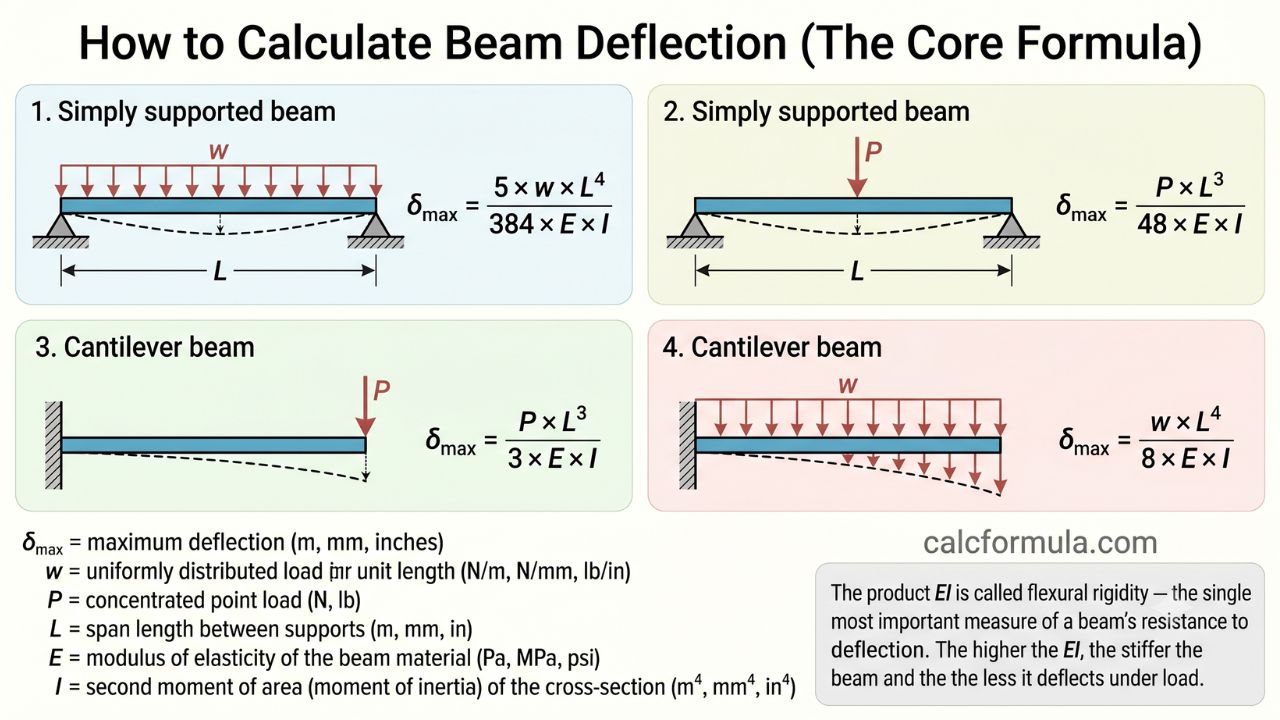
The deflection at the midspan of a simply supported beam under a uniformly distributed load is:
δ_max = (5 × w × L⁴) / (384 × E × I)For a simply supported beam with a single point load at center:
δ_max = (P × L³) / (48 × E × I)For a cantilever beam with a point load at the free end:
δ_max = (P × L³) / (3 × E × I)For a cantilever beam with a uniformly distributed load:
δ_max = (w × L⁴) / (8 × E × I)Where the variables are:
- δ_max = maximum deflection (m, mm, or inches)
- w = uniformly distributed load per unit length (N/m, N/mm, or lb/in)
- P = concentrated point load (N or lb)
- L = span length between supports (m, mm, or in)
- E = modulus of elasticity of the beam material (Pa, MPa, or psi)
- I = second moment of area (moment of inertia) of the cross-section (m⁴, mm⁴, or in⁴)
The product EI is called flexural rigidity — the single most important measure of a beam’s resistance to deflection. The higher the EI, the stiffer the beam and the less it deflects under load.
Once you’ve calculated δ_max, compare it against the code-specified allowable deflection limit for your application (covered in detail in the Variables section). For instant results without manual calculation, use the free Beam Deflection Calculator at CalcFormula.com — it handles all common beam types, support conditions, and load configurations in seconds.
What Affects Beam Deflection? (Variables Section)
How to Calculate Beam Deflection Based on Span Length
Span length is the single most powerful variable in beam deflection calculations because it appears as L³ or L⁴ in every formula. Doubling the span increases deflection by a factor of 8 (for point loads) or 16 (for distributed loads). This exponential sensitivity is why long spans require dramatically heavier or deeper beams — and why even a modest span increase during design development can invalidate a beam that was previously adequate.
Always measure span as the clear span between supports, not the overall beam length. For beams sitting on bearing walls, the clear span is the distance between the inner faces of the walls. For beams on posts or columns, it is the center-to-center distance between supports minus the bearing depth, depending on the code standard being applied.
Modulus of Elasticity (E) and Material Stiffness
The modulus of elasticity E describes how much a material strains under a given stress — it is purely a material property, unchanged by cross-section shape or size. Common values used in beam deflection calculations:
| Material | Modulus of Elasticity (E) |
|---|---|
| Structural steel (A36, A992) | 200,000 MPa (29,000,000 psi) |
| Aluminum 6061-T6 | 68,900 MPa (10,000,000 psi) |
| Douglas Fir-Larch No. 2 | 12,400 MPa (1,800,000 psi) |
| Southern Yellow Pine No. 2 | 12,400 MPa (1,800,000 psi) |
| Glulam (24F-V4) | 13,100 MPa (1,900,000 psi) |
| LVL (Laminated Veneer Lumber) | 13,800 MPa (2,000,000 psi) |
| Concrete (f’c = 30 MPa) | ~25,000 MPa (variable) |
Steel is roughly 15–16 times stiffer than typical structural timber. This is why a steel beam can span far greater distances with a much shallower depth than an equivalent wood beam carrying the same load.
Second Moment of Area / Moment of Inertia (I)
I describes how the cross-section’s area is distributed relative to the bending axis. Like span length, it has a direct mathematical impact on deflection — doubling I halves deflection. The formulas for common cross-sections:
Rectangular section (width b, depth d):
I = bd³ / 12Solid circular section (diameter D):
I = πD⁴ / 64Hollow rectangular section (B×D outer, b×d inner):
I = (BD³ − bd³) / 12For standard steel sections (W-shapes, S-shapes, HSS), I values are tabulated in the AISC Steel Construction Manual and do not need to be calculated by hand. For standard lumber sizes, I values are published in the NDS Supplement. When using the Beam Deflection Calculator, you can input cross-section dimensions directly and the calculator derives I automatically.
Load Type and Magnitude
Different load types distribute differently along the beam, which is why each has its own deflection formula. The three most common cases in practice are:
Uniformly distributed load (UDL): Dead weight of floors, roofing materials, snow load, live load distributed across a floor system. Uses the 5wL⁴/384EI formula for simply supported spans.
Point load: A beam, post, or concentrated piece of equipment sitting at a specific location. Uses the PL³/48EI formula when the load is at midspan. For off-center point loads, the formula changes and the location of maximum deflection shifts toward the load.
Combined loading: Most real beams carry both a distributed self-weight and one or more point loads. In this case, deflections from each load case are calculated separately, then superimposed (added together). This is the principle of superposition, valid for linearly elastic materials within working stress limits.
The Beam Load Calculator generates shear force and bending moment diagrams for combined loading scenarios and outputs the governing maximum moment — which you then carry into the deflection formula alongside your section properties.
Allowable Deflection Limits: The L/xxx Standards
Calculating deflection is only half the task. The other half is knowing what limit the deflection must stay within. Building codes and engineering standards define allowable deflection limits as a fraction of the span length:
| Application | Live Load Only | Total Load (DL + LL) |
|---|---|---|
| Floor beams (residential) | L/360 | L/240 |
| Floor beams (commercial) | L/360 | L/240 |
| Roof beams, no plaster ceiling | L/180 | L/120 |
| Roof beams, with plaster ceiling | L/360 | L/240 |
| Roof beams, no ceiling | L/240 | L/180 |
| Header beams over openings | L/360 | L/240 |
L/360 means: Maximum deflection must not exceed the span length divided by 360. For a 15-foot (180-inch) span, allowable deflection = 180/360 = 0.50 inches.
These limits exist to prevent visible sagging, cracking of attached finishes (drywall, plaster, tile), ponding of water on roofs, and discomfort from floor bounce. Exceeding them doesn’t necessarily mean immediate structural failure — but it does mean the beam doesn’t comply with code and will likely cause serviceability problems over time.
Support Conditions
The boundary conditions at each end of the beam have an enormous effect on deflection. A cantilever beam (fixed at one end, free at the other) deflects roughly 16 times more than an equivalent simply supported beam under the same UDL, because the fixed end provides rotational restraint that the simply supported beam lacks at midspan. The four standard support conditions in order of increasing stiffness (decreasing deflection) are: free end → simple support (pin/roller) → propped cantilever → fixed end. Always confirm the actual support condition in the field matches what the calculation assumes.
Step-by-Step Worked Example: How to Calculate Beam Deflection for a Floor Span
Problem: A residential floor beam spans 5.5 meters between two bearing walls (simply supported). It carries a total uniformly distributed load of 8 kN/m (including self-weight, dead load, and live load). The beam is a 250 mm × 400 mm glulam section with E = 13,100 MPa. Calculate the maximum deflection and check compliance with the L/240 total load limit.
Step 1: Identify the formula
Simply supported beam, uniformly distributed load:
δ_max = (5 × w × L⁴) / (384 × E × I)Step 2: Declare units and convert all values consistently
Working in N and mm throughout:
- w = 8 kN/m = 8,000 N/m = 8 N/mm
- L = 5.5 m = 5,500 mm
- E = 13,100 MPa = 13,100 N/mm²
Step 3: Calculate the moment of inertia (I)
Rectangular section: b = 250 mm, d = 400 mm
I = bd³ / 12 = (250 × 400³) / 12
I = (250 × 64,000,000) / 12
I = 16,000,000,000 / 12
I = 1,333.3 × 10⁶ mm⁴
Step 4: Calculate the numerator
5 × w × L⁴ = 5 × 8 × (5,500)⁴
(5,500)⁴ = 5,500² × 5,500² = 30,250,000 × 30,250,000 = 9.151 × 10¹⁴
Numerator = 5 × 8 × 9.151 × 10¹⁴ = 3.660 × 10¹⁶
Step 5: Calculate the denominator
384 × E × I = 384 × 13,100 × 1,333.3 × 10⁶
= 384 × 1.747 × 10¹⁰
= 6.709 × 10¹²
Step 6: Calculate maximum deflection
δ_max = 3.660 × 10¹⁶ / 6.709 × 10¹²
δ_max = 5,455 / 1,000 ...
Let’s redo this cleanly:
δ_max = (5 × 8 × 5,500⁴) / (384 × 13,100 × 1,333.3 × 10⁶)

Numerator:  5 × 8 = 40
            5,500⁴ = 9.1506 × 10¹⁴
            40 × 9.1506 × 10¹⁴ = 3.6603 × 10¹⁶

Denominator: 384 × 13,100 = 5,030,400
             5,030,400 × 1,333.3 × 10⁶ = 6.707 × 10¹⁵

δ_max = 3.6603 × 10¹⁶ / 6.707 × 10¹⁵ = 5.46 mm
Step 7: Check against allowable deflection limit
Allowable total load deflection for floor beams: L/240
δ_allowable = L / 240 = 5,500 mm / 240 = 22.9 mmResult: 5.46 mm calculated ≪ 22.9 mm allowable — the beam passes with a large margin.
Step 8: Check the live-load-only deflection limit (L/360)
Assuming live load is approximately 40% of total load (w_LL = 3.2 N/mm):
δ_LL = (5 × 3.2 × 5,500⁴) / (384 × 13,100 × 1,333.3 × 10⁶)
     = 5.46 × (3.2/8)
     = 5.46 × 0.40
     = 2.18 mm

δ_allowable (L/360) = 5,500 / 360 = 15.3 mm
2.18 mm ≪ 15.3 mm — passes comfortably. Both limits satisfied. For quick verification on alternative beam sizes or different spans, use the Beam Deflection Calculator to compare options side by side without repeating the arithmetic.
Common Mistakes When Calculating Beam Deflection
Mistake 1: Inconsistent units in the formula
L⁴ amplifies any unit mismatch enormously. If L is entered in meters but w is entered in N/mm, the formula produces a nonsensical result with no obvious warning. Always declare your unit system before computing — either all SI (N, mm, N/mm², mm⁴) or all imperial (lb, in, psi, in⁴) — and convert every value before plugging in.
Mistake 2: Using the wrong formula for the wrong support condition
The 5wL⁴/384EI formula is for a simply supported beam only. Applying it to a cantilever (which should use wL⁴/8EI) underestimates deflection by a factor of nearly 20. Before writing down any formula, sketch the beam, mark the support types, and confirm which standard case applies. If the actual beam doesn’t match a standard textbook case, use superposition to combine multiple simpler cases.
Mistake 3: Checking only one deflection limit
Most codes require checking deflection under live load alone (typically L/360) and under total load including dead load (typically L/240). Many engineers — and almost all students — check only one. A beam can pass L/240 total load while failing L/360 live load, or vice versa. Run both checks before concluding compliance.
Mistake 4: Ignoring the effect of beam self-weight
A W18×97 steel beam spanning 10 meters weighs 97 lb/ft (1.42 kN/m) — a non-trivial load that contributes to deflection independently of the applied floor or roof load. For steel beams, timber beams, and especially for long-span glulam or LVL, self-weight adds measurably to total-load deflection. Include self-weight as part of the dead load component in the distributed load w.
Mistake 5: Assuming all wood species have the same E value
Spruce-Pine-Fir No. 2 has E = 9,000 MPa; Douglas Fir-Larch Select Structural has E = 14,000 MPa. Using the wrong E for the actual wood species on site can produce deflection errors of 30–50%. Always verify the species, grade, and published E value from the NDS Supplement before calculating. Similarly, E for LVL and glulam is usually higher than for sawn lumber — check the manufacturer’s engineering data sheet.
Mistake 6: Not accounting for long-term creep deflection in wood and concrete
The deflection formulas in this guide calculate instantaneous (elastic) deflection under load. Over time, wood beams under sustained load experience creep — additional long-term deflection that can be 50–100% of the initial deflection under dead load. The NDS recommends multiplying dead load deflection by a creep factor of 1.5 for seasoned lumber and 2.0 for green lumber when checking total long-term deflection. Concrete beams experience similar long-term creep governed by ACI 318 provisions. For roof and floor spans that will carry sustained loads for years, always check long-term deflection alongside the elastic calculation.
Pro Tip: Design for stiffness by targeting EI directly
Rather than cycling through beam sizes manually, rearrange the deflection formula to find the minimum required EI for a given allowable deflection:
EI_required = (5 × w × L⁴) / (384 × δ_allowable)    [for UDL]
EI_required = (P × L³) / (48 × δ_allowable)           [for center point load]
Calculate EI_required first, then select a beam whose E × I product meets or exceeds that value. This approach turns beam selection into a direct lookup rather than a guessing process.
FAQ: How to Calculate Beam Deflection for Floors and Roof Spans
Q1: What is the allowable deflection for a floor beam?
The most widely used allowable deflection limits for floor beams in U.S. residential and commercial construction are L/360 for live load only and L/240 for total load (dead plus live). For a 12-foot (144-inch) floor span, L/360 = 0.40 inches and L/240 = 0.60 inches. These limits are specified in the International Residential Code (IRC), International Building Code (IBC), and referenced standards including the NDS for wood and AISC 360 for steel. Some jurisdictions or project specifications impose tighter limits — particularly for tile or stone floor finishes, which require L/480 live load deflection to prevent grout cracking.
Q2: What does L/360 mean in beam deflection?
L/360 is a deflection limit expressed as a fraction of the span length L. It means the maximum calculated deflection must not exceed the span divided by 360. The number in the denominator is a serviceability index: higher numbers are more restrictive (less deflection allowed). L/360 is the standard floor live-load limit. L/240 applies to total load on floors. L/180 applies to roof members without a ceiling. L/480 is used for brittle finishes like ceramic tile. Calculating deflection involves finding δ_max using the appropriate formula, then confirming it is less than L/divided-by-the-applicable-limit.
Q3: How does increasing beam depth affect deflection?
Beam depth has a very powerful effect because moment of inertia I = bd³/12 — depth appears as a cube. Doubling the depth of a rectangular beam (while keeping width constant) increases I by 8 times and reduces deflection by 8 times. This is why adding even 50 mm to the depth of a timber beam can dramatically improve deflection performance, and why deep, narrow beams are far more efficient for long spans than shallow, wide ones of the same cross-sectional area.
Q4: Can I use the same deflection formula for steel and wood beams?
Yes — the deflection formulas (5wL⁴/384EI, PL³/48EI, etc.) apply to all elastic structural materials regardless of whether the beam is steel, timber, aluminum, or glulam. The only difference is the value of E used in the calculation. Steel has E ≈ 200,000 MPa; timber ranges from 9,000–14,000 MPa depending on species and grade. The formulas are derived from mechanics of materials theory and are material-independent, provided the beam behaves elastically (stress remains below yield).
Q5: What is flexural rigidity (EI) and why does it matter?
Flexural rigidity EI is the product of the material’s modulus of elasticity (E) and the cross-section’s moment of inertia (I). It appears in the denominator of every beam deflection formula, so a larger EI always means less deflection. EI captures both material stiffness (E) and geometric efficiency (I) in one value. When comparing beam options, calculating EI for each alternative and comparing directly against EI_required is the most efficient design approach. For example, a steel W10×22 (E = 200,000 MPa, I = 27.9 × 10⁶ mm⁴) has EI = 5.58 × 10¹² N·mm² — compare this to a timber alternative to immediately see which provides adequate stiffness.
Q6: How do I calculate deflection for a beam with both a point load and a distributed load?
Use the principle of superposition: calculate deflection for the point load alone (using PL³/48EI for a midspan load on a simply supported beam), then calculate deflection for the distributed load alone (using 5wL⁴/384EI), and add the two results together. Superposition is valid as long as the beam behaves elastically — which is the case for virtually all working-stress structural design. For combined load cases, the Beam Load Calculator outputs the combined maximum bending moment, and the Beam Deflection Calculator can handle multiple simultaneous loads directly.
Q7: What happens if my beam deflection calculation exceeds the allowable limit?
If calculated deflection exceeds the allowable limit, you have four practical remedies: increase beam depth (most effective, since I scales with d³); increase beam width (less efficient, since I scales with b linearly); choose a stiffer material (e.g., switch from sawn lumber to LVL or steel); or reduce the effective span by adding an intermediate support. Reducing load is also possible but typically outside structural control. The fastest way to evaluate alternatives is to rearrange the formula for EI_required, find what minimum EI you need, and then select a section that provides it — a workflow the Beam Deflection Calculator supports directly.
Useful Calculators for Beam Deflection Design
These free tools cover every step of the beam deflection workflow, from loading to final compliance check:
Beam Deflection Calculator — Enter span length, load type and magnitude, modulus of elasticity, and section dimensions to instantly calculate maximum deflection, check it against L/360 and L/240 limits, and compare alternative beam sizes.
Beam Load Calculator — Generate shear force diagrams, bending moment diagrams, and maximum moment values for simply supported, cantilever, and fixed beams under point loads, distributed loads, and combined loading — feeding directly into your deflection calculation.
Final Thoughts: Calculate Beam Deflection Before You Build, Not After
Knowing how to calculate beam deflection is what separates a beam that performs for decades from one that sags, bounces, or damages finishes within the first few years. The formulas are straightforward once you understand what each variable contributes — and the exponential sensitivity to span length means that small errors in span estimation produce large errors in deflection predictions.
Work through the formula with consistent units, verify your E and I values for the actual material and cross-section, check both the L/360 live-load and L/240 total-load limits, and account for long-term creep in timber and concrete applications. The Beam Deflection Calculator makes verification fast and catches unit errors automatically — making it an essential tool at every stage of floor and roof beam design.
This article was written by a licensed Professional Engineer (PE) with 18+ years of structural design experience across residential, commercial, and industrial buildings. Formulas and deflection limits referenced are consistent with IBC, IRC, AISC 360, and NDS current editions.