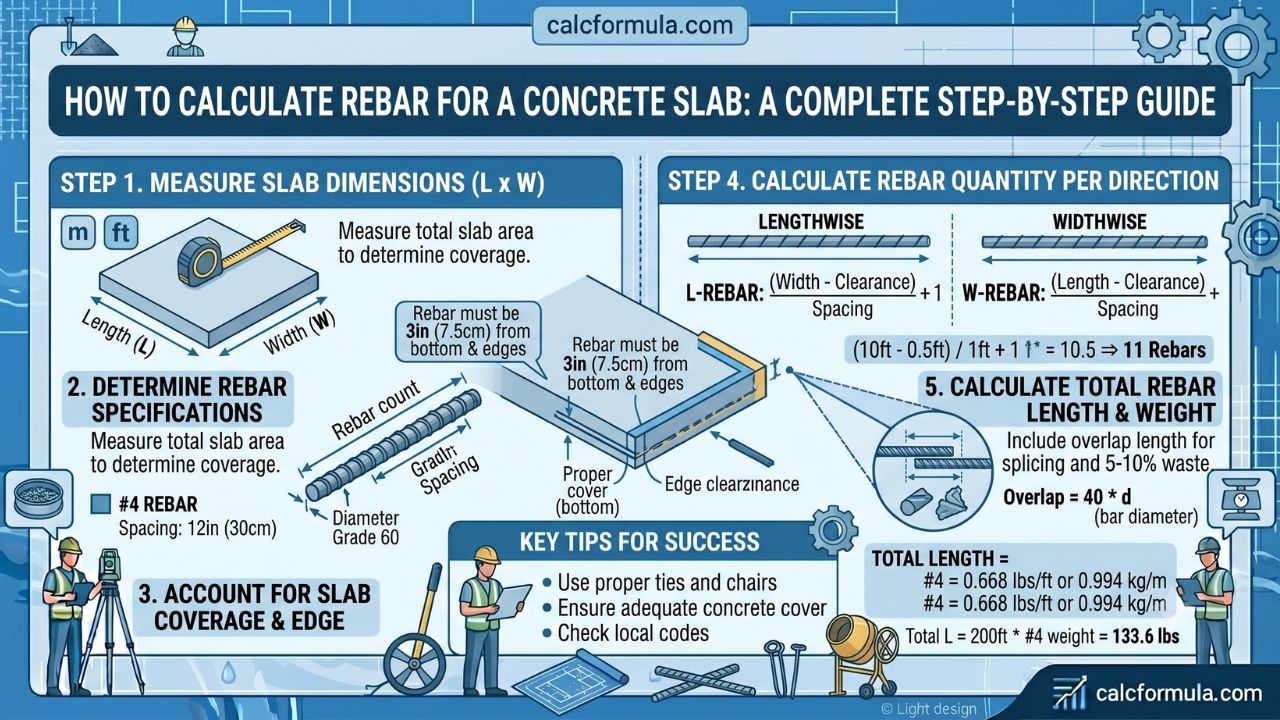
Most guides on rebar calculation give you the same three steps, a simple formula, and send you on your way. Then you get to the job site, realize your slab is 47 feet long with a bump-out, your spacing math doesn't account for lap splices, and you're either short on material or you over-ordered by $200.
This guide is different. We're going to cover not just how to run the numbers, but why the numbers matter, where contractors commonly get it wrong, how to handle non-rectangular slabs, and what happens if you cut corners. By the end, you'll be able to calculate rebar for nearly any residential or light commercial slab confidently - and understand what you're doing well enough to catch mistakes before they become expensive.
If you want the math done for you right now, our Rebar Calculator handles all of it - spacing, laps, waste, bar count - in seconds. But read on if you want to actually understand what it's calculating.
First: What Rebar Is Actually Doing Inside Your Slab
Here's something most people don't fully grasp: a concrete slab without rebar isn't a monolithic solid. It's closer to compressed stone - great under direct downward force, but brittle the moment it deflects. Soil settles unevenly. Tree roots grow. Freeze-thaw cycles push ground up and pull it down. Every one of those forces puts the bottom face of your slab in tension - and plain concrete fails in tension at roughly 10% of its compressive strength.
Rebar's job isn't to prevent cracks from ever forming. That's a misconception. Rebar's actual job is to hold cracks closed after they form, keeping the slab structurally intact and preventing small surface cracks from widening into full slab fractures. A rebar-reinforced slab can crack and still carry load. An unreinforced slab that cracks is basically two or more separate pieces.
That context matters when you're choosing bar size and spacing. You're not decorating the concrete - you're building a tensile skeleton inside it.
Rebar Sizes: What the Numbers Actually Mean
The # designation on rebar refers to the diameter in eighths of an inch. So #4 rebar = 4/8 = ½ inch diameter. Simple enough. What matters more is understanding which size is appropriate for your specific application - and where using undersized rebar is a genuine structural risk versus where it simply doesn't matter.
#3 Rebar (3/8")
Fine for sidewalks, garden paths, and light decorative slabs that will never see vehicle traffic. Some contractors use it for patios, though #4 gives better long-term performance for similar cost. At very close spacing (8-10 inches), it can substitute for #4 in some applications, but it's labor-intensive and rarely worth it.
#4 Rebar (½")
The workhorse of residential concrete work. Driveways, garage floors, shed pads, pool decks, residential foundations - #4 at 12-inch spacing is the standard that building codes and concrete contractors have converged on for good reason. It hits the sweet spot of material cost, structural performance, and ease of handling. When someone says "standard rebar grid," they almost always mean #4 at 12" OC.
#5 Rebar (5/8")
When load increases - commercial vehicle traffic, heavy equipment pads, slabs over poor or expansive soils, anything with a structural engineer involved - #5 becomes the standard. It's also common in thicker slabs (6" and above). The cost jump is noticeable; #5 runs roughly 50-60% heavier per linear foot than #4, which adds up on large pours.
#6 and Above
Foundation walls, retaining structures, grade beams, and commercial construction. If you're in this territory, you have an engineer specifying the reinforcement, and you don't need a blog post - you need stamped drawings.
One note on grade: Most residential rebar is Grade 60 (60,000 psi yield strength). Grade 40 exists but is increasingly rare. If you're buying from a real supplier, you're almost certainly getting Grade 60. If you're buying from an unnamed source and the price seems too good - verify the grade marking on the bar before using it in anything structural.
Spacing is where the most consequential decisions happen - and where the most money gets wasted or saved. Here's what the standard guidelines look like, and more importantly, what drives those recommendations:
| Application | Slab Thickness | Bar Size | Spacing |
|---|---|---|---|
| Sidewalk, garden path | 3-4" | #3 | 18" OC |
| Residential patio (foot traffic only) | 4" | #3 or #4 | 12-18" OC |
| Residential driveway | 4-5" | #4 | 12" OC |
| Garage floor (passenger vehicles) | 4-5" | #4 | 12" OC |
| Garage floor (trucks, RVs) | 5-6" | #4 or #5 | 12" OC |
| Workshop / heavy equipment pad | 6" | #5 | 12" OC |
| Residential foundation / grade beam | 8"+ | #5 or #6 | Per engineer |
"On center" (OC) is measured from the centerline of one bar to the centerline of the next - not the gap between bars. This matters when you're laying out the grid: your first bar goes at the edge setback distance (usually 3"), and then you step out by your spacing increment from there.
Why Tighter Spacing Isn't Always Better
There's a common instinct to go tighter on spacing - "more rebar = stronger slab, right?" Not necessarily. Beyond a certain point, additional rebar delivers diminishing returns on crack control while dramatically increasing cost and labor. Going from 18" to 12" spacing meaningfully improves performance. Going from 12" to 6" on a residential driveway is mostly waste - you'd be better off spending that money on better base preparation, a thicker slab, or higher-strength concrete mix.
The base under the slab matters more than most homeowners realize. A well-compacted, properly drained gravel base is what prevents differential settlement - which is the root cause of most residential slab cracking. Rebar can't compensate for a bad base. Don't let it become the excuse for skipping proper sub-base work.
The Full Rebar Calculation - Step by Step
Let's work through this with a real-world example that has some actual complexity to it: a 24-foot × 24-foot garage floor with a 12-foot × 8-foot bump-out on one side (a common layout). We'll use #4 rebar at 12-inch OC in both directions.
Step 1: Break Irregular Shapes Into Rectangles
If your slab is an L-shape, T-shape, or has any bump-outs, extensions, or step-downs - break it into rectangles first. Calculate each rectangle separately, then combine. Don't try to run one continuous grid across the whole form and call it done; the grid geometry changes at transitions.
For our example:
- Main garage: 24 ft × 24 ft
- Bump-out: 12 ft × 8 ft
Step 2: Calculate Bars in Each Direction for Each Rectangle
The formula for the number of bars running parallel to one side:
Number of bars = ⌊(dimension ÷ spacing)⌋ + 1
The ⌊ ⌋ symbol means round down to the nearest whole number before adding 1. That +1 accounts for the starting bar at the first edge setback.
Main garage (24 × 24), spacing = 1 ft:
Bars running N–S: (24 ÷ 1) + 1 = 25 bars, each 24 ft long → 600 linear feet
Bars running E–W: (24 ÷ 1) + 1 = 25 bars, each 24 ft long → 600 linear feet
Subtotal: 1,200 linear feet
Bump-out (12 × 8), spacing = 1 ft:
Bars running N–S: (12 ÷ 1) + 1 = 13 bars, each 8 ft long → 104 linear feet
Bars running E–W: (8 ÷ 1) + 1 = 9 bars, each 12 ft long → 108 linear feet
Subtotal: 212 linear feet
Combined raw total: 1,412 linear feet
Step 3: Account for Lap Splices
This step is where a lot of DIY calculations fall short. Standard rebar is sold in 20-foot lengths. Any run longer than 20 feet needs a lap splice - an overlap where two bars meet. The required lap length for #4 rebar Grade 60 in normal conditions is typically 24 inches (ACI 318 standard development length). Some engineers specify more; 24" is the safe residential minimum.
For our 24-foot runs, each bar requires one splice (at the 20-foot mark). That adds 2 feet of material per bar for each 24-foot run.
N–S bars in main garage: 25 bars, each needs 1 splice = 25 × 2 ft = 50 additional ft
E��W bars in main garage: 25 bars, each needs 1 splice = 25 × 2 ft = 50 additional ft
Bump-out bars are under 20 ft — no splices needed
Splice addition: 100 linear feet
Adjusted total: 1,512 linear feet
Step 4: Add Cutting Waste
Every project generates off-cuts. When you buy 20-foot bars and cut them to 8-foot lengths for the bump-out, you have 12-foot pieces left. Some of those can be reused; some can't. A 5% waste factor is reasonable for a well-planned job. Use 10% if the geometry is complex or you're not an experienced cutter.
1,512 × 1.07 (7% waste) = approximately 1,618 linear feet
Step 5: Convert to Bar Count
1,618 ÷ 20 ft per bar = 80.9 → order 82 bars (round up, and have a couple spare)
Want this done in 30 seconds for your exact dimensions? The Rebar Calculator handles irregular shapes, multiple spacings, and lap splice requirements automatically. It's the fastest way to get a material list you can take to the supplier.
Rebar Depth: The Placement Detail Most DIYers Get Wrong
You can calculate the perfect rebar grid and still end up with a weak slab if the bars end up in the wrong position during the pour. This is more common than it should be.
Rebar is most effective when it sits in the lower third of the slab - typically 1.5 to 2 inches from the bottom surface of a 4-inch slab. This positioning puts the steel at maximum distance from the compression zone (the top surface, which concrete handles fine) and in the tension zone (the bottom surface, where concrete is weakest).
The tool for achieving this is the rebar chair - a small plastic or wire support that holds the bar at a fixed height off the subgrade. They're inexpensive, sold in every concrete supply house, and genuinely critical. Rebar that rests on the ground, or that workers have stepped down during placement, sits in the compression zone and contributes almost nothing to tensile reinforcement.
Use chairs rated for the correct height. For a 4-inch slab, 1.5-inch chairs are standard. For a 6-inch slab, 2-inch chairs maintain proper cover while still keeping the bar in the lower third.
Minimum concrete cover over rebar:
- Slabs not exposed to weather: 3/4"
- Slabs exposed to weather (#5 and smaller): 1.5"
- Slabs in contact with ground: 3"
Driveways and exterior slabs exposed to deicing salts need at least 1.5" cover - often more. Salt accelerates corrosion dramatically. If you're in a snow belt and you're using road salt, consider epoxy-coated rebar for top-layer bars in driveways. The upcharge is real but so is the service life difference.
The Lap Splice Question: How Much Overlap Is Actually Needed?
The standard answer of "12-16 inches" that floats around online isn't quite right for all situations. Lap splice length in ACI 318 is a function of bar diameter, concrete strength, and rebar grade - not a fixed number. Here's a practical table for the most common residential scenarios:
| Bar Size | Concrete Strength (f'c) | Minimum Class B Lap Splice |
|---|---|---|
| #3 (3/8") | 3,000 psi | 15" |
| #4 (½") | 3,000 psi | 24" |
| #4 (½") | 4,000 psi | 21" |
| #5 (5/8") | 3,000 psi | 30" |
| #5 (5/8") | 4,000 psi | 26" |
Most residential concrete is ordered at 3,000-4,000 psi. The 24" minimum for #4 in 3,000 psi concrete is the conservative safe choice. Going shorter than this - which you see a lot in DIY installs where people eyeball "about a foot" - undermines the whole reason for splicing.
Lap splices should also be staggered: don't line up all your splices at the same point across the slab. Stagger them by at least 1.3 times the lap length. A row of splices at the same location creates a weak plane across the entire slab - exactly what you're trying to avoid.
Concrete Volume: The Calculation You Need to Do at the Same Time
Ordering concrete and ordering rebar need to happen together - not because the lead times are the same (they aren't), but because errors in one affect the other. Specifically: if you underestimate concrete volume and run short mid-pour, you have a cold joint problem. A cold joint - where fresh concrete meets concrete that has already begun to set - is a structural and waterproofing weakness that can't be fixed after the fact.
The volume formula is straightforward:
Volume (cubic yards) = (Length × Width × Thickness in feet) ÷ 27
For our 24×24 garage plus the 12×8 bump-out, at 5 inches thick (0.417 feet):
Main slab: 24 × 24 × 0.417 = 240.1 ft³
Bump-out: 12 × 8 × 0.417 = 40.0 ft³
Total: 280.1 ft³ ÷ 27 = 10.37 cubic yards
Add 10% overage: 10.37 × 1.10 = 11.4 → order 11.5 cubic yards
The 10% overage isn't paranoia - it accounts for subgrade that's slightly low in spots, form walls that flex under pour pressure, and the concrete that sticks to the truck drum and chute. Experienced contractors often add even more on complex pours. Running out of concrete is far worse than having a small amount left over.
Use the Concrete Calculator to get your cubic yards, estimate bag counts if you're doing a small pour by hand, and get a rough cost figure - all in one shot.
Rebar vs. Wire Mesh vs. Fiber: Making the Right Call
This is a decision point a lot of guides sidestep, but it matters for both cost and performance.
Rebar Grid
Best overall tensile reinforcement. Controls crack width, provides genuine load-distribution capability. More labor to install correctly, but the right choice for any slab that needs to perform under real load - vehicles, heavy storage, structural bearing. Cannot be substituted with mesh or fiber for structural applications.
Welded Wire Mesh (WWM)
Sheets of welded wire in a grid pattern - typically 6×6 W1.4×W1.4 for residential use. Faster to install than rebar, cheaper in material cost. Effective at controlling shrinkage cracking in lightly loaded slabs. The problem: mesh has a strong tendency to end up on the ground rather than elevated in the slab unless you're religious about using chairs. Contractors who kick it up during the pour ("snap it up with a hook") usually end up with mesh on the bottom of the slab where it contributes little. For anything bearing vehicle weight, rebar is the more reliable choice.
Synthetic Fiber (Polypropylene or Steel Fiber)
Mixed directly into the concrete at the batch plant. Excellent for controlling plastic shrinkage cracking (surface cracking that happens in the first few hours as concrete dries). Does not replace structural reinforcement - fiber doesn't provide the continuous tensile strength that a rebar grid does. Best used as a supplement to rebar in high-performance slabs, not a substitute. Some ready-mix suppliers market it as a replacement for wire mesh in light applications; that's reasonable. Marketing it as a replacement for a full rebar grid in a driveway is not.
Bottom line: For any slab that will see vehicle traffic or that you expect to last 20+ years with minimal maintenance, rebar is the right choice. Use fiber as an add-on if you want to reduce surface cracking. Use mesh only for light applications where you're comfortable with the limitations.
5 Rebar Mistakes That Will Cost You Later
1. Skipping Edge Setback
Rebar should sit at least 3 inches from every edge of the slab - including the edges where you'll eventually saw expansion joints. Rebar too close to an edge will rust over time, and as steel corrodes it expands. The expansion force from corrosion is enough to spall and delaminate the concrete edge. On exposed exterior slabs in freeze-thaw climates, this is one of the most common failure modes.
2. Letting Rebar Touch the Ground
Any steel with less than ½" of concrete cover will begin to corrode within years, not decades. Rebar that sits on the ground has zero cover. Use chairs - every time, for every bar. It adds maybe 20 minutes to a residential pour and adds years to the slab's life.
3. Using Rebar With Excessive Rust
Light surface rust on rebar is actually fine - it slightly improves the mechanical bond with concrete. What you don't want is heavy, flaking rust (mill scale) that reduces the bar's cross-sectional area. Test it: if you can rub the rust off with your hand and the bar is smooth and solid underneath, it's usable. If the bar is visibly pitted or flaking significantly, reject it.
4. Undersizing for the Actual Load
Be honest about what will sit on the slab. A 24-foot garage floor that will eventually hold an RV, a boat, and a vehicle is not the same load scenario as a car-only garage. If you're uncertain about loads, a brief conversation with a structural engineer - or even just calling your local building department and describing the project - can save you from an undersized slab.
5. Ignoring Control Joints
Rebar controls cracking but doesn't prevent it entirely, and it doesn't change the fact that concrete shrinks as it cures. Control joints (saw-cut grooves, typically 1/4 the depth of the slab) give the slab designated places to crack - out of sight, at regular intervals, in a controlled way. Slabs without control joints crack randomly. A common rule: cut control joints every 8-12 feet in each direction, with no panel larger than 1.5× its width. Don't let control joints cut through your rebar - the rebar should be continuous across the joint.
When Do You Actually Need an Engineer?
Most residential concrete work - driveways, patios, garage floors - doesn't legally require a structural engineer, and the standard specifications discussed above are well-established. But there are situations where getting an engineer involved is genuinely worth the money:
- Slab thickness over 8 inches - probably a foundation or structural element
- Soil with known issues - high clay content, poor drainage, expansive soil, fill areas less than 2 years old
- Slopes over 10% - lateral forces change the reinforcement requirements
- Heavy point loads - lifts, industrial equipment, loaded racking systems
- Anything attached to a structure - garage slabs connected to foundations need to be detailed correctly to avoid differential movement cracking
- Any slab the building permit requires engineering on - varies by jurisdiction, always check
A structural engineer reviewing a slab design typically costs $300-$700 for a residential project. Replacing a failed slab costs $3,000-$15,000+. The math isn't complicated.
Quick Sanity-Check Numbers for Common Residential Slabs
These estimates are for #4 rebar at 12-inch OC in both directions, 20-foot standard bar lengths, 7% waste factor, and 24-inch lap splices on runs over 20 feet. Use them as rough targets to verify your own calculations - not as final order quantities.
| Slab Size | Total Linear Feet (est.) | 20-ft Bars (est.) | Concrete @ 4" (cu. yd.) | Concrete @ 5" (cu. yd.) |
|---|---|---|---|---|
| 10 × 10 | 245 LF | 13 bars | 1.2 cu. yd. | 1.5 cu. yd. |
| 12 × 20 | 545 LF | 28 bars | 3.0 cu. yd. | 3.7 cu. yd. |
| 16 × 20 (standard 1-car garage) | 750 LF | 38 bars | 4.0 cu. yd. | 4.9 cu. yd. |
| 20 × 20 | 910 LF | 46 bars | 4.9 cu. yd. | 6.2 cu. yd. |
| 24 × 24 (standard 2-car garage) | 1,330 LF | 67 bars | 7.1 cu. yd. | 8.9 cu. yd. |
| 20 × 40 (large driveway) | 1,950 LF | 98 bars | 9.9 cu. yd. | 12.3 cu. yd. |
| 30 × 50 | 3,200 LF | 160 bars | 18.5 cu. yd. | 23.1 cu. yd. |
If your calculated number is wildly different from the table above, recheck your spacing conversion (are you working in feet, not inches?) and verify you've applied the +1 bar correction. Those two errors account for the majority of miscalculations.
For custom dimensions and configurations, plug your numbers into the Rebar Calculator and get a precise material list. Run your concrete figures through the Concrete Calculator to confirm your order quantity before you call the batch plant.
Cost Reality Check
Rebar pricing fluctuates with steel markets, but as a rough baseline: #4 rebar (20-foot lengths) runs approximately $8-$14 per bar depending on your region and whether you're buying from a concrete supply house (cheaper) or a big-box retailer (more expensive).
For our 24×24 garage example (82 bars), that's roughly $660-$1,150 in rebar alone, before delivery. Add rebar chairs, tie wire, and tie pliers. The concrete will be your larger cost by far - typically $130-$200 per cubic yard for ready-mix - so 11.5 yards puts you in the $1,500-$2,300 range just for material.
The point: rebar is not where you save money on a concrete project. A 4-inch garage slab without proper reinforcement that fails in 8 years will cost you far more in replacement or remediation than the $800 in rebar would have. Slab replacement means breaking out the concrete, repairing any subgrade issues, re-forming, re-pouring, and finishing - usually $6-$12 per square foot. On a 24×24 garage, that's $3,500-$6,900 for what should have been a 40-year slab.
Frequently Asked Questions
Do I need rebar in a 4-inch concrete slab?
For pedestrian-only slabs in good soil conditions, you can sometimes get away without it - but you should use wire mesh at minimum and understand you're accepting more cracking risk. For any slab that will see vehicle weight, rebar is strongly recommended. Most building codes require reinforcement in driveways and garage floors, even when a permit isn't required. Check your local requirements.
Can I use rebar in a 3-inch slab?
A 3-inch slab is too thin for rebar to be positioned effectively - you can't achieve 1.5" of cover on both faces in only 3 inches of concrete. Wire mesh is more practical for very thin slabs. For anything bearing real load, a 3-inch slab is undersized regardless of reinforcement.
Should rebar be placed in the middle of the slab or the bottom?
Lower third of the slab - typically 1.5" to 2" from the bottom on a 4" slab. This is the tension zone during deflection. Centering rebar in a slab that sits on grade misses the point of where the steel needs to be. Some applications use two layers of rebar (top and bottom mats) for very thick slabs or high-load scenarios, but that's engineer-specified work.
Do I need to tie rebar at every intersection?
Tying at every single intersection isn't strictly required - some builders tie every other intersection. What matters is that the grid stays in position during the pour. If bars can shift when concrete is flowing and workers are walking on them, tie more. On large pours with a lot of foot traffic during the pour, tie everything.
What happens if rebar is too close to the surface?
Corrosion. Steel expands as it rusts - up to 4× its original volume in some conditions. That expansion force delaminate and spalls the concrete covering it. You'll see raised rust stains, then cracks, then chunks lifting off the surface. This happens faster in coastal environments, freeze-thaw climates, and where deicing salts are used. Minimum 1.5" cover on weather-exposed surfaces, and don't skip the chairs.
How much does rebar add to the cost of a concrete slab?
For a standard 24×24 garage floor, rebar typically adds $700-$1,200 to material costs. As a percentage of total project cost (including concrete, forms, labor, finishing), that's usually 10-20%. It's not where projects go over budget. The pour itself and any subgrade preparation are the bigger cost drivers.
Can I calculate rebar for a circular slab?
Yes, but the geometry is more involved. The standard approach is to use a square grid inscribed within the circle - calculate as if the slab is square, and cut the bars at the circular edge. The Rebar Calculator is a faster way to handle circular and irregular geometries without doing the trigonometry by hand.
The Pre-Pour Rebar Checklist
Run through this before the truck arrives:
- Subgrade compacted and verified - rebar cannot compensate for a settling base
- Rebar size confirmed against your load requirements and local code
- Grid laid at correct spacing in both directions, measured from edge setbacks
- All bars elevated on chairs at the correct height for your slab thickness
- Grid tied at intersections - stable enough that workers walking on it won't shift it
- Lap splices at minimum 24" for #4, staggered so they're not all at the same location
- Minimum 3" clearance from all edges and form boards
- Control joint locations marked on forms - verify rebar is continuous through those points
- Concrete volume calculated and ordered with 10% overage (use the Concrete Calculator to confirm)
- Enough finishers and equipment on site to handle the full pour without stopping
Summary
Calculating rebar for a concrete slab isn't complicated, but it does require working through several connected decisions: bar size, spacing, lap splice lengths, waste factor, and edge setbacks. None of those numbers are arbitrary - each one comes from structural logic and decades of observed failure modes in real slabs.
The quick version: for most residential driveways and garage floors, #4 rebar at 12-inch on-center spacing in both directions, positioned 1.5-2 inches from the bottom, with 24-inch lap splices and 3-inch edge setbacks, is the specification that has worked reliably for generations of concrete contractors. Start there. Adjust up if your loads or soil conditions demand it. And don't save money on rebar - save it somewhere that doesn't compromise a slab you'll be living with for the next 30 years.
Run your specific dimensions through the Rebar Calculator for an exact bar count, and get your concrete order nailed down with the Concrete Calculator before you commit to a pour date.