Round columns and piers are among the most common concrete elements in residential and light commercial construction - deck footings, fence posts, carport supports, pergola bases, retaining wall piers, and structural columns all rely on accurately estimating cylindrical concrete volumes. Get the calculation wrong and you either run out of mix mid-pour or waste money on excess bags.
The good news: the formula is straightforward. One equation - the cylinder volume formula - handles every round column, pier, or sonotube you'll ever pour. This guide walks you through how to calculate concrete for round columns and piers from first principles, gives you multiple worked examples across common real-world scenarios, flags the most costly mistakes, and answers the questions most DIYers and contractors search for before they buy their first bag of mix.
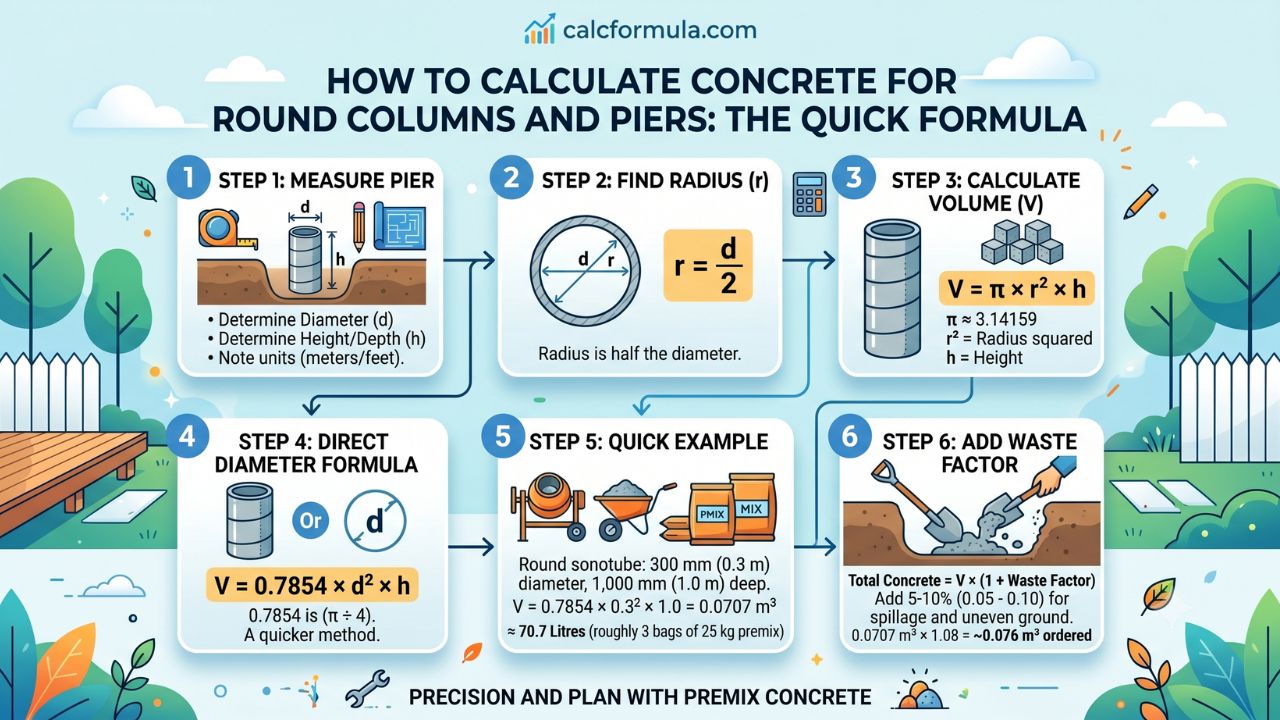
How to Calculate Concrete for Round Columns and Piers: The Quick Formula
Every round column or pier is a cylinder. The volume of a cylinder is:
V = π × r² × h
Where:
- V = Volume of concrete (in cubic metres or cubic feet)
- π = Pi, approximately 3.14159
- r = Radius of the column (half the diameter)
- h = Height (or depth) of the column or pier
If you know the diameter rather than the radius, use this equivalent form:
V = (π ÷ 4) × d² × h
Or numerically:
V = 0.7854 × d² × h
Quick example: A round sonotube 300 mm (0.3 m) in diameter and 1,000 mm (1.0 m) deep:
V = 0.7854 × 0.3² × 1.0 = 0.7854 × 0.09 × 1.0 = 0.0707 m³
That's roughly 70.7 litres of concrete, or approximately 3 bags of 25 kg premix (each 25 kg bag yields about 12.5 litres of mixed concrete).
Add a 5-10% waste factor for spillage, uneven excavation walls, and absorption by surrounding soil, so order for:
0.0707 × 1.08 = ~0.076 m³
For multiple columns, multiply the single-column volume by the number of pours before applying the waste factor. Skip the repetitive arithmetic with the free Concrete Column Calculator at CalcFormula, which handles any number of round columns in one step.
What Affects the Concrete Volume Calculation for Round Columns and Piers
Before you get to the calculator or the formula, you need accurate inputs. Each of these variables directly changes your result - misread even one and your material order will be off.
1. Diameter vs. Radius: Getting It Right From the Start
Most sonotubes, concrete forms, and post-hole auger bits are marketed by diameter - "a 12-inch sonotube," "a 300 mm column form." The cylinder formula uses radius (half the diameter), so forgetting to halve the diameter before squaring it is the most common and most expensive calculation error. Squaring a diameter instead of a radius produces a volume four times too large. This error is covered in depth in the common mistakes section below.
2. Column Height vs. Depth Below Grade
A deck post footing may extend 900 mm below ground but only 100 mm above grade - giving a total concrete height of 1,000 mm, not 900. Always measure the full pour height: from the bottom of the excavation or tube to the top of the intended pour. If you're forming a column that sits proud above a slab or footing pad, include that above-grade section in your height measurement.
3. Sonotube or Cardboard Form Wall Thickness
When using commercially manufactured sonotubes or column forms, the printed diameter refers to the interior (void) dimension - the space that fills with concrete. This is the measurement to use in your formula. No deduction is needed for the cardboard wall itself since you're calculating the volume of concrete inside, not the overall form diameter.
However, if you are pouring into an unformed borehole (augered into soil), measure the actual borehole diameter carefully. Loose or disturbed soil walls often flare slightly at depth, meaning the true volume can be 10-15% more than the clean bore calculation suggests. Always add at least 10% waste in this case.
4. Number of Columns
For a deck with six identical footings, or a fence line with twenty post holes, you're multiplying single-column volume by the count before adding your waste factor. Apply waste across the entire order, not per column individually - this gives a slightly more efficient material estimate.
5. Concrete Mix Type and Yield
This variable affects how many bags you order, not the volume itself. Common options:
| Product Type | Weight per Bag | Approximate Yield |
|---|---|---|
| Premix (rapid-set) | 20 kg | ~9.5 litres |
| Premix (standard) | 25 kg | ~12.5 litres |
| Premix (standard) | 40 kg | ~20 litres |
| Site-mixed M20 | - | 0.0454 m³ per 50 kg cement bag |
For deep structural piers, site-mixed M20 or M25 is more economical at volume. For small fence posts and deck footings, rapid-set premix bags are faster and easier to work with.
6. Soil Type and Frost Depth
Frost-susceptible soils require footings to extend below the frost line to prevent heave. The deeper the pier, the more concrete volume - but also the more critical it is to get the calculation right before starting to dig. Adding 300 mm to the depth because soil conditions changed mid-project can add a full extra bag per hole on larger diameter piers.
7. Reinforcement (Rebar)
For structural columns, rebar displaces a small volume of concrete. In practice, this displacement (typically 1-3% for standard residential columns) is smaller than the waste factor, so it's conventional not to deduct for rebar volume in hand calculations or on standard calculators. Engineers working to exact specifications on commercial projects may apply a rebar deduction, but for DIY and residential work it is safe to ignore.
For quick multi-column estimates and automatic bag count calculations across all standard mix types, the Sonotube Calculator at CalcFormula handles diameter, depth, number of columns, and waste factor simultaneously.
Step-by-Step: How to Calculate Concrete for Round Columns and Piers
The following three worked examples cover the most common real-world scenarios: a single deck footing, a row of fence post holes, and a heavier structural pier.
Worked Example 1: Single Deck Post Footing (Sonotube)
Scenario: One 300 mm diameter sonotube, set 1,200 mm deep, with 100 mm projecting above grade.
Step 1 - Determine total pour height Below grade depth + above grade projection = 1,200 + 100 = 1,300 mm = 1.3 m
Step 2 - Convert diameter to metres 300 mm ÷ 1,000 = 0.3 m
Step 3 - Apply the formula V = 0.7854 × d² × h V = 0.7854 × (0.3)² × 1.3 V = 0.7854 × 0.09 × 1.3 V = 0.0919 m³
Step 4 - Add 8% waste 0.0919 × 1.08 = 0.0993 m³ ≈ 0.1 m³
Step 5 - Convert to bags (25 kg premix, yield ≈ 12.5 L = 0.0125 m³ per bag) 0.1 ÷ 0.0125 = 8 bags of 25 kg premix
Worked Example 2: Row of Fence Post Holes
Scenario: 10 fence posts, 150 mm diameter augered holes, 750 mm deep.
Step 1 - Single hole volume V = 0.7854 × (0.15)² × 0.75 V = 0.7854 × 0.0225 × 0.75 V = 0.01325 m³ per hole
Step 2 - Total for 10 holes 0.01325 × 10 = 0.1325 m³
Step 3 - Add 10% waste (unformed augered holes, soil variability) 0.1325 × 1.10 = 0.1458 m³
Step 4 - Convert to 20 kg rapid-set bags (yield ≈ 0.0095 m³ each) 0.1458 ÷ 0.0095 = 15.3 → order 16 bags of 20 kg rapid-set premix
Pro tip: For fence posts, rapid-set premix is worth the slight extra cost per litre - it reaches working strength in 20-40 minutes, meaning you can brace the post temporarily, pour, and move on without waiting overnight.
Worked Example 3: Structural Pier with Site-Mixed Concrete
Scenario: 4 structural piers for a carport, each 450 mm diameter, 1,800 mm deep, using site-mixed M20 concrete.
Step 1 - Single pier volume V = 0.7854 × (0.45)² × 1.8 V = 0.7854 × 0.2025 × 1.8 V = 0.2864 m³
Step 2 - Total for 4 piers 0.2864 × 4 = 1.1456 m³
Step 3 - Add 8% waste 1.1456 × 1.08 = 1.2372 m³ - order 1.25 m³ of ready-mix, or calculate materials for a site mix:
Site mix material quantities (M20 = 1:1.5:3):
- Dry mix volume = 1.2372 × 1.54 = 1.905 m³
- Cement = (1 ÷ 5.5) × 1.905 = 0.3464 m³ × 1440 kg/m³ = 498.8 kg ≈ 10 bags of 50 kg cement
- Sand = (1.5 ÷ 5.5) × 1.905 = 0.5195 m³
- Coarse Aggregate = (3 ÷ 5.5) × 1.905 = 1.039 m³
- Water (W/C = 0.50) = 0.50 × 498.8 = ~249 litres
At this volume (over 1 m³), ready-mix concrete delivered by truck is usually more economical and produces more consistent results than batching on site. Use the Concrete Column Calculator at CalcFormula to generate a full material breakdown and share it directly with your ready-mix supplier.
Common Mistakes When Calculating Concrete for Round Columns and Piers
These errors appear repeatedly on job sites and in DIY projects. Each one costs either money or time.
❌ Mistake 1: Using Diameter Instead of Radius in the r² Formula
This is the single most consequential arithmetic error. If your column is 300 mm in diameter and you plug 0.3 into V = π × r² × h without halving it first, you calculate the volume for a 600 mm diameter column - four times the actual concrete needed. Always use the 0.7854 × d² form if you're working from diameter, since it already accounts for the halving and squaring.
❌ Mistake 2: Mixing Units Mid-Calculation
Measuring diameter in millimetres and depth in metres produces nonsense. Convert everything to the same unit before calculating - either all in metres (for m³ results) or all in feet (for ft³ results). A 300 mm diameter column is 0.3 m, not 300 m.
❌ Mistake 3: Forgetting the Above-Grade Projection
A sonotube set 900 mm into the ground with 150 mm projecting above a footing pad still holds 1,050 mm of concrete, not 900. Forgetting this projection consistently means under-ordering, particularly when multiple piers are involved.
❌ Mistake 4: Ordering Exactly Calculated Volume with Zero Waste
Concrete pours are not laboratory conditions. Soil walls flex. Tubes aren't perfectly plumb. Mix sticks to tools and wheelbarrows. Ordering exactly your calculated volume is a gamble - and running short on a structural pier mid-pour means a cold joint that compromises the whole footing. Always order a minimum of 5% extra for formed pours and 10% for unformed borehole pours.
❌ Mistake 5: Assuming All Premix Bags Have the Same Yield
A 20 kg bag, 25 kg bag, and 40 kg bag each yield different volumes. Even within the same weight, rapid-set and standard mixes may yield slightly different volumes per bag due to different aggregate specifications. Always check the manufacturer's stated yield on the bag before calculating bag counts.
❌ Mistake 6: Ignoring Frost Depth Requirements
Pouring a pier to 600 mm depth when local frost lines are at 900 mm means the footing will heave seasonally, cracking or tilting whatever it supports. Check your local frost depth before finalising column depth - this affects both structural performance and your concrete volume estimate.
❌ Mistake 7: Calculating Volume Without Accounting for Auger Flare
Power augers often produce a slightly flared entry hole and irregular sidewalls, particularly in sandy or gravelly soils. The actual fill volume can exceed the clean-bore calculation by 15% or more. For augered holes, use a minimum 12-15% waste factor, not the standard 5-8%.
Frequently Asked Questions About Calculating Concrete for Round Columns and Piers
Q1: What is the formula to calculate concrete volume for a round column?
The formula is V = π × r² × h, where r is the radius (half the diameter) and h is the height or depth of the pour. An easier form for working from diameter is V = 0.7854 × d² × h. This gives volume in whatever unit you used for diameter and height - if both are in metres, the result is in cubic metres. Multiply cubic metres by 1,000 to convert to litres.
Q2: How much concrete does a sonotube need?
It depends entirely on the tube's diameter and depth. A 200 mm × 1,000 mm sonotube holds about 31.4 litres (roughly 3 bags of 20 kg rapid-set premix). A 300 mm × 1,200 mm sonotube holds about 84.8 litres (around 9 bags of 20 kg). Use the Sonotube Calculator at CalcFormula to get an instant bag count for any size sonotube - just enter the diameter, depth, and number of tubes.
Q3: How many bags of concrete do I need for a round post hole?
Divide the hole's volume (in litres) by the manufacturer's stated yield per bag. Standard 25 kg premix bags yield approximately 12.5 litres each. A 200 mm diameter × 800 mm deep post hole has a volume of about 25 litres - so you'd need 2 bags of 25 kg premix per hole. Always round up to the next whole bag.
Q4: What sonotube diameter should I use for deck footings?
The diameter depends on the load being transferred from the deck structure above. For typical residential decks (light-frame timber, single level), a 200-300 mm diameter sonotube set to frost depth is generally adequate for post spacing of 2-3 metres. For heavier loads, closer spacing, or engineer-specified designs, 300-450 mm diameters are common. Always verify with your local building authority or structural engineer - sonotube diameter alone doesn't determine structural adequacy; depth and concrete grade matter equally.
Q5: How deep should concrete piers be poured?
In frost-affected climates, piers must extend below the local frost depth to prevent heave. Frost depths range from 300 mm in mild climates to 1,500 mm or more in northern regions. In frost-free areas, a minimum depth of 600-900 mm is standard practice for deck and pergola footings. Structural piers for building foundations are typically engineered to specific bearing depth requirements.
Q6: Is there a difference between a concrete column and a concrete pier?
Structurally, a pier typically transfers load axially through bearing at its base (think deck footing or bridge pier). A column transfers compressive load over its full height and may be part of a lateral load system. For volume calculation purposes, there is no difference - both are cylinders, and the same formula applies. The distinction matters to engineers designing the reinforcement and connection details, not to the person calculating how much concrete to buy.
Q7: Can I use site-mixed concrete for structural piers?
Yes, provided you use the correct mix grade. For structural piers carrying building loads, M20 or M25 concrete is standard. Rapid-set premix bags are convenient for small quantities (1-4 piers), but for more than five or six larger piers, batching an M25 site mix from cement, sand, and aggregate becomes more economical. For very large quantities - over 1 m³ - ready-mix delivery from a concrete plant gives the most consistent strength and is often the most cost-effective option per cubic metre.
Use These Free Calculators to Check Your Round Column Concrete Estimates
Manual calculation builds understanding, but before finalising a material order it's worth running your figures through a dedicated tool to catch any unit conversion errors or transcription mistakes.
Concrete Column Calculator - CalcFormula Enter column diameter, height, number of columns, and waste percentage. The calculator returns total concrete volume in m³ and cubic feet, plus bag counts for common premix sizes. Ideal for deck footings, structural piers, pergola posts, and any circular column pour.
Sonotube Calculator - CalcFormula Built specifically for sonotube and cardboard column form pours. Enter tube diameter (from the manufacturer's printed size), pour depth, number of tubes, and your chosen premix bag weight. The tool calculates total and per-tube volume, total bag count, and estimated cost when you input a price per bag.
Both tools are free, require no sign-up, and handle all the unit conversions automatically - a useful cross-check whether you're pouring two deck posts or twenty structural piers.
Summary: Key Takeaways for Calculating Concrete for Round Columns and Piers
Knowing how to calculate concrete for round columns and piers comes down to mastering one formula and respecting a handful of practical rules:
- Use V = 0.7854 × d² × h - it's the cleanest form when working from diameter.
- Convert all measurements to the same unit before calculating.
- Always include the above-grade projection in your total pour height.
- Add 5-10% waste for formed pours; 10-15% for unformed boreholes.
- Check your bag yield - it varies by brand, bag weight, and mix type.
- Verify frost depth before finalising pier depth - it directly changes your volume and your structural outcome.
One formula, consistent units, and a modest waste buffer. That's the entire framework for accurate concrete estimation on any round column or pier project.
Technical content reviewed against ACI 318 (Building Code Requirements for Structural Concrete) and standard residential footing design practices. Always consult a licensed structural engineer for load-bearing or foundation-critical applications.