Knowing exactly how many gallons are in your swimming pool is one of the most practically important numbers in pool ownership. Every chemical treatment you add - chlorine, algaecide, pH adjusters, stabilizer - is dosed by volume. Get the gallon count wrong by 20% and your sanitizer levels will be chronically off, your water will run cloudy or over-treated, and you'll spend far more on chemicals than necessary. Pool volume also determines fill time, heating costs, pump turnover rates, and the correct size of filtration equipment.
Whether you're buying a new pool, calculating chemical doses for the first time, planning a water heating system, or simply satisfying curiosity, this guide gives you every formula you need to calculate swimming pool volume in gallons for any shape - rectangular, circular, oval, kidney, and irregular - along with a full worked example, common calculation mistakes, and answers to the most frequently asked pool volume questions.
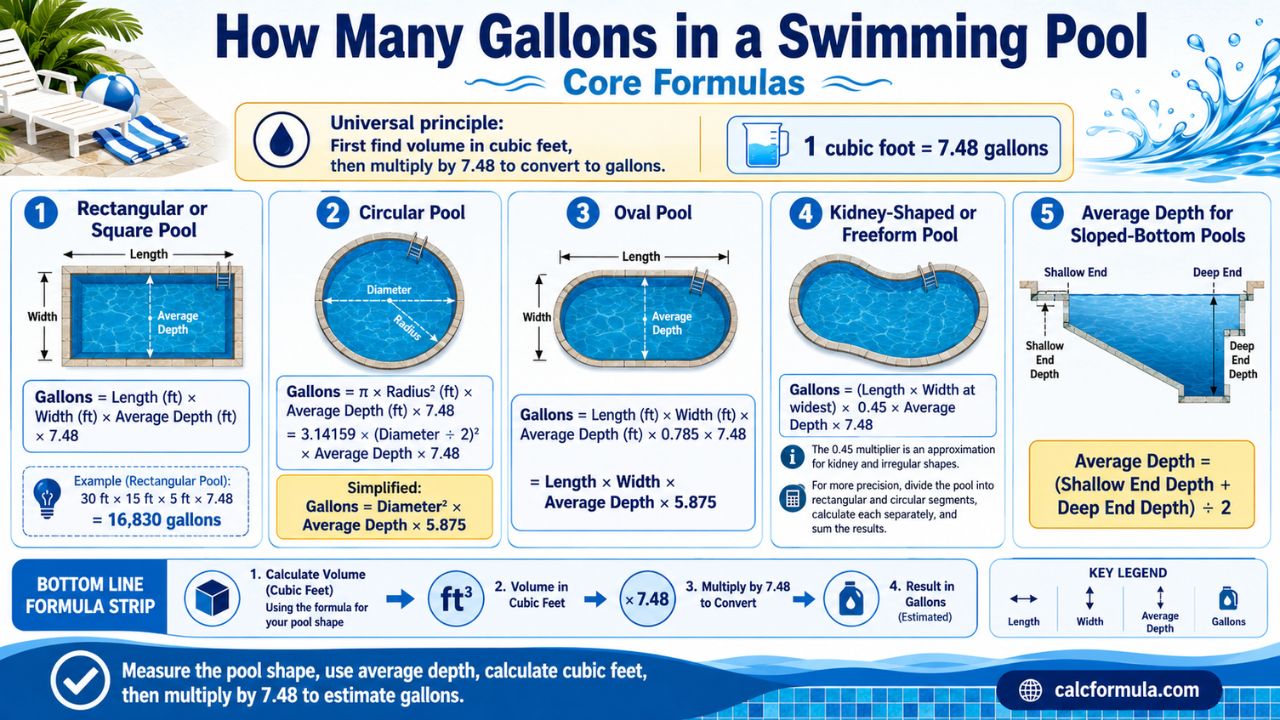
Quick Answer: How Many Gallons in a Swimming Pool (Core Formulas)
The universal principle behind all pool volume calculations is the same two-step process: find the pool's volume in cubic feet, then multiply by 7.48 to convert to gallons.
The key conversion factor:
1 cubic foot = 7.48 gallonsFormula by pool shape:
Rectangular or square pool:
Gallons = Length (ft) × Width (ft) × Average Depth (ft) × 7.48Circular pool:
Gallons = π × Radius² (ft) × Average Depth (ft) × 7.48
        = 3.14159 × (Diameter ÷ 2)² × Average Depth × 7.48
Simplified:
Gallons = Diameter² × Average Depth × 5.875Oval pool:
Gallons = Length (ft) × Width (ft) × Average Depth (ft) × 0.785 × 7.48
        = Length × Width × Average Depth × 5.875
Kidney-shaped or freeform pool:
Gallons = (Length × Width at widest) × 0.45 × Average Depth × 7.48The 0.45 multiplier is an approximation for kidney and irregular shapes. For precision, divide the pool into rectangular and circular segments, calculate each separately, and sum the results.
Average depth for sloped-bottom pools:
Average Depth = (Shallow End Depth + Deep End Depth) ÷ 2Skip the manual math entirely with the free Pool Calculator at CalcFormula.com - input your pool shape and dimensions and get instant gallons, liters, and cubic feet for any pool configuration.
What Affects How Many Gallons Are in a Swimming Pool? (Variables Section)
How Many Gallons in a Swimming Pool Depends First on Pool Shape
Pool shape is the primary determinant of which formula applies and how much accuracy your calculation can achieve. The most common pool shapes in residential and commercial installations each carry different geometric multipliers:
Rectangular and square pools are the most straightforward to calculate because every dimension is a right angle and depth can be measured directly at each end. These are the easiest shapes to calculate with precision.
Circular above-ground pools are nearly as simple - measure the diameter (not radius) at water level and use the simplified circular formula. Be precise here: a measurement error of just 6 inches on diameter changes volume by a surprising amount on larger pools.
Oval pools follow an ellipse area formula. The 0.785 multiplier (equivalent to π/4) corrects for the fact that an oval has less area than the rectangle it fits inside. Many above-ground pools sold as "oval" are actually more rectangular with rounded ends - measure the true longest length and widest width for the most accurate input.
Kidney, lagoon, and freeform pools require either the 0.45 approximation method or a segmented approach. For precision, a pool designer will divide the free-form shape into a grid and use planimetry or digital area measurement from a scaled drawing. For most chemical dosing purposes, the approximation method is accurate enough.
For any pool with a sloped or beach-entry floor - including pools with a graduated slope from shallow to deep end, pool slope features, and zero-entry sections - the Pool Slope Calculator calculates the effective volume contributed by each sloped zone separately, preventing the overestimation that results from simply averaging the two extreme depths.
Pool Dimensions: Length, Width, and Diameter
Pool dimensions should always be measured at the waterline, not at the coping edge or the outermost tile line. The water-holding volume is what matters for chemical and heating calculations. For irregular pools, measure the maximum length and maximum width at the widest perpendicular point.
Measure in feet and decimal fractions of feet - not feet and inches - before entering values into any formula. A pool that is 24 feet 6 inches long is 24.5 feet, not 24.6 feet. Converting incorrectly at this stage introduces a consistent error into every downstream calculation.
Average Depth: The Most Critical Variable
Average depth is where most pool volume calculations go wrong. Very few residential pools have a perfectly flat bottom - almost all have a shallow end, a deep end, and a slope connecting them. Using only the deep end depth dramatically overstates volume; using only the shallow end understates it.
For a pool with a single uniform slope from shallow to deep:
Average Depth = (Shallow End Depth + Deep End Depth) ÷ 2A pool with a 3-foot shallow end and an 8-foot deep end has an average depth of (3 + 8) ÷ 2 = 5.5 feet.
For a pool with a flat shallow section, a breakpoint, and a sloped deep section (the most common residential design):
The flat shallow section and the sloped deep section must be calculated separately with their own average depths, then combined proportionally by length. For example:
- Flat shallow section: 15 ft long, 3.5 ft depth (constant)
- Sloped section: 25 ft long, average depth = (3.5 + 9.0) ÷ 2 = 6.25 ft
Calculate each zone's volume independently and add them:
Zone 1 volume = 15 × Width × 3.5 × 7.48
Zone 2 volume = 25 × Width × 6.25 × 7.48
Total = Zone 1 + Zone 2
This two-zone approach is significantly more accurate than a simple overall average and is the method recommended by the Pool & Hot Tub Alliance (PHTA) for chemical dosing calculations.
Water Level vs. Total Pool Capacity
Pool volume calculations should always be based on the actual current water level, not the theoretical maximum fill depth. Most pools operate at a water level 2-4 inches below the coping or skimmer throat. This difference is relatively small on large pools but can represent 3-5% of calculated volume - meaningful when calculating precise chemical dosing.
Standard practice is to calculate volume at the normal operating water level (just below the skimmer mid-point), not at the absolute full depth of the pool walls.
Pool Features That Add or Subtract Volume
Steps, benches, swim-outs, and ledges built into the pool interior displace water and reduce total volume below what the basic formula predicts. The tanning ledge (Baja shelf) common in modern lagoon pools can be 1-3 feet deep and cover 15-30% of pool surface area - subtracting hundreds of gallons from the calculated volume.
To account for built-in features, estimate their volume (length × width × depth of feature above pool floor) and subtract from the total. A swim-out bench that is 5 ft wide × 3 ft long × 3.5 ft tall sitting on the pool floor displaces approximately 5 × 3 × 3.5 × 7.48 ≈ 393 gallons that the basic formula would incorrectly count as water.
Pool Volume vs. Tank Volume
For above-ground pools, above-ground spas, and stock tank pools, the geometry differs slightly from inground construction - walls are vertical and the floor is typically flat, which simplifies the calculation and usually makes the basic formula more accurate. Portable hot tubs and inflatable pools often have irregular interior shapes; for these, use the manufacturer's stated volume or the Tank Volume Calculator which supports cylindrical, rectangular, oval, and cone-bottom tank shapes commonly used for above-ground water storage and portable pool applications.
Step-by-Step Worked Example: Calculating How Many Gallons in a Swimming Pool
Project: A residential inground pool with the following dimensions: 16 feet wide, 36 feet long. The floor has a flat shallow zone (3.5 ft depth) for the first 12 feet, then a sloped breakpoint section transitioning to a 9-foot deep end over the remaining 24 feet. Width is constant throughout. Calculate total volume in gallons.
Step 1: Identify the two depth zones
Zone 1 (flat shallow): Length = 12 ft, Depth = 3.5 ft (constant) Zone 2 (sloped deep): Length = 24 ft, Shallow side depth = 3.5 ft, Deep end depth = 9.0 ft
Step 2: Calculate average depth for Zone 2
Average Depth (Zone 2) = (3.5 + 9.0) ÷ 2 = 12.5 ÷ 2 = 6.25 ftStep 3: Calculate volume of Zone 1 in cubic feet
Volume (Zone 1) = Length × Width × Depth
                = 12 ft × 16 ft × 3.5 ft
                = 672 cubic feet
Step 4: Calculate volume of Zone 2 in cubic feet
Volume (Zone 2) = Length × Width × Average Depth
                = 24 ft × 16 ft × 6.25 ft
                = 2,400 cubic feet
Step 5: Sum total cubic feet
Total Volume = 672 + 2,400 = 3,072 cubic feetStep 6: Convert cubic feet to gallons
Gallons = 3,072 × 7.48 = 22,978 gallons ≈ 23,000 gallonsStep 7: Subtract for built-in features
This pool has two swim-out benches, each 4 ft wide × 2 ft deep × 3.0 ft tall:
Bench volume each = 4 × 2 × 3.0 × 7.48 = 179 gallons
Two benches = 358 gallons

Adjusted total = 23,000 − 358 = 22,642 gallons
Rounding to the nearest 100 gallons for practical purposes: approximately 22,600 gallons.
Step 8: Verify with the Pool Calculator
Enter the pool dimensions into the Pool Calculator as a two-zone rectangular pool. The calculator confirms 22,600-23,000 gallons depending on whether bench displacement is included - consistent with the manual calculation. This is the number to use for all chemical dosing, pump turnover rate, and heating load calculations going forward.
Common Mistakes When Calculating How Many Gallons in a Swimming Pool
Mistake 1: Using a single average depth for a two-zone pool
Calculating average depth as (3.5 + 9.0) ÷ 2 = 6.25 ft and applying it across the full 36-foot length ignores the fact that only 24 feet of the pool transitions to the deep end - the other 12 feet is flat and shallow. The one-average-depth approach for this pool would give: 36 × 16 × 6.25 × 7.48 = 26,928 gallons - overstating actual volume by nearly 4,300 gallons, a 19% error. On a 20,000-gallon pool, a 19% overestimate means adding 19% too much of every chemical you buy.
Mistake 2: Measuring in feet and inches without converting
The formulas require all measurements in decimal feet. A 9-foot 6-inch deep end is 9.5 feet, not 9 feet. A 3-foot 9-inch shallow end is 3.75 feet, not 3 feet. Entering 9 instead of 9.5 for a deep-end depth on a large pool understates volume by roughly 5%. Always convert every inch measurement to decimal feet (divide inches by 12 and add to whole feet) before plugging values into any formula.
Mistake 3: Measuring the pool's outside dimensions instead of inside water dimensions
Pool coping, beam caps, and tile borders sit outside the water surface. Measuring from outside coping edge to outside coping edge on a 20-foot wide pool might return 21.5 feet - adding nearly 8% to the width input. Always measure the inside waterline dimensions where the water surface meets the pool wall, not the outer perimeter of the deck or coping.
Mistake 4: Ignoring volume displacement from pool steps and ledges
A standard set of pool entry steps can displace 200-500 gallons depending on their size and depth. A tanning ledge or Baja shelf in a freeform pool can subtract 800-1,500 gallons from theoretical volume. Most homeowners skip this subtraction entirely and end up with a volume estimate that's 3-8% high. For chemical dosing, this compounds over every treatment: a pool that's calculated at 22,000 gallons but actually holds 20,500 gallons will be consistently over-dosed.
Mistake 5: Applying the rectangular formula to an oval or kidney pool
A 15-foot × 30-foot oval pool does not hold the same gallons as a 15-foot × 30-foot rectangle. The oval formula requires multiplying by 0.785 to correct for the elliptical area. Skipping this multiplier overstates oval pool volume by approximately 27%. A kidney pool calculated as a plain rectangle without the 0.45 shape factor is similarly overstated. Always match the formula to the actual pool shape, not the nearest rectangular approximation.
Mistake 6: Not recalculating after adding a water feature or spa
An attached spa, raised sun shelf, or waterfall basin adds volume that must be calculated separately and added to the pool volume if those features share the same water chemistry. A standard residential attached spa holds 300-600 gallons. Ignoring the spa volume when calculating chlorine dosing for a combined pool-and-spa system leads to under-dosing in the total water mass.
Pro Tip: The Paint Can Verification Method
If you want a precise volume check without measuring depths, pour a known volume of a traceable dye (such as cyanuric acid at a known concentration) into the pool, allow it to circulate for several hours, then test the resulting concentration. Using the dilution formula (C₁V₁ = C₂V₂), solve for V₂ (pool volume). This method accounts for every geometric irregularity automatically and is used by pool professionals when chemical dosing precision is critical.
FAQ: How Many Gallons in a Swimming Pool
Q1: How many gallons are in a 12×24 foot pool?
A 12×24 foot rectangular pool at an average depth of 4.5 feet (shallow end 3 ft, deep end 6 ft) holds approximately 12 × 24 × 4.5 × 7.48 = 9,720 gallons. At a deeper average depth of 5.5 feet (3 ft shallow, 8 ft deep), the same footprint holds 12 × 24 × 5.5 × 7.48 = 11,880 gallons. Depth has the single biggest impact on volume for a given pool size, which is why knowing actual measured depths - not nominal design depths - is essential. For your exact pool dimensions and depths, use the Pool Calculator to get a precise gallon count instantly.
Q2: How many gallons are in a 15-foot round above-ground pool?
A 15-foot diameter round above-ground pool at a standard fill depth of 48 inches (4 feet) holds approximately: π × (7.5)² × 4 × 7.48 = 3.14159 × 56.25 × 4 × 7.48 = 5,286 gallons. At the common 52-inch wall height with a 48-inch water depth, this estimate is accurate. Note that above-ground pool walls are usually not filled to the absolute top - measure actual water depth for the most accurate calculation. The Tank Volume Calculator is also useful for circular above-ground pools and portable pools, where cylindrical tank geometry applies directly.
Q3: Why does knowing pool volume in gallons matter for chemical treatment?
Every pool chemical is dosed per 10,000 gallons of water. A 1-pound bag of calcium hypochlorite, for example, raises free chlorine by approximately 5 ppm in 10,000 gallons of water. If your pool holds 25,000 gallons and you calculate it as 20,000 gallons, you're adding only 80% of the chlorine needed - leaving 20% of the pool water consistently under-sanitized. Over time this leads to persistent algae growth, cloudy water, and higher chemical costs as you add more product to chase a problem that stems entirely from an inaccurate volume estimate.
Q4: How do I calculate average depth for a pool with a sloped bottom?
For a pool with a straightforward uniform slope from shallow end to deep end, average depth = (shallow end depth + deep end depth) ÷ 2. Measure depth at the wall, not in the middle of the slope. For pools with multiple depth zones - a flat shallow area, a transition slope, and a flat deep area - calculate the average depth and volume for each flat or sloping section separately, then add the volumes together. This two-zone or three-zone method is significantly more accurate than a single overall average and is what the Pool Slope Calculator uses when breaking down pool volume by zone.
Q5: How long does it take to fill a swimming pool?
Fill time depends on your hose flow rate (typically 9-17 GPM for a standard garden hose) and your pool's total gallon volume. Divide total gallons by your hose GPM to get fill time in minutes, then convert to hours. A 20,000-gallon pool filled at 12 GPM takes 20,000 ÷ 12 = 1,667 minutes = approximately 27.8 hours of continuous fill time. Most homeowners fill with two hoses simultaneously to cut fill time roughly in half. Measure your hose GPM using the bucket test (time how long it takes to fill a 5-gallon bucket) before estimating fill time.
Q6: How does pool volume affect pump sizing and water turnover rate?
Pool sanitation guidelines recommend turning over the entire pool volume at least once every 8 hours (and preferably every 6 hours for residential pools). Pump flow rate required for an 8-hour turnover is: Pool Volume (gallons) ÷ 480 minutes = required GPM. A 20,000-gallon pool needs at minimum: 20,000 ÷ 480 = 41.7 GPM pump capacity, accounting only for turnover and not for friction losses through the filter, plumbing, and fittings. In practice, select a pump rated for 50-60 GPM for a 20,000-gallon pool to ensure adequate turnover even as filter pressure increases between cleanings.
Q7: How do I calculate how many gallons an irregularly shaped pool holds?
For kidney, lagoon, and freeform pools without a simple geometric profile, use one of three approaches in order of increasing accuracy. First, the approximation method: Gallons = Longest Length × Widest Width × Average Depth × 0.45 × 7.48. Second, the segmentation method: divide the pool into rectangular and semi-circular zones from an overhead diagram, calculate each zone's volume separately, and sum them. Third, the dye test method (described in the Pro Tip above), which accounts for all irregularities automatically. The first method is accurate within 10-15% for typical kidney shapes. The segmentation method achieves 3-5% accuracy. The dye method approaches 1-2% accuracy and is the gold standard for chemical program management.
Useful Calculators for Pool Volume and Design
These free tools make pool volume calculation precise and fast at every stage of pool ownership and design:
Pool Calculator - Enter pool shape, length, width, and shallow and deep end depths to instantly calculate total gallons, liters, and cubic feet for rectangular, round, oval, and irregular pools. Also outputs chemical dosing recommendations based on calculated volume.
Pool Slope Calculator - Calculate pool volume by zone for sloped-bottom pools, beach entry pools, and multi-depth designs where a single average depth formula would introduce significant error.
Tank Volume Calculator - Ideal for above-ground pools, circular stock tank pools, portable spas, and above-ground water storage tanks where cylindrical, oval-cylinder, or rectangular tank geometry applies. Supports multiple tank shapes and outputs volume in gallons, liters, and cubic feet simultaneously.
Final Thoughts: Get Your Pool Volume Right and Everything Else Gets Easier
The question of how many gallons are in a swimming pool might seem like simple math - and in some ways it is - but getting it consistently right requires knowing which formula applies to your pool shape, measuring the right dimensions at the waterline, calculating average depth correctly for sloped-bottom designs, and accounting for built-in features that displace water volume. An accurate gallon count, calculated once and verified, pays dividends every single time you add chemicals, adjust your pump schedule, or plan a water heating system.
Use the formulas and two-zone worked example in this guide as your baseline approach, verify your result with the Pool Calculator before finalizing any chemical program, and revisit your gallon count any time the pool layout changes - a new tanning ledge, a rebuilt spa, or a replaced liner can all shift the actual water volume meaningfully.
This article was written by a Certified Pool & Spa Professional (CPSP) with over 14 years of experience designing residential and commercial aquatic systems and water chemistry programs. All volume formulas are consistent with Pool & Hot Tub Alliance (PHTA) standards and ANSI/PHTA/ICC-7 published guidelines for pool volume measurement and chemical dosing.