Every plumbing system, irrigation network, and fire suppression layout depends on one number more than any other: flow rate, measured in gallons per minute (GPM). Too little flow and your sprinkler heads don't pop up, your fixtures run at a trickle, or your fire suppression system fails during an emergency. Too much flow and pipes erode, fittings blow apart, pressure regulators fail, and water bills spiral out of control. Getting flow rate right is the starting point for every hydraulic calculation in residential, commercial, and agricultural systems.
Whether you're sizing a new residential water service, designing a drip irrigation zone, calculating demand at a fire hydrant, or troubleshooting low pressure in an existing system, this guide walks you through the exact formulas, every variable that affects the result, a complete worked example from start to finish, and the most common errors that lead to undersized or oversized piping. By the end, you'll know how to calculate flow rate in GPM accurately and confidently for any application.
Quick Answer: How to Calculate Flow Rate in GPM (Core Formulas)
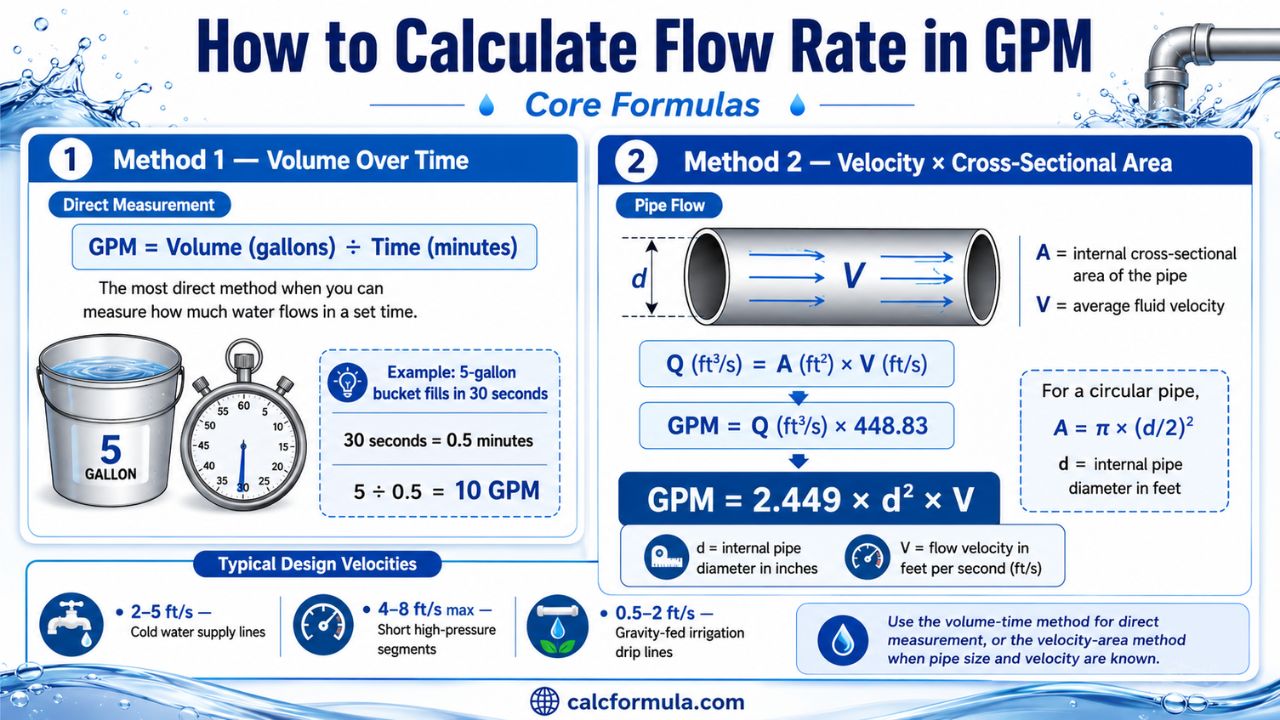
The two most commonly used methods for calculating flow rate in GPM are the volume-over-time method and the velocity-area method.
Method 1 - Volume Over Time (Direct Measurement):
GPM = Volume (gallons) ÷ Time (minutes)This is the most direct approach when you can physically measure how much water flows in a set time. Fill a 5-gallon bucket in 30 seconds? That's 5 ÷ 0.5 = 10 GPM.
Method 2 - Velocity × Cross-Sectional Area (Pipe Flow):
Q (ft³/s) = A (ft²) × V (ft/s)To convert to GPM:
GPM = Q (ft³/s) × 448.83Where A is the internal cross-sectional area of the pipe and V is the average fluid velocity.
For a circular pipe:
A = π × (d/2)² where d = internal pipe diameter in feetCombined formula for GPM directly from pipe diameter and velocity:
GPM = 2.449 × d² × VWhere d = internal pipe diameter in inches and V = flow velocity in feet per second (ft/s).
Typical design velocities: 2-5 ft/s for cold water supply lines; 4-8 ft/s maximum for short high-pressure segments; 0.5-2 ft/s for gravity-fed irrigation drip lines.
For instant results across all these methods, the free Gallons Per Minute Calculator at CalcFormula.com covers volume-time, velocity-area, and pressure-based flow rate calculations without manual arithmetic.
What Affects Flow Rate in GPM? (Variables Section)
How to Calculate Flow Rate in GPM Based on Pipe Diameter
Pipe diameter is the dominant variable in any pipe flow calculation. Because area scales with the square of the diameter, a small increase in pipe size produces a large increase in flow capacity. Doubling the pipe diameter quadruples the cross-sectional area - and at the same velocity, quadruples the GPM.
This is why undersizing a pipe by just one nominal size (say, choosing ¾-inch instead of 1-inch supply line) can cut flow capacity nearly in half and is one of the most common causes of low pressure complaints in residential plumbing.
Always use the internal (inside) diameter, not the nominal pipe size. Nominal pipe sizes are labels, not actual measurements. Here are actual internal diameters for common pipe types:
| Nominal Size | Schedule 40 PVC ID | Type L Copper ID | CPVC ID |
|---|---|---|---|
| ½ inch | 0.622 in | 0.545 in | 0.600 in |
| ¾ inch | 0.824 in | 0.745 in | 0.804 in |
| 1 inch | 1.049 in | 0.995 in | 1.029 in |
| 1¼ inch | 1.380 in | 1.245 in | 1.360 in |
| 1½ inch | 1.610 in | 1.481 in | 1.590 in |
| 2 inch | 2.067 in | 1.959 in | 2.047 in |
Using the wrong internal diameter in a GPM formula produces results that are consistently wrong by a fixed ratio. Plug actual IDs into the Pipe Volume Calculator to confirm pipe cross-sectional area and volume per linear foot before running your flow rate calculations.
Flow Velocity and the Velocity-Pressure Relationship
Flow velocity determines both the GPM a pipe delivers and the pressure drop it creates along its length. Higher velocity means higher flow rate - but also higher friction losses, more noise, and accelerated pipe wear. Recommended design velocities by application:
| Application | Recommended Velocity Range |
|---|---|
| Cold water supply (residential) | 2 - 4 ft/s |
| Hot water supply (residential) | 2 - 3 ft/s |
| Irrigation main lines | 3 - 5 ft/s |
| Irrigation lateral lines | 2 - 4 ft/s |
| Fire protection mains | 4 - 8 ft/s |
| Drain, waste, vent (gravity) | 2 - 4 ft/s (self-cleaning min.) |
Velocities above 8 ft/s in water supply piping cause erosion corrosion, water hammer, and noise - particularly at elbows and tees. ASHRAE and the Uniform Plumbing Code both recommend staying below 8 ft/s for general supply applications.
Pressure at the Source and Pressure Drop Along the Line
Available pressure at the supply point directly limits maximum achievable flow rate. The relationship between pressure and flow comes from the Hazen-Williams equation, which governs pressurized pipe flow in water systems:
Q = 0.432 × C × d^2.63 × S^0.54Where:
- Q = flow rate (GPM)
- C = Hazen-Williams roughness coefficient (dimensionless)
- d = internal pipe diameter (inches)
- S = hydraulic slope = head loss (ft) ÷ pipe length (ft)
Hazen-Williams C values for common pipe materials:
| Pipe Material | C Value |
|---|---|
| New steel pipe | 140 - 150 |
| PVC (new) | 140 - 150 |
| Copper tubing | 130 - 140 |
| Cast iron (older) | 100 - 120 |
| Galvanized steel | 100 - 120 |
| Old corroded steel | 60 - 80 |
Lower C values mean higher friction and lower flow for the same pressure and pipe size. Old galvanized steel pipes with C = 80 deliver significantly less GPM than new PVC at C = 150 - which is why re-piping aging galvanized systems frequently resolves chronic low-pressure complaints without touching the meter or main.
Friction Losses from Fittings and Valves
Straight pipe friction is only part of the total pressure drop in a real system. Fittings, valves, and changes in direction all create additional resistance, expressed as equivalent pipe length - the additional length of straight pipe that would produce the same pressure drop as that fitting.
Common equivalent lengths (for 1-inch pipe; scale proportionally with pipe size):
- 90° elbow: 2.5 ft equivalent
- 45° elbow: 1.3 ft equivalent
- Tee (through-run): 1.7 ft equivalent
- Tee (branch): 5.5 ft equivalent
- Gate valve (fully open): 0.7 ft equivalent
- Ball valve (fully open): 1.0 ft equivalent
- Globe valve (fully open): 18 ft equivalent
On short residential supply runs, fittings may add 20-30% to total equivalent pipe length. On complex commercial systems with dozens of valves and fittings, equivalent length from fittings can match or exceed the actual pipe run. Always include equivalent length of fittings when computing friction losses and available head for GPM calculations.
Application-Specific Flow Demands
Different systems have different target GPM ranges, and designing to the right range is critical before selecting pipe sizes:
Residential plumbing fixtures (GPM at each fixture): Toilet flush valve: 3-6 GPM; bathroom lavatory: 0.5-1.5 GPM (post-2005 code); kitchen faucet: 1.0-1.8 GPM; showerhead: 1.8-2.0 GPM; bathtub: 4-6 GPM; dishwasher: 1-2 GPM; washing machine: 3-5 GPM.
Irrigation design flow: Rotary sprinkler heads: 1-3 GPM per head; spray heads: 0.5-2 GPM; drip emitters: 0.1-2 GPH (note: gallons per hour) per emitter; micro-spray: 3-15 GPH. Always confirm with the manufacturer's spec sheet for the exact model being used.
Fire flow requirements: Minimum fire flow GPM for residential structures typically ranges from 500-1,000 GPM at 20 psi residual pressure for 1-2 hours. For commercial structures, fire flow can reach 3,500 GPM or more. The Fire Flow Calculator determines required fire flow GPM based on building area, construction type, and occupancy classification - a calculation that must be verified against ISO (Insurance Services Office) standards and local fire code requirements.
Step-by-Step Worked Example: Calculating Flow Rate in GPM for an Irrigation System
Project: A residential drip irrigation system has a dedicated ¾-inch PVC supply line (Schedule 40, ID = 0.824 inches) fed from a municipal water meter. The line runs 80 feet from the meter to the irrigation zone valve, with the following fittings: two 90° elbows, one tee (branch run), and one ball valve (fully open). Available pressure at the meter is 65 psi. Determine the available flow rate in GPM at the zone valve and whether it can support 6 drip emitters running at 1 GPH each plus 4 rotary heads at 1.5 GPM each.
Step 1: Calculate total fixture demand
Drip emitters:   6 × 1 GPH = 6 GPH = 0.1 GPM
Rotary heads:    4 × 1.5 GPM = 6.0 GPM
Total demand:    6.0 + 0.1 = 6.1 GPM
Step 2: Calculate equivalent pipe length including fittings
For ¾-inch pipe, scale the 1-inch equivalent lengths by approximately 0.85:
Actual pipe run:          80.0 ft
Two 90° elbows:           2 × (2.5 × 0.85) = 4.25 ft
One tee (branch):         1 × (5.5 × 0.85) = 4.68 ft
One ball valve (open):    1 × (1.0 × 0.85) = 0.85 ft
Total equivalent length:  80.0 + 4.25 + 4.68 + 0.85 = 89.78 ft ≈ 90 ft
Step 3: Determine allowable pressure drop
Typical irrigation design allows 50% of available static pressure for friction losses, leaving 50% as residual pressure at the zone valve:
Available pressure drop = 65 psi × 0.50 = 32.5 psi
Head loss in feet:       32.5 psi × 2.307 ft/psi = 74.98 ft ≈ 75 ft
Hydraulic slope S:       75 ft ÷ 90 ft = 0.833 ft/ft
Step 4: Apply the Hazen-Williams equation
For Schedule 40 PVC, C = 150; d = 0.824 inches; S = 0.833:
Q = 0.432 × C × d^2.63 × S^0.54
Q = 0.432 × 150 × (0.824)^2.63 × (0.833)^0.54
Computing each term:
(0.824)^2.63 ≈ 0.641
(0.833)^0.54 ≈ 0.910
Q = 0.432 × 150 × 0.641 × 0.910
Q = 0.432 × 150 × 0.583
Q = 0.432 × 87.45
Q ≈ 37.8 GPM available capacity
Step 5: Compare available capacity to system demand
Available flow:   37.8 GPM
Required demand:   6.1 GPM
The ¾-inch PVC line has vastly more capacity than the zone requires. The system will run at a fraction of its maximum velocity - roughly:
V = GPM ÷ (2.449 × d²) = 6.1 ÷ (2.449 × 0.824²) = 6.1 ÷ 1.661 ≈ 3.7 ft/s3.7 ft/s falls comfortably within the 3-5 ft/s recommended range for irrigation mains. The design is confirmed.
For quick cross-checking of GPM at different pressure and pipe size combinations without manual Hazen-Williams computation, use the Gallons Per Minute Calculator and the Pipe Volume Calculator side by side to compare alternatives rapidly.
Common Mistakes When Calculating Flow Rate in GPM
Mistake 1: Confusing GPM and GPH
Gallons per minute and gallons per hour differ by a factor of 60. Drip irrigation emitters are almost always rated in GPH (gallons per hour), while sprinkler heads and supply lines are rated in GPM. Mixing the two without converting produces flow rate calculations that are off by 60× - leading to dramatically undersized or oversized pipe. Every time you see a flow specification, check the unit. Convert GPH to GPM by dividing by 60 before using it in any formula.
Mistake 2: Using Nominal Pipe Diameter Instead of Actual Internal Diameter
A ¾-inch nominal Schedule 40 PVC pipe has an actual internal diameter of 0.824 inches - not 0.75 inches. A ¾-inch Type L copper pipe has an ID of 0.745 inches. Using the nominal size (0.75 inches) in the GPM formula overstates cross-sectional area and produces a flow rate result that is higher than reality. On a small pipe this error is relatively small; on large-diameter pipes, the nominal vs actual discrepancy grows. Always use the actual internal diameter from a manufacturer specification or pipe data table.
Mistake 3: Ignoring Pressure Drop When Calculating Available GPM
GPM doesn't exist independently of pressure. A pipe can only deliver a certain flow rate if sufficient pressure is available to overcome friction losses. Calculating pipe flow capacity at 65 psi static pressure and then designing the system to use all that flow rate ignores the fact that flowing water loses pressure to friction - meaning actual pressure at the end of the line is significantly less than at the meter. Design around residual (flowing) pressure, not static pressure.
Mistake 4: Forgetting to Add Fittings to Equivalent Pipe Length
On simple systems with short runs, fittings contribute relatively little to total friction loss. On complex irrigation systems or commercial plumbing with multiple floors, zone valves, backflow preventers, and pressure regulators, fitting losses can easily double the effective friction length. A backflow preventer alone can have an equivalent length of 30-60 feet. Always add equivalent pipe length for every major fitting before calculating friction loss and available GPM.
Mistake 5: Designing All Zones to the Same Flow Rate Without Checking Main Line Capacity
In multi-zone irrigation systems, each zone is designed for its own GPM demand. But all zones are fed from the same water meter and service line. The main service line must be sized to handle the single highest-demand zone, plus any concurrent indoor plumbing demand. Many DIY irrigation systems are installed without checking whether the existing service line has adequate capacity - resulting in pressure collapse whenever a zone activates. Confirm total available GPM at the meter using the volume-time bucket test before designing any zone.
Mistake 6: Not Accounting for Fire Flow Requirements Separately
In commercial, multi-family, and large residential projects, domestic water supply and fire flow demand must be calculated independently. Fire flow calculations use different formulas and different standards (ISO, NFPA 13, local fire code) than domestic plumbing. Combining fire flow GPM with domestic demand without checking system capacity is a compliance failure and a life-safety issue. Use the Fire Flow Calculator to determine the required fire flow GPM for your specific building type before sizing any shared service line or on-site water storage.
Pro Tip: Run the Bucket Test Before Any GPM Calculation
Before designing any irrigation or plumbing modification, measure actual available GPM at the point of connection using the volume-time method. Open a hose bib or remove a fixture supply line and time how long it takes to fill a 5-gallon bucket. Divide 5 by the time in minutes. This real-world measurement accounts for your actual meter size, supply line condition, municipal main pressure, and peak-hour demand - all of which theoretical formulas can miss if input data is assumed rather than measured.
FAQ: How to Calculate Flow Rate in GPM for Plumbing and Irrigation
Q1: How do I calculate GPM from pipe diameter and pressure?
Use the Hazen-Williams equation: Q = 0.432 × C × d^2.63 × S^0.54, where C is the pipe roughness coefficient (150 for PVC, 130 for copper), d is the internal pipe diameter in inches, and S is the hydraulic slope (head loss in feet divided by pipe length in feet). Alternatively, the Gallons Per Minute Calculator accepts pipe diameter, pipe material, length, and available pressure as inputs and returns GPM directly - no manual Hazen-Williams computation required.
Q2: What is a good flow rate in GPM for a residential water service?
A typical single-family home water service is sized to deliver 10-15 GPM at the meter to support simultaneous use of multiple fixtures. A two-bathroom home at peak demand (shower, toilet, dishwasher, washing machine) might require 8-12 GPM simultaneously. A ¾-inch service line can typically deliver 10-15 GPM depending on utility pressure, while a 1-inch service line delivers 20-30 GPM at the same pressure. If measured available GPM at a hose bib drops below 6-8 GPM, the service line is likely undersized for modern household demand.
Q3: How many GPM does a standard irrigation zone need?
A standard residential irrigation zone using rotary sprinkler heads typically requires 6-15 GPM depending on the number of heads and precipitation rate. A typical 6-head rotary zone at 1.5 GPM per head needs 9 GPM total. Drip irrigation zones are far lower demand - a 20-emitter drip zone at 1 GPH each needs only 20 GPH, or 0.33 GPM. This is why drip zones can often run simultaneously without exceeding meter capacity. Design each zone separately, confirm total zone demand against available GPM at the meter, and never overlap zone run times unless supply capacity has been verified to support simultaneous demand.
Q4: How is GPM calculated for a fire hydrant or fire suppression system?
Fire flow calculations follow ISO (Insurance Services Office) methodology, NFPA 13/24 standards, or local fire department requirements. The basic ISO formula for required fire flow is: NFF = 18F × C^0.5 × (X + Y)^0.75, where F is a construction coefficient based on building area, C is an occupancy factor, and X and Y are exposure factors. Required GPM for a single-family wood-frame home typically ranges from 500 to 1,500 GPM at 20 psi residual for a 1-2 hour duration. The Fire Flow Calculator implements these standards automatically - critical input for water main sizing and fire hydrant placement in new developments.
Q5: What is the difference between static pressure and flow pressure in GPM calculations?
Static pressure is the water pressure measured when no water is flowing in the system - the pressure reading you get when all fixtures are off. Flow pressure (also called residual pressure or dynamic pressure) is the pressure measured while water is actively flowing at a specified rate. GPM calculations must use flow conditions, not static conditions, because pressure drops as flow increases due to friction. A system with 65 psi static pressure might drop to 45 psi at 10 GPM and 30 psi at 20 GPM. Always design plumbing and irrigation systems based on the residual pressure at the maximum design flow rate, not the static pressure at zero flow.
Q6: How do I convert GPM to other flow rate units?
The most commonly used conversions in plumbing and irrigation calculations are: 1 GPM = 0.0631 liters per second (L/s); 1 GPM = 60 gallons per hour (GPH); 1 GPM = 0.00223 cubic feet per second (ft³/s); 1 GPM = 0.134 cubic feet per minute (CFM); 1 ft³/s = 448.83 GPM. For irrigation-specific work, knowing that 1 GPM = 60 GPH is the most critical conversion since emitter and drip line specifications are almost universally listed in GPH while pipe and zone calculations use GPM.
Q7: How do I measure actual GPM if I don't know my pipe size or pressure?
Use the bucket test: place a 5-gallon bucket under a fully open hose bib or outdoor spigot and time how many seconds it takes to fill completely. Divide 5 gallons by the fill time converted to minutes. For example, a 5-gallon fill in 40 seconds equals 5 ÷ (40÷60) = 5 ÷ 0.667 = 7.5 GPM. This measures actual available flow under real system conditions including pipe condition, meter restriction, utility pressure, and existing demand - more accurate than theoretical formulas when source conditions are uncertain. Conduct the test during peak demand hours (morning or early evening) for the most conservative reading.
Useful Calculators for GPM and Flow Rate Design
These free tools support every stage of plumbing, irrigation, and fire flow calculations:
Gallons Per Minute Calculator - Calculate flow rate in GPM from volume and time, pipe diameter and velocity, or pressure and pipe parameters. Covers residential plumbing, irrigation design, and commercial flow analysis instantly.
Pipe Volume Calculator - Find pipe cross-sectional area, volume per linear foot, and fill volumes for any pipe diameter and material. Essential for confirming internal diameters before plugging values into GPM formulas.
Fire Flow Calculator - Determine required fire flow GPM for residential and commercial structures based on building area, construction type, and occupancy classification - consistent with ISO methodology and NFPA standards.
Final Thoughts: Flow Rate Accuracy Starts With the Right Formula and the Right Inputs
Knowing how to calculate flow rate in GPM is foundational to every plumbing and irrigation decision - from choosing the right pipe diameter at the permit stage to diagnosing low pressure in an existing system. The math is manageable once you understand what each variable contributes, but the real skill is using the right inputs: actual internal pipe diameter (not nominal size), residual pressure (not static), actual C values for your pipe material, and correct units throughout.
Use the formulas and worked example in this guide as your calculation template, confirm pipe dimensions and equivalent lengths before computing friction losses, and leverage the Gallons Per Minute Calculator to verify every result. Accurate GPM calculations at the design stage prevent the two most expensive outcomes in any water system: insufficient flow that fails to meet demand, and oversized piping that wastes material and drives velocity so low that sediment accumulates in the line.
This article was written by a licensed Mechanical and Plumbing Engineer (PE) with over 16 years of experience designing domestic water systems, irrigation networks, and fire protection infrastructure for residential and commercial projects. All formulas and flow velocity recommendations are consistent with the Uniform Plumbing Code (UPC), NFPA 13 and 24, ASHRAE Handbook of Fundamentals, and current ISO fire flow methodology.