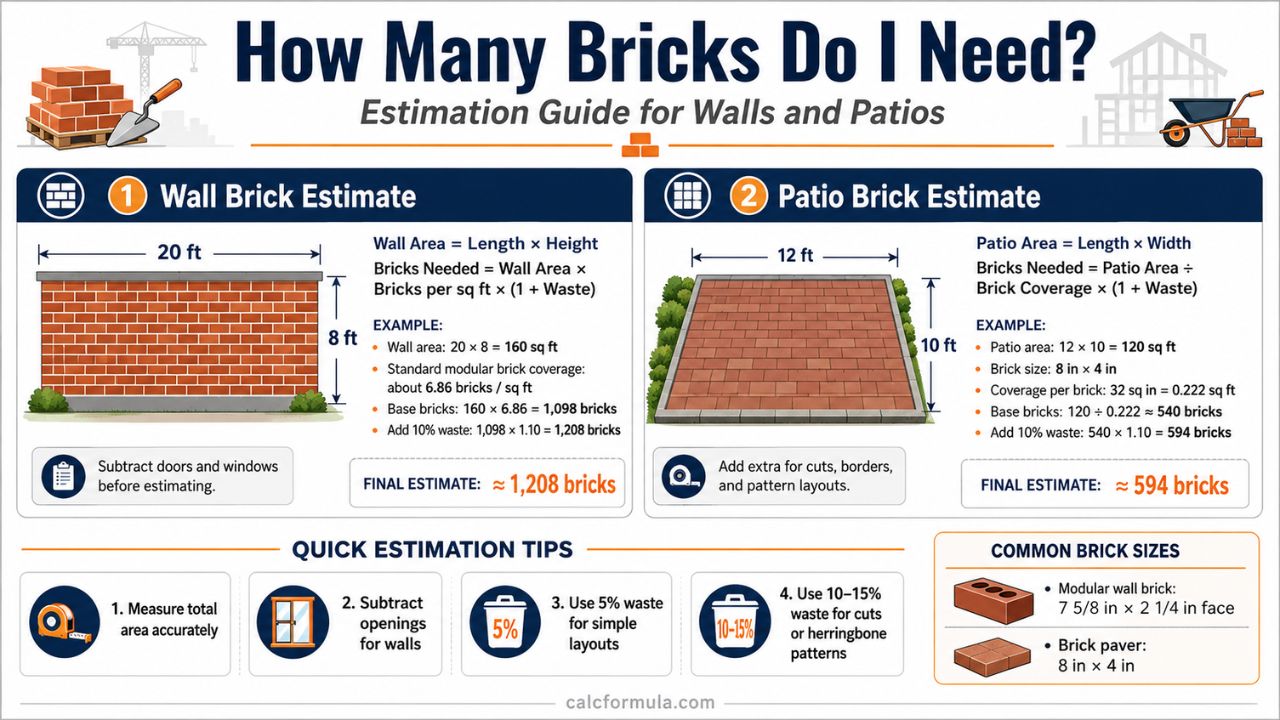
The question sounds simple. You’ve got a wall to build or a patio to lay — how many bricks do you buy? But anyone who’s stood in a masonry supplier’s yard, order sheet in hand, knows the follow-up questions come fast: Which brick size? What mortar joint width? What pattern are you running? Single or double wythe? Is that patio sand-set or mortared?
Every one of those answers changes your brick count. Sometimes by 5%. Sometimes by 25%.
This guide works through the real estimation process — not just the formula, but the variables that make or break the formula. We’ll cover walls, patios, piers, corners, bond patterns, waste factors, and mortar. And if you want your final number without the manual math, the Brick Calculator runs the full calculation instantly based on your actual project dimensions.
Start Here: Brick Sizes Actually Vary More Than You Think
The single biggest source of estimation error in brickwork is assuming all bricks are the same size. They’re not — and the differences compound across hundreds or thousands of units.
In the US, the most common brick types you’ll encounter:
| Brick Type | Actual Dimensions (W × H × L) | Nominal With 3/8″ Joint | Bricks per sq ft (running bond) |
|---|---|---|---|
| Standard | 3-5/8″ × 2-1/4″ × 7-5/8″ | 4″ × 2-2/3″ × 8″ | ~6.75 |
| Modular | 3-5/8″ × 2-1/4″ × 7-5/8″ | 4″ × 2-2/3″ × 8″ | ~6.75 |
| Queen | 3″ × 2-3/4″ × 9-5/8″ | 3-1/8″ × 3-1/8″ × 10″ | ~5.5 |
| King | 3-5/8″ × 2-5/8″ × 9-5/8″ | 4″ × 3″ × 10″ | ~5.3 |
| Jumbo Standard | 4″ × 2-3/4″ × 8″ | 4-1/2″ × 3-1/8″ × 8-5/8″ | ~5.2 |
| Norman | 3-5/8″ × 2-1/4″ × 11-5/8″ | 4″ × 2-2/3″ × 12″ | ~4.5 |
| Utility | 3-5/8″ × 3-5/8″ × 11-5/8″ | 4″ × 4″ × 12″ | ~3.0 |
Standard and Modular bricks are dimensionally the same — the terminology refers more to manufacturing and coursing standards. For most residential projects in the US, “standard” is what you’ll find at local suppliers and what most DIY guides assume. If you’re buying from a specialty supplier or matching existing brickwork, confirm the actual dimensions before calculating anything.
One more thing: brick dimensions are actual size (the physical brick) versus nominal size (the brick plus one mortar joint). When estimators talk about “a 4×8 brick,” they mean nominal. The physical unit is 3-5/8″ × 7-5/8″. This distinction matters when you’re calculating coursing heights and checking against a fixed wall dimension.
Mortar Joint Width: The Variable Nobody Talks About
Mortar joint width has a bigger effect on brick count than most people expect, because it compounds across every single course and every single column of bricks.
Standard joints for face brick are 3/8 inch. That’s the specification written into most building codes and the number used in brick-per-square-foot tables. But:
- 3/8″ joints — standard for most face brick, smooth wall appearances, tight coursing
- 1/2″ joints — common for rough-textured brick, rustic styles, or when slight size variation in the brick makes 3/8″ impractical
- Dry-stack (no mortar) — used for some retaining walls with specific interlocking systems; brick count increases significantly because you lose the joint spacing
- Sand-set patios (butt joints) — bricks touch or near-touch; this is a completely different count than a mortared patio
Here’s why this matters numerically. A standard brick at 3/8″ joints gives you approximately 6.75 bricks per square foot of wall face. Switch to 1/2″ joints and that drops to about 6.4 bricks per square foot — roughly 5% fewer bricks for the same area. On a 200-square-foot wall, that’s 70 bricks. On a 1,000-square-foot project, the difference in your order is meaningful.
Most residential brick suppliers assume 3/8″ joints in their coverage tables. If you’re using a different joint width, adjust accordingly — or use a calculator that lets you specify joint width explicitly.
Estimating Bricks for a Wall: The Full Process
Let’s work through a wall estimate properly, with a real example: a 40-foot long, 4-foot tall garden wall, single wythe (one brick thick), standard brick at 3/8″ mortar joints, running bond pattern.
Step 1: Calculate the Gross Wall Area
Wall area = Length × Height
Wall area = 40 ft × 4 ft = 160 sq ft
Step 2: Subtract Openings
Gates, doorways, windows, or intentional gaps all reduce your brick count. If our wall has a 4-foot gate opening:
Opening area = 4 ft wide × 4 ft tall = 16 sq ft
Net wall area = 160 – 16 = 144 sq ft
Don’t skip this step. A common error is ordering for the gross area and ending up with 10–15% more brick than needed on a wall with multiple openings.
Step 3: Apply the Brick Coverage Rate
For standard brick at 3/8″ joints in running bond:
Brick count = Net area × 6.75 bricks per sq ft
Brick count = 144 × 6.75 = 972 bricks
Step 4: Account for Wall Thickness
A single wythe wall (one brick width) is fine for garden walls and low retaining walls. But a standard brick is only 3-5/8″ thick — not enough for most structural applications. Wall thickness changes your calculation significantly:
| Wall Type | Thickness | Multiplier vs. Single Wythe | Notes |
|---|---|---|---|
| Single wythe (stretcher) | ~4″ | 1× | Garden walls, decorative borders |
| Double wythe | ~8″ | ~2× + header courses | Residential structural walls, freestanding walls |
| Brick veneer over block | 4″ brick face + block core | 1× bricks + block separately | Most common for residential exteriors |
| Soldier course (cap) | N/A — single row on edge | Count by linear foot | Wall caps, windowsill accents |
For a double wythe wall, a traditional approach uses header courses — every 6th or 7th course is a header course where bricks are turned perpendicular to tie the two wythes together. This changes the brick orientation and effectively doubles your brick consumption while adding structural integrity. Header-bond patterns also affect your material estimate, which is another reason to verify with a project-specific calculation.
Step 5: Add Waste
Waste in brickwork comes from cuts, chips, rejects, and the brick you drop on concrete. The standard waste factor depends on pattern complexity:
- Running bond (straight wall): 5–8% — minimal cuts except at openings and corners
- Flemish or English bond: 8–12% — alternating header/stretcher courses require more cuts
- Stack bond: 5% — simple pattern, but structurally weak (requires significant rebar reinforcement)
- Herringbone (patio): 15–20% — diagonal cuts at all four borders
- 45° diagonal pattern: 20–25% — every edge row requires 45° cuts
For our garden wall in running bond:
972 × 1.07 (7% waste) = 1,040 bricks → order 1,050 to round to a practical supplier quantity
Run the same calculation for your exact dimensions — and any pattern complexity — using the Brick Calculator. It accounts for bond pattern, joint width, and waste in one pass.
Estimating Bricks for a Patio: Different Animal Entirely
Patio estimation diverges from wall estimation in several important ways. Bricks lie flat rather than standing vertically, which means a completely different face is exposed. You have two distinct installation methods with different brick counts. And patterns matter more aesthetically — which directly affects your waste factor and therefore your order quantity.
Sand-Set Patios vs. Mortared Patios
This is the first decision that changes your math.
Sand-set (dry-laid): Bricks rest on a compacted sand bed, joints are filled with polymeric sand or fine-grade sand. No mortar joint gap between bricks — they’re set tight (or with a 1/8″ finger gap). This means more bricks per square foot than a mortared surface, but also a more forgiving installation and a patio that can be disassembled and reset if the base shifts.
Mortared patio: Bricks are set in mortar on a concrete slab base, with tooled mortar joints (typically 3/8″). Fewer bricks per square foot, but requires a poured concrete substrate — adding significant cost and complexity. More permanent and flatter, which matters for drainage and usability.
| Installation Method | Joint Width | Standard Bricks per Sq Ft (flat-laid, stretcher face up) |
|---|---|---|
| Sand-set, tight-laid | 0–1/8″ | ~4.7 |
| Sand-set with sand joints | 1/8″–3/16″ | ~4.5 |
| Mortared on concrete | 3/8″ | ~4.0 |
| Mortared on concrete | 1/2″ | ~3.8 |
Patio Patterns and Their Real Waste Implications
The pattern you choose determines how much of every brick you use vs. cut off and discard at the edges. This is where a lot of DIY estimates go sideways — someone calculates area × bricks per sq ft, adds 5% waste, and then cuts 20% of their border bricks in half for a herringbone pattern and runs short.
Running bond (horizontal rows, staggered half-brick): The simplest and most forgiving. Cuts happen only at two opposite border edges. A 5–8% waste factor is realistic.
Jack-on-jack (stack bond, aligned grid): Minimal cuts, but this pattern has no inherent strength and shifts easily in a sand-set application. Fine for small areas with edging restraints. 5% waste.
Herringbone (45° or 90°): 90° herringbone cuts bricks in half at borders — moderately wasteful. 45° herringbone means every single brick at every border is cut at a 45° angle — dramatically more wasteful. Budget 15% for 90° herringbone and 20–22% for 45°. These cuts also take time: if you’re renting a wet saw, factor in the hours.
Basketweave: Pairs of bricks alternating horizontal and vertical. Looks complex but actually cuts only at borders. 8–10% waste. Popular for patios because it reads as more formal without the high waste of herringbone.
Pinwheel: Groups of four bricks around a center brick. Requires precise brick size consistency — tolerance variation makes this difficult. 10–12% waste, plus a higher rejection rate for size variance.
Running bond at 45°: Diagonal rows from corner to corner. Every single border requires cuts. 18–22% waste. Visually dynamic but expensive in material terms on large patios.
Full Patio Example: 16 × 20 Foot Mortared Patio in 90° Herringbone
Patio area: 16 ft × 20 ft = 320 sq ft
Subtract any permanent features (fire pit pad, planter base): –0 sq ft (none in this example)
Net area: 320 sq ft

Bricks per sq ft (mortared, 3/8" joints): 4.0
Base count: 320 × 4.0 = 1,280 bricks

Herringbone at 90°, waste factor: 15%
1,280 × 1.15 = 1,472 bricks

Add soldier border course (single row on edge around perimeter):
Perimeter = (16 + 20) × 2 = 72 linear feet
Standard brick laid as soldier = 3 bricks per linear foot (approx.)
72 × 3 = 216 additional bricks

Total: 1,472 + 216 = 1,688 bricks
Order: 1,700 bricks
That soldier border course addition is easy to miss if you’re just calculating the interior area. Decorative edging, soldier courses, and rowlock caps all consume bricks at rates that don’t match the main field calculation — always tally them separately.
Corners, Piers, and Other Details That Eat More Brick Than Expected
Corners
At every corner in a running bond wall, you lose approximately half a brick per course to maintain the bond pattern — one wythe runs long and the other short, alternating by course. For a 4-foot wall (approximately 18 courses of standard brick at 3/8″ joints), that’s 18 additional half-bricks per corner, or roughly 9 extra full bricks per corner in cuts and off-cuts. Not a huge number, but worth adding to your estimate on walls with multiple corners.
Brick Piers
Freestanding piers for gates or fence posts follow a separate calculation entirely. A standard 12″ × 12″ pier (the most common residential size) uses 4 bricks per course in alternating patterns. At 6 courses per vertical foot, a 4-foot pier = 24 courses × 4 bricks = 96 bricks per pier. That’s a significant number — two gate piers alone consume nearly 200 bricks before you’ve built an inch of wall.
Rowlock Courses (Wall Caps)
A rowlock course — bricks laid on edge with the long face exposed — is a common decorative wall cap. It provides a finished top to the wall and sheds water better than a flat-laid cap. One rowlock course requires approximately 4.5 bricks per linear foot (the brick is laid on its long edge, 2-1/4″ face visible, so you need more bricks per foot than a normal stretcher course). A 40-foot wall cap = 180 additional bricks before waste.
Mortar: How Much Do You Actually Need?
Bricks without mortar are just a pile of masonry units. Mortar estimation is the second part of any brick order, and it’s consistently underestimated because people focus on the bricks and treat the mortar as an afterthought.
Understanding Mortar Mix Ratios
Masonry mortar is not the same as concrete mix, and it’s not the same as general-purpose cement. The three components are Portland cement, hydrated lime, and masonry sand — in ratios that vary by mortar type:
| Mortar Type | Portland Cement | Hydrated Lime | Masonry Sand | Compressive Strength | Best Used For |
|---|---|---|---|---|---|
| Type M | 1 part | 1/4 part | 3 parts | 2,500 psi | Below-grade, retaining walls, heavy loads |
| Type S | 1 part | 1/2 part | 4.5 parts | 1,800 psi | Exterior walls, patios, driveways — the residential standard |
| Type N | 1 part | 1 part | 6 parts | 750 psi | Above-grade interior walls, soft brick, non-structural |
For most exterior residential projects — patios, garden walls, retaining walls, veneer — Type S is the right choice. It’s strong enough for freeze-thaw cycling, flexible enough to resist cracking from minor movement, and compatible with most common brick types.
Type M is stiffer and stronger, which sounds better but isn’t always — a mortar that’s stronger than the brick it’s bonding can actually cause brick faces to spall under stress, because the mortar won’t absorb movement that the system needs to accommodate. This is a real-world failure mode in historic brick restoration when inappropriate high-strength mortars are used with soft antique brick.
Mortar Volume Calculations
A practical rule of thumb: for standard brick at 3/8″ joints, you’ll use approximately 0.3 cubic feet of mortar per square foot of wall for a single wythe. That includes bed joints, head joints, and a standard amount of waste from tooling and squeeze-out.
For our 144 sq ft net wall area example:
Mortar needed: 144 × 0.3 = 43.2 cubic feet
Add 10–15% for waste: 43.2 × 1.12 = 48.4 cubic feet
Pre-mixed mortar bags (Type S, 60-lb bags) yield approximately 0.45 cubic feet per bag when mixed.
Bags needed: 48.4 ÷ 0.45 ≈ 108 bags (60-lb Type S)
For large projects, it’s more economical to buy components separately (Portland cement, lime, sand) and mix in a mortar mixer or rented mixer. The Cement Calculator can work out your component quantities for custom mix ratios — useful when you’re buying bulk sand and bagged Portland cement separately rather than pre-blended mortar.
Mortar Coverage by Brick Count (Quick Reference)
| Number of Bricks | Approximate Mortar Volume | Pre-mixed 60-lb Bags (Type S) |
|---|---|---|
| 100 bricks | ~4.5 cu ft | ~10 bags |
| 250 bricks | ~11 cu ft | ~25 bags |
| 500 bricks | ~22 cu ft | ~49 bags |
| 1,000 bricks | ~45 cu ft | ~100 bags |
| 2,000 bricks | ~90 cu ft | ~200 bags |
These are working approximations for standard brick at 3/8″ joints. Thicker joints, larger bricks, or double-wythe construction will increase mortar consumption proportionally.
The Brick Ordering Mistake That Ruins Projects: Batch Consistency
Here’s something that doesn’t appear in any formula but comes from hard experience watching projects go wrong: brick color varies between production batches. The same SKU from the same manufacturer can look noticeably different between a batch made in April and one made in September. Kiln temperature variations, raw material source changes, and firing duration all contribute.
The consequence: if you underestimate your brick count and have to reorder mid-project, the new bricks may not match the ones already in the wall. You’ll see it immediately — a band of slightly different color where the new material starts. Some variation weathers out over years; some doesn’t.
Always order more than your calculated need on the first order. A 10% buffer isn’t just about cuts and breakage — it’s insurance against needing a second run. Any unused whole bricks from a good supplier can often be returned; a mismatched wall cannot be unbuilt.
When you pick up or receive delivery, check the batch numbers on the pallets before they’re unloaded. Reputable suppliers will pull from the same batch if you request it. If multiple pallets arrive with different batch numbers, flag it immediately — don’t find out on day three of laying.
Weight and Delivery: The Logistics Most Guides Skip
Bricks are heavy. A standard brick weighs approximately 4.5 pounds. A typical pallet holds 500–525 bricks and weighs around 2,400–2,600 pounds. This matters in several practical ways:
- Delivery vehicle access: Most masonry suppliers deliver on flatbed trucks with a pallet jack or boom crane. If your jobsite doesn’t have easy access, you may need to hand-offload, or pay for a smaller vehicle.
- Staging location: A pallet of bricks weighs more than most residential driveways are designed for long-term. Get it off the apron and onto the lawn or gravel if you can.
- Personal vehicle limits: Tempting to save delivery cost by picking up yourself? Your pickup truck’s payload capacity is real. 1,000 bricks = 4,500 lbs. Very few half-ton trucks can legally carry that in a single load.
- Labor planning: An experienced mason lays approximately 300–500 standard bricks per day on straightforward work. More complex patterns or difficult site conditions reduce that significantly. Factor this into your project timeline before scheduling the concrete pour for the patio base.
6 Brick Estimation Mistakes That Cost You Money
1. Using Gross Area Without Subtracting Openings
Every door, gate, window, or built-in planter you fail to subtract is money you’re paying for bricks you don’t need. On a project with multiple openings, this adds up fast.
2. Applying the Wrong Waste Factor for Your Pattern
Using 5% waste on a herringbone patio is how you end up making an emergency run to the supplier and gambling on batch matching. Know your pattern’s actual waste rate before you order.
3. Forgetting Soldier Courses, Caps, and Border Details
The main field calculation is where people focus, but decorative details often consume 10–20% of total bricks on a well-finished patio or wall. Tally them separately.
4. Not Specifying Brick Size to the Supplier
“A pallet of red brick” will get you whatever they have. If you’ve calculated based on standard (7-5/8″ long) bricks and they deliver Norman bricks (11-5/8″ long), your entire layout and joint spacing calculation is wrong.
5. Underestimating Mortar
Running out of mortar mid-job is almost as bad as running out of bricks. Mixed mortar has a working time of 2–2.5 hours before it stiffens — you can’t save unused mix. Buy enough bags, work in manageable batches, and don’t be surprised when you go through material faster than expected on hot or windy days when evaporation speeds set time.
6. Using Concrete Mix Instead of Masonry Mortar
These are not interchangeable. Concrete mix has aggregate (gravel) in it — you’ll see chunks in your joints and the mix won’t behave properly. Masonry mortar uses only fine sand, which is why it flows into thin joints and bonds to brick faces cleanly. The bags look similar at the big-box store. Read the label.
Quick Reference: Bricks Needed for Common Projects
These estimates are based on standard US brick (3-5/8″ × 2-1/4″ × 7-5/8″), 3/8″ mortar joints, running bond pattern for walls, flat-laid for patios with 3/8″ joints, and a 7% waste factor. Use them as sanity checks, not final order quantities — your actual dimensions and pattern may differ.
| Project | Dimensions | Estimated Bricks | Notes |
|---|---|---|---|
| Garden wall, single wythe | 20 ft × 3 ft | ~435 | No openings |
| Garden wall, single wythe | 40 ft × 4 ft | ~870 | No openings |
| Small patio, running bond | 10 ft × 12 ft | ~515 | Mortared, no border |
| Standard patio, running bond | 16 ft × 20 ft | ~1,370 | Mortared, with soldier border |
| Large patio, herringbone 45° | 20 ft × 24 ft | ~2,240 | 20% waste factor applied |
| Driveway apron | 12 ft × 20 ft | ~1,030 | Mortared, running bond |
| Gate piers (pair) | 12″ × 12″ × 48″ tall | ~200 | 4 bricks/course, 24 courses each |
| Raised garden bed | 8 ft × 4 ft × 2 ft tall | ~325 | Single wythe, no cap |
For your specific project — including irregular shapes, mixed patterns, or custom joint widths — the Brick Calculator will give you a precise count with waste factored in. Pair it with the Cement Calculator to get your mortar component quantities in the same session.
Frequently Asked Questions
How many bricks do I need per square foot?
For standard US brick in running bond with 3/8″ mortar joints on a vertical wall: approximately 6.75 bricks per square foot. For flat-laid patio bricks with 3/8″ joints: approximately 4.0 per square foot. These numbers shift based on brick size, joint width, and bond pattern — see the tables above for adjusted rates.
How many bricks are in a pallet?
Most suppliers palletize standard bricks at 500–525 per pallet. Some large-format bricks come 250–300 per pallet. Verify with your specific supplier — pallet quantities vary and affect your order planning significantly. Always confirm the batch number matches across multiple pallets before unloading.
How do I calculate bricks for a curved wall?
For a gradual curve (long radius), treat it as a series of short straight sections and sum them. For tight curves, you’ll need to factor in that brick cuts become much more frequent — each brick must be tapered slightly, either by cutting on a wet saw or by using narrower mortar joints on the inside of the curve. Tight-radius curved walls are mason’s work; the material waste in cuts alone can reach 25–30%.
What’s the difference between Type S and Type N mortar for bricklaying?
Type S is the residential exterior standard — high enough compressive strength for freeze-thaw cycling and lateral loads, with enough lime content for flexibility and workability. Type N has more lime (softer, more flexible) and is appropriate for interior work or non-structural above-grade applications with soft brick. For most outdoor walls and patios, Type S is the right call. When in doubt, Type S over Type N — the extra strength is a low-cost insurance policy.
Can I reuse old bricks, and do they calculate the same?
Old bricks from demolition are a good source of material for projects where character and patina matter. However, they almost certainly aren’t exactly the same size as modern standard brick — tolerance variation was higher in older manufacturing. Measure a representative sample before calculating, not just one or two bricks. Also check for previous mortar adhesion: old mortar on face surfaces affects bond quality and appearance. Acid washing removes it, but that’s additional labor and cost to factor in.
How much does a brick patio cost in materials?
At current pricing, standard face bricks typically run $0.50–$1.50 per unit depending on region, quality, and quantity. Premium or specialty bricks can reach $3–$5 per unit. For a 320 sq ft mortared patio using ~1,300 bricks at $0.80 each, brick material alone is around $1,040. Add mortar (~$250–$400 for pre-mixed bags), the concrete slab base (use the Cement Calculator to estimate that separately), and delivery. Total material cost for a mid-range mortared patio typically runs $8–$18 per square foot before any labor.
What’s the easiest brick pattern for a DIY patio?
Running bond — straight rows with half-brick offsets — is the most forgiving for beginners. Cuts happen only at two border edges, the pattern is self-correcting if you drift slightly, and it’s fast to lay. Basketweave is a step up in visual complexity with only marginally more difficulty. Save herringbone and diagonal patterns for when you’re comfortable with a wet saw and have the patience for precise layout work — they look exceptional when done well and obviously wrong when they’re not.
Should I seal a brick patio?
For mortared patios in freeze-thaw climates: a penetrating masonry sealer applied after the mortar has cured (28 days minimum) reduces water infiltration and slows the spalling cycle. Use a breathable penetrating sealer, not a film-forming sealer — trapped moisture is more damaging than surface moisture. For sand-set patios, polymeric sand in the joints does more work than sealing the brick faces. Don’t seal before the mortar is fully cured; sealing can trap curing gases and cause efflorescence (the white salt bloom that makes new brickwork look patchy).
The Pre-Order Checklist
Before you submit a brick and mortar order, confirm these:
- Brick dimensions confirmed (actual, not nominal) — and verified with supplier’s product sheet
- Gross area calculated, openings subtracted, net area established
- Pattern selected — waste factor applied appropriately (not a flat 10% on everything)
- Soldier courses, caps, border details, and piers tallied separately and added to total
- Wall thickness confirmed — single or double wythe changes the calculation entirely
- Joint width confirmed — 3/8″ is standard; verify this is what you’re planning before using standard coverage tables
- Buffer added (minimum 10%, more for complex patterns and on first-time projects)
- Pallet batch numbers requested from supplier — same batch across all pallets
- Mortar type specified (Type S for most exterior work) and quantity calculated separately
- Cement and component quantities confirmed via the Cement Calculator if mixing from components
- Delivery access confirmed — weight, vehicle size, unloading method
- Return policy confirmed — unused whole bricks, restocking fees, time limit
Final Word
Getting your brick count right is less about the formula and more about knowing which variables actually move the number. Brick size, joint width, bond pattern, and wall thickness all matter — and they all interact. The formula without those inputs is just math with a wrong answer.
Take the time to confirm your brick dimensions with your supplier, choose your pattern before you calculate (not after), and always order more than your bare minimum. The batch-matching risk alone justifies a 10% buffer on any visible exterior project. Spend extra at the front end of the project, return what you don’t use, and avoid spending four times as much trying to fix a material mismatch that’s already mortared in place.
Use the Brick Calculator to get your precise unit count, and run your mortar components through the Cement Calculator to close out your full materials list before you order anything.