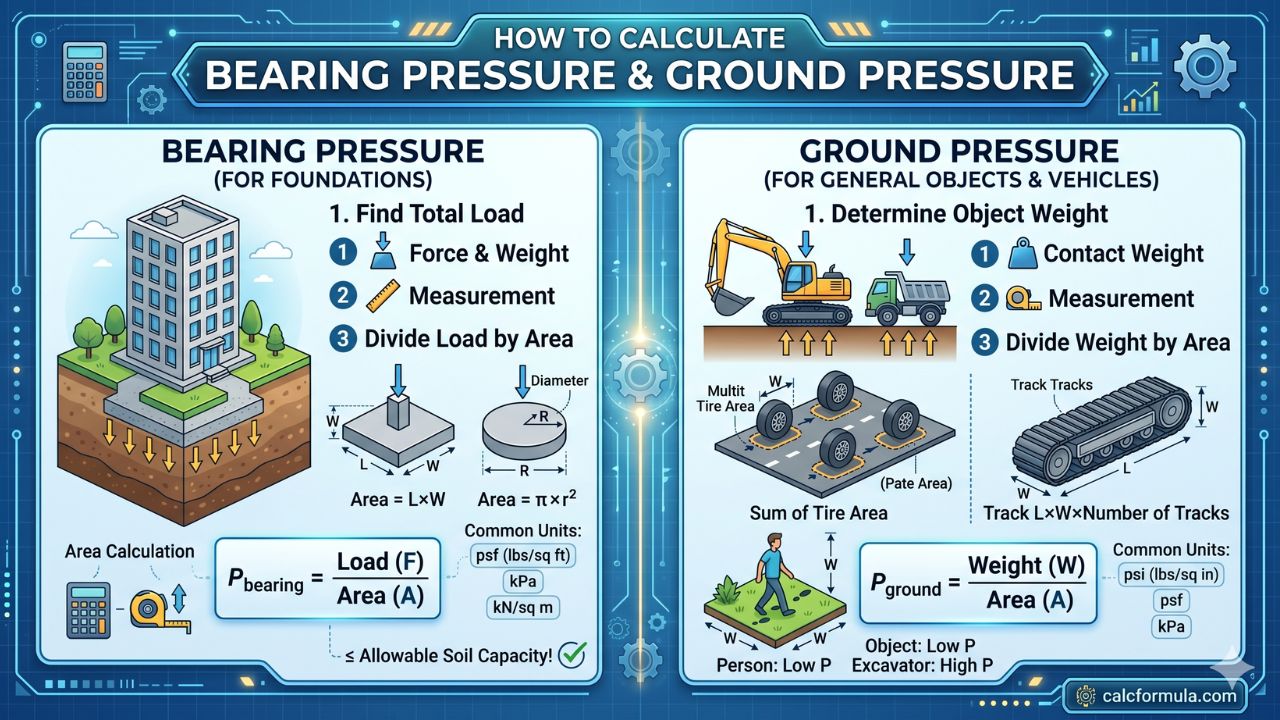
Bearing pressure and ground pressure describe how a load spreads across a contact area - whether that load comes from a footing sitting on soil, a crane outrigger pad resting on fill, a retaining wall base, or heavy equipment moving across a site.
Both values are expressed as force per unit area (typically pounds per square foot or kips per square foot) and tell you whether the ground beneath a structure or machine can carry what is placed on it without shearing, settling, or failing.
Getting this number right is fundamental to foundation design, temporary works planning, and equipment deployment. The Ground Pressure Calculator handles equipment and distributed contact loads, while the Bearing Pressure Calculator focuses on structural footing and foundation loads.
Neither replaces a geotechnical engineer's assessment - always verify calculated values against project drawings, soil investigation reports, and local design requirements.
What the Pressure Diagram Is Actually Showing
The diagram above shows the core concept: a column transfers its load P down through a footing into the soil. That load does not stay concentrated - it spreads across the full contact area A of the footing base. Bearing pressure q is simply how hard the footing is pushing against the soil at that interface, measured in pounds per square foot (psf) or kips per square foot (ksf).
Ground pressure follows the same principle but is applied to equipment - a crane with outrigger pads, a crawler track, or a loaded vehicle. The contact area is the pad or track footprint, and the total load is the machine weight plus any lifted load. In both cases, the calculated pressure must stay below the allowable bearing capacity of the soil beneath, otherwise settlement or shear failure can occur.
The Core Formulas
Formula Reference
Bearing / Ground Pressure
q = P ÷ A
| Symbol | Meaning | Common Units |
|---|---|---|
| q | Bearing or ground pressure | psf, ksf, kPa |
| P | Total applied load | lbs, kips, kN |
| A | Contact area (footing base or pad footprint) | ft², m² |
Contact Area (Rectangular)
A = B × L
B = footing width (ft) | L = footing length (ft)
Contact Area (Circular)
A = π × r²
r = radius (ft)
Eccentric Load (Moment Present)
q_max = (P ÷ A) + (M ÷ S)
M = moment (ft·lbs) | S = section modulus of footing base (ft³) = B × L² ÷ 6
Units and Conversions That Cause Real Errors
Bearing pressure calculations break down most often because load and area units don't match. A load in kips divided by an area in square inches gives a completely different number than the same load divided by square feet. Always convert to a consistent unit system before dividing.
| Convert From | Convert To | Multiply By | Notes |
|---|---|---|---|
| Inches | Feet | ÷ 12 | Convert footing dimensions before computing area |
| Square inches | Square feet | ÷ 144 | Critical for pad/plate area conversions |
| Pounds (lbs) | Kips | ÷ 1,000 | Structural loads commonly stated in kips |
| Kips | Pounds | × 1,000 | |
| Tons (short) | Pounds | × 2,000 | Equipment weights often given in short tons |
| kN (kilonewtons) | kips | ÷ 4.448 | SI to US customary |
| kPa | psf | × 20.885 | Useful when geotech report is in SI units |
| ksf | kPa | × 47.88 |
Step-by-Step Worked Example
🧮 Worked Example - Spread Footing Under Column
Inputs
- Column axial load: 120 kips
- Footing size: 5 ft × 5 ft (rectangular)
- Footing self-weight: 3 kips (assumed for this example)
- No moment - load is concentric
Step 1 - Total Load
P = 120 kips + 3 kips = 123 kips
Step 2 - Contact Area
A = 5 ft × 5 ft = 25 ft²
Step 3 - Bearing Pressure
q = P ÷ A = 123 kips ÷ 25 ft² = 4.92 ksf
In psf: 4.92 × 1,000 = 4,920 psf
Step 4 - Interpret the Result
The footing is applying approximately 4.92 ksf to the soil surface. This must be compared against the allowable bearing capacity from a geotechnical report. A typical allowable value for medium-dense sand might be 3-5 ksf - but that figure must come from actual soil testing, not a generic table.
Key assumption that changes the answer: If footing self-weight is ignored, q drops to 4.80 ksf. If the footing is enlarged to 6 ft × 6 ft (A = 36 ft²), q drops to about 3.42 ksf. Footing size is the most direct lever to reduce bearing pressure.
Load Types and How the Contact Area Changes
| Load / Structure Type | Contact Area Definition | Formula Used | Notes |
|---|---|---|---|
| Square spread footing | B × B | q = P ÷ B² | Simplest case; concentric load assumed |
| Rectangular footing | B × L | q = P ÷ (B × L) | Common under wall columns |
| Circular footing / pier | π × r² | q = P ÷ (π × r²) | Round columns, drilled piers at surface |
| Wall footing (strip) | B × 1 ft (per foot of wall) | q = P/ft ÷ B | Load expressed per linear foot of wall |
| Crane outrigger pad | Pad width × pad length | q = reaction ÷ Apad | Reaction from crane load chart; pad may be timber or steel |
| Crawler track | Track contact length × track width × 2 | q = machine weight ÷ Atrack | Only the portion of track actually on ground counts |
| Eccentric / moment load | Effective area (reduced by eccentricity) | qmax = P/A + M/S | Used where wind, seismic, or offset loads create moment |
Safety Factors and Allowable Bearing Capacity
Calculating bearing pressure gives you the applied stress. To know whether the ground can handle it, you need the allowable bearing capacity - a value that must come from a geotechnical investigation or a site-specific assessment. Applied bearing pressure must stay below this allowable value with an appropriate factor of safety, commonly 2.0 to 3.0 depending on load type and consequence of failure.
Soil type governs what's achievable. Dense gravel and competent rock can carry 8,000-20,000+ psf. Stiff clay might allow 3,000-5,000 psf. Soft clay or loose fill may permit only 500-2,000 psf. These are illustrative ranges only - never use generic ranges to approve a design. Always check against the project's geotechnical report. Site conditions such as groundwater depth, fill history, organic content, or nearby excavations can all reduce the effective bearing capacity below published typical values.
For equipment and temporary works, the approach is similar: compare calculated ground pressure against the rated bearing capacity at the deployment location. Crane manufacturers publish outrigger reaction loads and require the site to provide a certified bearing surface. Using larger outrigger pads directly increases the contact area and reduces ground pressure proportionally.
Common Calculation Mistakes
⚠️ Mixing Unit Systems
Entering load in kips and area in square inches gives pressure in kips per square inch (ksi), not ksf. Convert area to ft² or load to lbs before dividing. This single mistake can produce a result that is 144× off.
⚠️ Ignoring Footing Self-Weight
The footing itself adds load to the soil. A 5 ft × 5 ft × 1.5 ft concrete footing weighs roughly 5,600 lbs. Omitting it undercalculates the applied pressure, which may lead to undersized footings.
⚠️ Using Gross Area for Equipment Tracks
The full nominal track length is not all in contact with the ground. Only the flat, loaded portion counts. Using the full track length underestimates ground pressure and may exceed safe limits on soft ground.
⚠️ Treating All Soil Types the Same
Plugging the same allowable bearing capacity into every scenario ignores soil variability. Fill, disturbed soil, and clay near saturation behave very differently from undisturbed dense granular soil. Check the geotechnical report for each location.
⚠️ Ignoring Moment Under Eccentric Loads
When a load is not centred on the footing - due to wall offset, wind, or equipment swing - the pressure is not uniform. Using q = P/A alone misses the peak pressure at the toe, which can be significantly higher than the average.
⚠️ Confusing Net and Gross Bearing Pressure
Gross bearing pressure includes the weight of overburden soil above the footing base. Net bearing pressure subtracts it. Geotechnical reports often state allowable net pressure. Using net capacity against gross applied pressure leads to errors.
⚠️ Short-Term vs. Long-Term Capacity
Clay soils have different undrained (short-term) and drained (long-term) bearing capacity. A load that passes the short-term check may still cause long-term consolidation settlement. This distinction matters for permanent structures on cohesive soils.
⚠️ Not Accounting for Load Combinations
Dead load alone may pass the bearing check, but dead load plus live load plus wind may not. Always use the critical combined load case when calculating applied bearing pressure. Structural drawings specify the applicable load combinations.
Choosing the Right Calculator
| Your Need | Use This Calculator | Why |
|---|---|---|
| Find the pressure a spread footing, wall footing, or foundation base exerts on the soil | Bearing Pressure Calculator | Designed for structural foundation loads - inputs include load, footing dimensions, and moment |
| Find the pressure a crane, crawler, vehicle, or outrigger pad places on the ground surface | Ground Pressure Calculator | Suited for equipment loads - inputs include machine weight, lifted load, and contact footprint area |
| Check whether an outrigger pad of a given size is adequate for a given crane reaction | Ground Pressure Calculator | Enter pad dimensions and known outrigger reaction to get ground pressure; compare to soil capacity |
| Size a rectangular footing to keep pressure under an allowable limit | Bearing Pressure Calculator | Adjust footing dimensions until calculated pressure is at or below allowable; check against geotech report |
What These Calculations Cannot Tell You
⛔ Calculation Limitations
- The formula assumes a uniform pressure distribution. Real soils produce non-uniform stress beneath footings, especially under eccentric or moment loads.
- Calculated bearing pressure is only as good as the load input. Using estimated or unfactored loads will produce unreliable results.
- The calculator does not know the soil bearing capacity at your site. That must come from a geotechnical report, test borings, or a qualified engineer's assessment.
- These formulas do not account for settlement. A footing may not fail in shear but may still settle excessively, particularly on soft clays or loose fills.
- Equipment ground pressure calculations assume the full load acts through the pad or track. Dynamic effects (starts, stops, swings) can increase effective load and are not included here.
- The formula does not apply to pile foundations or deep footings where the load transfer mechanism is side friction and end bearing, not direct surface pressure.
- Ground improvements, compaction grouting, or geosynthetic reinforcement beneath the footing will change the effective capacity - the formula alone does not capture this.
- Always verify results against project drawings, geotechnical investigation reports, and applicable building codes before use in design decisions.
Frequently Asked Questions
What is the difference between bearing pressure and bearing capacity?
Bearing pressure () is what you calculate - the load your footing or equipment is applying to the soil per unit area. Bearing capacity is what the soil can resist - usually established from field tests (SPT, CPT) or lab testing and reported in a geotechnical investigation. For a design to work, applied bearing pressure must be less than or equal to the allowable bearing capacity, which typically has a factor of safety already built in.
What units should I use in the calculator?
Use a consistent unit set throughout. The most common for US construction is: load in kips (thousands of pounds), area in square feet (ft²), giving pressure in ksf (kips per square foot). Alternatively, load in lbs and area in ft² gives psf. Avoid mixing kips and square inches unless you intentionally want ksi. The calculators on this site use ft² for area and lbs or kips for load - confirm the active unit before entering values.
Does footing depth affect bearing pressure?
Footing depth affects the allowable bearing capacity (deeper footings reach denser soil and benefit from more overburden confinement) but does not appear in the basic bearing pressure formula . The formula calculates the pressure at the footing base contact plane only. Depth is accounted for separately in the geotechnical design, not in this formula.
How do I calculate ground pressure for a crawler crane?
Enter the total machine weight plus any load being lifted, divided by the total track contact area. Track contact area is approximately: track shoe width × contact length (the portion of track flat on the ground) × 2 tracks. Manufacturer specifications often provide a ground bearing pressure directly for given machine configurations - always cross-check your calculation against the manufacturer's rated values and the actual site soil conditions.
What if my load is not centred on the footing?
An eccentric load creates a moment at the footing base. Use the formula: where is the moment (load × eccentricity distance) and is the section modulus of the footing base ( for bending about the L-direction). The maximum pressure at the toe will exceed the average, and this peak value must be kept below the allowable bearing capacity. If the eccentricity is large enough, tension can develop on the heel side - a concrete footing cannot handle tension from the soil, so the effective area must be recalculated.
How does groundwater affect bearing capacity?
Groundwater reduces the effective stress in the soil, which reduces its shear strength and therefore its bearing capacity. If the water table is at or near the footing depth, allowable bearing capacity values for granular soils can be reduced by as much as 50% compared to dry conditions. This is a geotechnical engineering determination - the bearing pressure formula itself is unchanged, but the allowable value you compare against will be lower. This is one of the most important reasons to get an up-to-date geotechnical report rather than relying on published generic tables.
Can I use the same formula for temporary works and permanent structures?
Yes, the formula is the same. However, the allowable bearing capacity applied to temporary works (shoring, crane pads, falsework) may differ from permanent design values. Temporary works often use short-term or undrained soil strength values. Some engineers apply a reduced factor of safety for temporary loading. These distinctions should be confirmed with the project's geotechnical recommendations and the applicable temporary works design standard.
My geotechnical report gives bearing capacity in kPa - how do I compare it to my ksf result?
Multiply your ksf value by 47.88 to convert to kPa. Or divide the geotechnical report's kPa value by 47.88 to get ksf. For example, an allowable bearing capacity of 200 kPa equals approximately 4.18 ksf. Make sure you are comparing the same type of pressure (net vs. gross) and that the factors of safety are applied consistently in both values before comparing.
References and Further Reading
The following sources are useful for verifying bearing pressure calculations, ground pressure estimates, unit conversions, soil capacity values, and design assumptions.
- NIST SP 811 - Unit Conversion Factors
Use for force, pressure, and area conversions such as lb to kip, psf to kPa, and ksf to kPa. - ASTM soil testing standards - ASTM D1586/D1586M, ASTM D3441, and ASTM D2166/D2166M
Reference standards for Standard Penetration Test data, cone penetration testing, and unconfined compressive strength of cohesive soils. - ASCE/SEI 7 - Minimum Design Loads and Associated Criteria
Relevant when the load used in a bearing pressure calculation comes from structural design loads and load combinations. - ACI 318 - Building Code Requirements for Structural Concrete
Used for reinforced concrete design checks, including foundation-level design where factored loads and bearing pressure may be evaluated. - AISC Steel Construction Manual
Useful for steel column base plate and anchor rod design where bearing pressure under base plates must be checked. - AISC Base Plate Guidance
Reference for base plate design questions, including bearing under steel column base plates on concrete. - Crane manufacturer load charts and outrigger reaction tables
Required for crane ground pressure calculations. Always use the load chart for the exact crane model, counterweight, boom length, radius, configuration, and outrigger setup. - Project geotechnical investigation report
The site geotechnical report is the controlling source for allowable bearing pressure, settlement limits, groundwater conditions, and soil recommendations. A calculator or generic soil table should not replace it. - FHWA Geotechnical Engineering Circular No. 6 - Shallow Foundations
Practical reference for shallow foundation design, allowable bearing pressure, settlement, and bearing capacity evaluation. - State DOT geotechnical design manuals
Use your local State DOT manual when working on transportation, bridge, retaining wall, or public infrastructure projects because bearing capacity methods and safety factors may vary by agency.