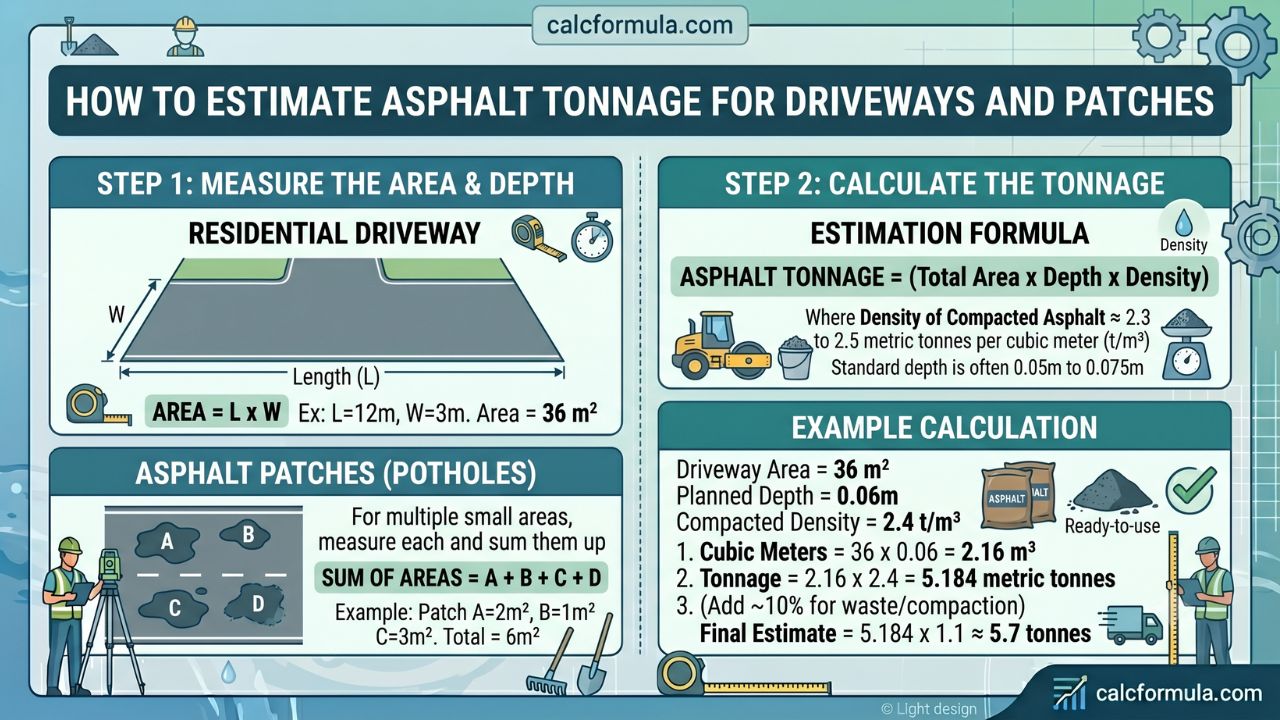
Estimating asphalt tonnage is the foundational step before ordering hot-mix asphalt (HMA) or cold-patch material for any driveway installation or pavement repair. The calculation converts your project's physical dimensions - length, width, and compacted depth - into a weight in tons that you can take directly to a supplier or use to validate a contractor's quote.
Tonnage estimation matters because asphalt is sold and delivered by weight, not volume. Under-ordering forces a second delivery and cold joints; over-ordering wastes money on material you cannot return. The Asphalt Calculator handles full-area paving jobs such as new driveways, overlays, and parking areas.
The Cold Patch Asphalt Calculator handles targeted repairs - potholes, utility cuts, edge failures, and alligator-cracked sections - where a bagged or bulk cold-mix product fills a confined void. Both tools require the same core inputs: area dimensions and compacted thickness, converted using asphalt's unit weight to produce a tonnage figure. Always verify your final estimate against project drawings, supplier delivery tickets, and actual field measurements before ordering.
Asphalt Layer Structure: What You Are Actually Measuring
The diagram shows a standard flexible pavement cross-section. From bottom to top: compacted native subgrade, a crushed-stone aggregate base, an optional binder course, and the surface wearing course. When you use the Asphalt Calculator, you are estimating the weight of asphalt material required to fill the surface course to a specified compacted depth across your project area. The base and subgrade are separate materials and are not included in an asphalt tonnage figure.
For patch work estimated with the Cold Patch Asphalt Calculator, the geometry is the same - length × width × depth - but the area is usually much smaller (a single pothole or a utility trench cut), and the material is a pre-mixed cold-applied product rather than hot-mix delivered by truck. Cold-patch density differs from hot-mix density, so the calculator uses the appropriate unit weight for whichever product you select.
What the Calculation Actually Measures
Asphalt tonnage estimation starts with area (square feet) multiplied by compacted thickness (inches converted to feet) to get a loose volume in cubic feet. That volume is then multiplied by asphalt's unit weight - typically expressed in pounds per cubic foot - and divided by 2,000 to convert pounds to short tons. The critical measurement inputs are:
- Length - measured in feet along the longest axis of the paving area or patch.
- Width - measured in feet perpendicular to length. For irregular shapes, calculate the average width or break the area into rectangles.
- Compacted depth - the finished thickness of the asphalt layer after rolling, measured in inches. This is not the loose-spread depth.
- Unit weight (density) - the weight of compacted asphalt per cubic foot. Standard hot-mix asphalt is commonly taken as 145 lb/ft³, but dense-graded mixes, open-graded mixes, and cold-patch products each carry different densities. Always check your supplier's technical data sheet.
The Core Formula
Formula - Asphalt Tonnage
- L = Length of the area (feet)
- W = Width of the area (feet)
- D = Compacted depth (inches) - divide by 12 to convert to feet
- ρ (rho) = Unit weight of compacted asphalt (lb/ft³) - commonly 145 lb/ft³ for dense-graded HMA
- 2,000 = pounds per short ton
Equivalent two-step form:
Unit Conversions You Need to Know
Asphalt estimating mixes imperial units throughout: project dimensions often arrive in feet and inches, depth specs are in inches, and weight is delivered in short tons. Getting the unit chain right prevents the most common calculation errors. The key conversion steps are:
- Inches → feet: divide by 12. A 3-inch compacted depth = 3 ÷ 12 = 0.25 ft.
- Cubic feet → cubic yards: divide by 27 (1 yd³ = 27 ft³). Useful if a supplier quotes a yardage price.
- Pounds → short tons: divide by 2,000. Asphalt is sold in short (US) tons, not metric tons.
- Square inches → square feet: divide by 144. Relevant when measuring small patch dimensions in inches.
| Convert From | Convert To | Multiply By | Notes |
|---|---|---|---|
| Inches | Feet | ÷ 12 | Depth conversion - most critical step |
| Cubic feet | Cubic yards | ÷ 27 | Volume comparison only; asphalt is ordered in tons |
| Pounds | Short tons (US) | ÷ 2,000 | Standard asphalt ordering unit |
| Short tons | Metric tonnes | × 0.9072 | Only if supplier uses metric |
| Square inches | Square feet | ÷ 144 | Small patch area measured in inches |
Worked Example: Single-Car Driveway, 2-Inch Overlay
Worked Example - Step-by-Step
Scenario: A single-car driveway, 40 ft long × 10 ft wide. The spec calls for a 2-inch compacted hot-mix asphalt overlay. Standard dense-graded HMA unit weight: 145 lb/ft³. Add a 5% waste factor for trimming and edge loss.
- Area:
- Depth in feet:
- Volume:
- Weight in pounds:
- Weight in tons (net):
- Add 5% waste factor:
Result: Order approximately 5.1 tons of hot-mix asphalt for this overlay. Most suppliers set a minimum delivery of 2-5 tons; confirm before ordering.
Sensitivity note: Changing the unit weight from 145 to 148 lb/ft³ (a stiffer polymer-modified mix) raises the order to roughly 5.2 tons. Changing the compacted depth from 2 to 3 inches raises it to approximately 7.6 tons. Always confirm the design thickness with your project drawings or engineer's specification.
Typical Compacted Thickness by Application
Compacted depth is the single variable that most dramatically changes your tonnage figure. The table below shows commonly used thickness ranges by application type. These are general references - always defer to your project drawings, local DOT specifications, or engineer's recommendation for the required compacted depth on your specific job.
| Application | Typical Compacted Depth | Approx. Tons per 100 ft² (145 lb/ft³) | Notes |
|---|---|---|---|
| Residential driveway (overlay) | 1.5 - 2 in | 0.9 - 1.2 tons | Existing base in good condition |
| Residential driveway (new full-depth) | 3 - 4 in | 1.8 - 2.4 tons | May include separate binder course |
| Light commercial parking lot | 3 - 5 in | 1.8 - 3.0 tons | Check local municipality requirements |
| Pothole / cold-patch repair | 2 - 4 in (void depth) | Varies; calculate per patch | Use Cold Patch Calculator; density varies by product |
| Utility trench repair | 2 - 3 in surface + base layers | Calculate each layer | Permanent reinstatement specs vary by jurisdiction |
| Mill-and-fill resurfacing | Matches milled depth (typically 1.5 - 2 in) | 0.9 - 1.2 tons | Milling depth confirmed before ordering |
Density, Compaction, and Waste Adjustment Factors
The formula uses the compacted unit weight of asphalt, not the loose weight of material as it leaves the truck. Hot-mix asphalt is placed loose and then compacted 15-25% by volume using a roller. This means the volume of loose mix you receive will be greater than the compacted volume you calculated - you do not need to adjust tonnage upward for this compaction loss, because the formula already targets the compacted state. What you do need to adjust for are waste, edge loss, and shape inefficiency.
| Adjustment Factor | Typical Range | When to Apply |
|---|---|---|
| Edge trim / overspray waste | 3 - 5% | All jobs; material lost at borders |
| Irregular shape premium | 5 - 10% | Curved, angled, or non-rectangular areas |
| Subgrade low spots / depression fill | 5 - 15% | Old surfaces with ruts or dips |
| Cold-patch settling / re-application | 10 - 20% | Temporary patches expected to be reapplied |
| Hauling / truck residue loss | 1 - 2% | Long hauls, sticky mix adhering to truck |
Unit weight for standard dense-graded HMA is commonly taken as 145 lb/ft³ (approximately 2,320 kg/m³), but this depends on aggregate type, mix design, and compaction level. Some suppliers provide a unit weight on their mix design report (also called a job-mix formula). Cold-patch products vary more widely - bagged products often run 100-130 lb/ft³ because they use lighter aggregate and remain semi-flexible. Always check your supplier's technical data sheet for the specific unit weight to use.
Common Estimation Mistakes
❌ Using Loose Depth Instead of Compacted Depth
Loose asphalt is spread 20-25% thicker before rolling. If you measure the pre-compaction depth and use it as your spec depth, you will under-order by that same margin. The formula requires the finished, compacted thickness from your drawings or spec sheet.
❌ Forgetting to Divide Depth in Inches by 12
Entering depth as "3" when the formula expects feet - without dividing by 12 - overstates volume by a factor of 12. This is the single most common arithmetic error in manual asphalt calculations. Always convert: .
❌ Using a Single Density for All Products
Cold-patch material is not the same density as hot-mix. Using 145 lb/ft³ for a bagged cold-patch product that weighs 110 lb/ft³ will produce a significant over-estimate. Use the density from the product's technical data sheet.
❌ Measuring the Entire Driveway for a Partial Patch
Only the area being repaired - not the full driveway - should be entered into the Cold Patch Calculator. Measuring the whole slab for a single pothole repair produces a wildly inflated tonnage.
❌ Ignoring Waste and Edge Loss
A bare-formula result assumes a perfect rectangle with zero material loss. Real jobs lose 3-10% to edge trimming, irregular cuts, and residue on tools and trucks. Not adding a waste factor is the primary reason jobs run short.
❌ Conflating Short Tons and Metric Tonnes
A US short ton = 2,000 lb. A metric tonne = 2,204.6 lb. If your supplier invoices in metric and you calculated in short tons, you will under-order by about 10%. Confirm the unit with your supplier before placing the order.
❌ Not Accounting for Subgrade Low Spots
An old driveway with ruts or depressions will consume significantly more material than the average design depth implies. A surface that is nominally 2 inches deep but has a 1-inch rut consumes 3 inches of asphalt in that zone. Survey the surface and add a depression allowance before finalizing your order.
Which Calculator Fits Your Job
| Your Estimation Need | Use This Calculator | Why |
|---|---|---|
| New full-depth driveway installation | Asphalt Calculator | Handles large rectangular or combined-rectangle areas; uses standard HMA density defaults |
| Overlay resurfacing of existing driveway | Asphalt Calculator | Enter overlay thickness (not total depth) and full driveway area; base layer is already in place |
| Parking area or apron paving | Asphalt Calculator | Use for any continuous paved surface measured in length × width |
| Single pothole or depression repair | Cold Patch Asphalt Calculator | Sized for small, confined areas; uses cold-mix product density; calculates bags or bulk weight |
| Utility cut / trench reinstatement patch | Cold Patch Asphalt Calculator | Trench patches are narrow rectangles filled with cold-mix or temporary HMA; enter trench dimensions |
| Edge cracking or alligator patch repair | Cold Patch Asphalt Calculator | Isolated distress areas measured individually; cold patch applied by hand or plate compactor |
What the Calculation Cannot Account For
⚠ Estimate Limitations
- Actual mix density: The 145 lb/ft³ default is a common approximation. Your specific HMA mix design report may show a different unit weight. Cold-patch products vary widely by manufacturer. Always use supplier-provided density when available.
- Irregular or curved areas: The formula assumes rectangular geometry. Circular driveways, curved aprons, and irregular patch shapes require area decomposition or geometric formulas before entering dimensions. The calculator cannot compute non-rectangular areas automatically.
- Subgrade condition and bearing capacity: The tonnage calculation says nothing about whether the subgrade can support the finished pavement. Soft, wet, or expansive soils may require additional base depth or geotextile, which changes total project scope but not the asphalt tonnage formula itself.
- Field measurement accuracy: Dimensions measured in the field often differ from drawing dimensions. Always measure the actual area at the site and verify against project drawings before placing a material order.
- Temperature and haul distance: Hot-mix asphalt must be placed and compacted above a minimum temperature. Long hauls in cold weather can result in temperature loss and reduced compactability, affecting final density. This is a field condition, not a calculable input.
- Supplier minimum loads: Most asphalt plants have a minimum delivery quantity (often 2-5 tons). A calculated need of 1.2 tons may still require a minimum delivery charge or a 2-ton minimum order. Confirm delivery thresholds with your supplier.
- Local DOT or municipal thickness requirements: Residential driveways that connect to public roads, or utility cut patches in public rights-of-way, may have mandated pavement thicknesses and mix specifications that supersede the values you enter. Verify local requirements before specifying a depth.
Frequently Asked Questions
How many tons of asphalt does one square foot require at a given depth?
At 145 lb/ft³ and a 2-inch compacted depth: $(1\ \text{ft}^2 \times 0.1667\ \text{ft}) \times 145 \div 2000 = 0.0121\ \text{tons/ft}^2$. Multiply that by your total square footage. At 3 inches: . These quick unit rates let you sanity-check any tonnage figure before ordering.
Why does the formula use compacted depth rather than spread depth?
You are buying material by weight, and the unit weight (145 lb/ft³) represents the density of asphalt after compaction. The volume you calculate must match the compacted volume you want in the ground. If you used the loose spread depth (which is 20-25% greater), your tonnage figure would overestimate the required order - the compaction step is already built into the density figure.
What density should I use for cold-patch products?
Cold-patch (cold-mix) asphalt uses a cutback or emulsified binder and lighter aggregate, so density is lower than hot-mix. Typical ranges are 100-130 lb/ft³, but this varies significantly by brand and product formulation. Check the product's technical data sheet or the bag label. If the manufacturer publishes a coverage rate (e.g., one 50-lb bag covers X square feet at Y inches deep), you can back-calculate the density to verify your Cold Patch Calculator inputs.
How do I handle an L-shaped or curved driveway?
Break the area into rectangular segments and calculate tonnage for each separately, then sum. For example, an L-shaped driveway can be split into two rectangles. For curved or circular sections, calculate the area using geometry ( for a circle, or approximate a curve as a rectangle at the average width) and enter that area into the calculator. Add a 5-10% shape waste factor for curved cuts and irregular edges.
Should I order the exact calculated tonnage or add a buffer?
Always add a waste factor - typically 5% for clean rectangular jobs and 10% for irregular or patched areas. The calculated tonnage represents a theoretical minimum under ideal conditions. Short-ordering on hot-mix is a significant problem because the plant may not be able to deliver a small top-up load, and cold joints created by adding material later are weaker than a continuous pour.
Does the formula change for a mill-and-overlay project?
No - the formula is identical. For a mill-and-overlay, enter the milled depth as your compacted thickness (since the overlay fills exactly the milled void). For example, if you mill 1.5 inches and replace with 1.5 inches of new surface mix, use 1.5 inches as the depth input. Confirm the milled depth from your milling plan or field survey before calculating.
Can I use the Asphalt Calculator for a multi-layer job (binder + surface course)?
Yes, but calculate each layer separately. Binder course and surface course often have different mix designs and slightly different densities. Run the Asphalt Calculator once for the binder layer (with its depth and density) and again for the surface layer, then add the two tonnage results. Do not simply add the depths together if the densities differ.
What is a reasonable tons-per-square-yard rule of thumb for residential asphalt?
A commonly cited field shortcut: 1 inch of compacted asphalt ≈ 0.057 tons per square foot, or about 0.5 tons per square yard. At a 2-inch depth, that is roughly 1.0 ton per square yard. This approximation uses the 145 lb/ft³ standard density and is a useful sanity-check against a detailed calculation - but always run the full formula with your actual dimensions and the supplier's confirmed density for any material order.
References
- NIST Special Publication 811 - Guide for the Use of the International System of Units (SI) . National Institute of Standards and Technology, U.S. Department of Commerce. Used for SI unit usage, unit symbols, and unit conversion consistency.
- ASTM D3515 - Standard Specification for Hot-Mixed, Hot-Laid Bituminous Paving Mixtures . ASTM International. This is a withdrawn standard, so it should only be used for historical hot-mix asphalt classification context, not as the current design authority.
- ASTM D6927 - Standard Test Method for Marshall Stability and Flow of Asphalt Mixtures . ASTM International. Provides testing context for Marshall stability and flow of compacted asphalt mixture specimens.
- FHWA Asphalt Pavements . Federal Highway Administration. Used as a public pavement engineering reference for asphalt pavement design, materials, construction, and performance guidance.
- State DOT Standard Specifications . Federal Highway Administration. Use your state Department of Transportation specifications for local pavement construction requirements, compacted asphalt depths, mix types, and road or driveway construction standards.
- Asphalt Institute MS-2 - Asphalt Mix Design Methods . Asphalt Institute. Industry reference for asphalt mixture design, volumetric calculations, material selection, specific gravity, and density-related mix design context.
- Supplier or plant technical data sheets. For cold-patch asphalt, bagged asphalt, and proprietary mixes, use the manufacturer’s published density, coverage rate, compaction instructions, and application thickness before ordering material.
Read Also:
- Construction Material Estimate Limits: Waste, Density, and Compaction
- How to Calculate Drainage Fall and Pipe Slope
- How to Calculate Slope, Grade, Rise, Run, and Angle
- How to Estimate Gravel, Crushed Stone, and Road Base Quantity
- How to Calculate Concrete Volume for Slabs, Columns, and Stairs
- Read Full Guide list