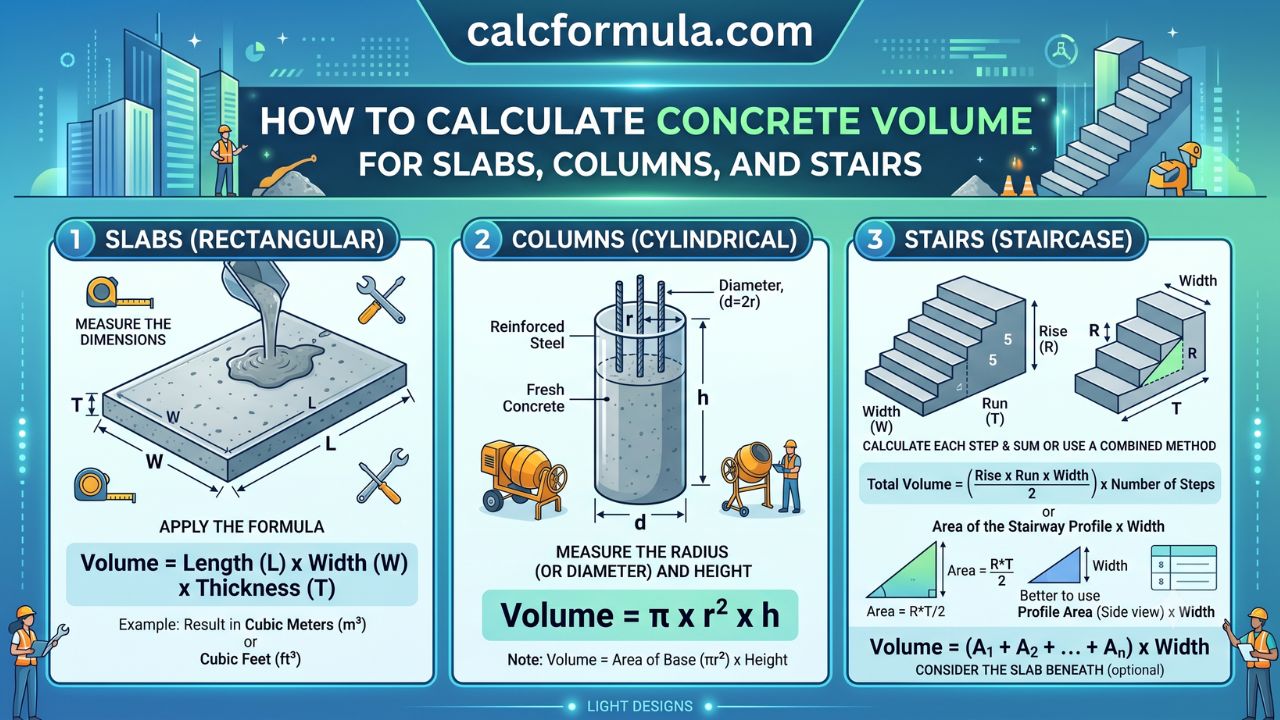
Concrete volume estimation determines how many cubic yards or cubic meters of mixed concrete a formed element requires before the pour. It is used at three distinct project stages: material ordering (to schedule ready-mix delivery), form design (to verify structural load on shores and decking), and cost budgeting (to confirm quantities against the bill of materials).
This guide covers the three most common poured-in-place elements - flat slabs on grade, vertical columns (rectangular and circular), and monolithic stair flights - and walks through the geometry, unit handling, and adjustment factors behind each calculation.
The same volume principles also apply when sizing an aggregate base layer of crushed stone, road base, or pea gravel beneath a slab, so related material calculators are referenced throughout. Final quantities should always be checked against project drawings, local concrete supplier minimums, and site-specific conditions before placing an order.
1. What This Estimate Measures
This guide estimates volume - the three-dimensional space occupied by cured concrete inside a form. Volume is expressed in:
- Cubic feet (ft³) - raw calculation unit when working in feet and inches
- Cubic yards (yd³) - standard ordering unit for ready-mix concrete in the United States (one cubic yard = 27 cubic feet)
- Cubic meters (m³) - standard ordering unit in metric regions
The formula produces a net geometric volume: the space defined by the form dimensions alone. It does not account for displaced volume from reinforcing steel, embedded anchors, or blockouts unless those items are subtracted manually. For most residential and light commercial work, rebar displacement is less than 2 % of total volume and is typically ignored. On heavily reinforced industrial slabs or moment frames, verify with the structural engineer whether deduction is required.
Tonnage and density are not part of the volume calculation itself, but they become relevant when estimating the weight of a poured element for shoring design or when calculating aggregate base tonnage under the slab. See the Road Base and Crushed Stone calculators for aggregate weight conversions.
Main Formulas
2a. Concrete Slab
A slab is a rectangular prism. Its volume is the product of three orthogonal dimensions:
Variable definitions:
- = length of the slab (ft or m)
- = width of the slab (ft or m)
- = slab thickness (ft or m - convert from inches before multiplying)
- = volume in ft³ or m³
A 4-inch slab uses . A 6-inch slab uses . This is the single most common arithmetic error in slab estimation - leaving thickness in inches while L and W are in feet.
2b. Rectangular (Square) Column
A rectangular column or pier is also a rectangular prism. The formula is identical in structure to a slab, with height replacing thickness:
- = cross-section dimension 1 (ft)
- = cross-section dimension 2 (ft)
- = column height (ft)
2c. Circular Column or Sonotube Pier
A circular column is a cylinder. Its cross-sectional area is , giving:
Equivalently expressed using diameter:
- = radius of column (ft) - half the diameter
- = diameter of column (ft)
- = column height (ft)
2d. Monolithic Concrete Staircase
This formula applies to a solid, poured-in-place stair flight where concrete fills the entire form from the bearing slab up through each step - no void underneath. The staircase is modelled as a stack of rectangular blocks, one per step, each block taller than the last by one riser height:
- = stair width (ft)
- = tread run - horizontal depth of one step, excluding nosing (ft)
- = riser height - vertical height of one step (ft)
- = number of steps (risers) in the flight
- = triangular number; accounts for the stepped stack of concrete
The formula derives from the fact that step 1 (from the bottom) is 1 riser tall, step 2 is 2 risers tall, and so on. The sum . If there is also a landing slab at the top or bottom, add it as a separate flat slab calculation using .
Note: This formula covers solid monolithic stairs only. Cantilevered stairs, precast treads on steel stringers, and stairs with void forms underneath require different geometry.
Unit Conversion Notes
Most calculation errors in concrete estimation come from mixing units within the same formula. Convert all dimensions to a single unit before multiplying.
| Conversion | Formula | Common Mistake |
|---|---|---|
| Inches → Feet | Divide by 12 | Using "4" for a 4-inch slab instead of 0.333 ft |
| Cubic feet → Cubic yards | Divide ft³ by 27 | Dividing by 3 instead of 27 |
| Cubic meters → Cubic yards | Multiply m³ by 1.308 | Confusing metric and imperial order quantities |
| Millimeters → Feet | Divide mm by 304.8 | Using mm value directly in a ft-based formula |
| Diameter → Radius | Divide diameter by 2 | Using full diameter value as r² in the cylinder formula, which quadruples the result |
| Cubic yards → 80-lb bags | Multiply yd³ by ~45 bags | Varies by mix design; check bag yield printed on packaging |
The 27 ft³ per yd³ conversion deserves emphasis. Concrete is sold by the cubic yard in the US, but field measurements are almost always taken in feet and inches. Failing to divide by 27 at the end of the calculation results in ordering 27 times too much - a number large enough that it should trigger an immediate sanity check.
Worked Examples
Example A - Residential Garage Slab
Given: Slab is 24 ft long, 22 ft wide, 5 inches thick.
Step 1 - Convert thickness to feet:
Step 2 - Calculate volume in cubic feet:
Step 3 - Convert to cubic yards:
Result: The slab requires approximately 8.15 yd³ of concrete net. Most suppliers add a minimum overage to their batches, so you would typically order 8.5 or 9 yd³ after applying a waste factor (see Section 5). Verify this quantity against the structural drawing slab schedule before ordering.
Example B - Circular Deck Footing (Sonotube)
Given: Cylindrical pier, 12-inch diameter, 4 ft deep.
Step 1 - Convert diameter to radius in feet:
Step 2 - Calculate volume:
Step 3 - Convert to cubic yards:
Result: Each 12-in diameter × 4-ft footing holds about 0.116 yd³. For a deck with 8 such footings, total concrete = . Most ready-mix plants have a minimum order of 1 yd³; adding a margin lands you at 1 yd³ ordered for this application. For small pours like this, bagged concrete may be more practical - at approximately 0.6 ft³ per 80-lb bag, each pier needs roughly 5-6 bags.
Example C - Interior Concrete Stair Flight
Given: 7 steps, each with a 7.5-inch rise and 11-inch run, stair width 4 ft. Solid poured monolithic flight, no landing.
Step 1 - Convert rise and run to feet:
Step 2 - Calculate the triangular number:
Step 3 - Calculate volume:
Step 4 - Convert to cubic yards:
Result: The flight requires approximately 2.38 yd³ net. This covers only the stacked-block stair volume. If a 4 ft × 3 ft × 5-inch landing pad is included at the top, add $V_{\text{landing}} = 4 \times 3 \times 0.417 = 5.0\ \text{ft}^3 = 0.19\ \text{yd}^3$, bringing the total to about 2.57 yd³ before waste allowance.
Waste Factor and Safety Margin
Geometric volume calculations produce a theoretical net quantity. Actual concrete placed on a jobsite is consistently higher due to several factors:
- Subgrade irregularity: A nominally 4-inch slab poured over uneven compacted aggregate may average 4.3 to 4.6 inches due to low spots and depressions. Site conditions can change the result significantly.
- Form deflection: Wood forms bow outward under hydrostatic pressure, increasing cross-section beyond the nominal dimension - most pronounced in deep walls and columns.
- Overpour and spillage: Concrete left in chutes and over-poured at slab edges is wasted but was batched and charged.
- Pump line priming: Pumped concrete requires flushing slurry through the line before the mix reaches the form. This is typically 0.25-0.75 yd³ of wasted material depending on line length.
A commonly allowed waste factor for flat slabs on grade is 5-10 % added to the calculated volume. For irregular shapes, curved walls, or hand-placed footings in rocky soil, 10-15 % is more common. These are industry guidelines, not engineering specifications - the appropriate margin depends on crew experience, form quality, and subgrade condition.
To apply a waste factor, multiply the calculated volume by where is the decimal waste fraction:
For the garage slab example above with a 7 % waste factor: , rounded to 9 yd³ for ordering.
Concrete mix design also affects actual placed density and shrinkage, but these do not change the volume calculation - they affect structural performance, which is outside the scope of this guide. Check supplier technical data sheets and project mix design specifications for w/c ratio, compressive strength class, and slump requirements before finalising an order.
Common Mistakes
- Not converting thickness from inches to feet before multiplying. This is the most frequent error in slab calculations. A 4-inch slab entered as "4" instead of "0.333" produces a volume 12 times too large. Always divide inch dimensions by 12 as the first step.
- Using diameter instead of radius in the cylinder formula. The formula uses , not . Plugging in a 12-inch diameter as 1.0 ft instead of 0.5 ft (radius) produces a result four times larger than correct. This is easy to miss when the sonotube is specified by diameter on the drawing.
- Forgetting to divide by 27 when converting ft³ to yd³. Volume in cubic feet is divided by 27, not by 3. Dividing by 3 is the linear-dimension conversion (yards to feet), not the volumetric one.
- Applying the stair formula to non-solid stairs. The stacked-block formula assumes the stair is poured solid from the bottom bearing surface up. If the design uses a sloped flight slab with step blockouts attached to the top surface (a common approach in multi-storey buildings), the geometry is fundamentally different and this formula does not apply.
- Omitting landing slabs and intermediate pads. A stair landing - even a small 2 ft × 4 ft × 4-inch platform - adds measurable volume. Calculate landings separately as flat slabs and add them to the flight volume.
- Double-counting area where slabs and columns share space. In elevated slabs, column volumes that project above the slab soffit are sometimes counted in both the slab pour and the column schedule. Check whether columns are poured monolithically with the slab or in a separate operation, and deduct accordingly.
- Ignoring minimum order quantities. Ready-mix plants typically have a minimum charge (often 1 yd³). Calculating 0.6 yd³ and ordering 0.6 yd³ is not possible - you pay for 1 yd³. This affects small-pour decisions around bagged concrete vs. ready-mix.
- Measuring slab area from face of walls rather than from form edges. If a slab is poured between masonry stem walls, the concrete area is the interior dimension between forms. Measuring overall building footprint and multiplying by thickness will overcount by the wall thickness on each side.
Which Calculator to Use
| Your Element | Calculator to Use | Notes |
|---|---|---|
| Flat slab, footing pad, or driveway section | Concrete Slab Calculator | Inputs: length, width, thickness. Outputs: yd³ with optional waste. |
| Square or rectangular column, pier, or grade beam segment | Concrete Column Calculator | Use for rectangular cross-sections; enter both cross-section dimensions and height. |
| Round column or cylindrical footing, such as a sonotube pier | Sonotube / Circular Column Calculator | Enter diameter and depth; calculator applies π × r² × h. |
| Solid poured stair flight | Concrete Stair Calculator | Inputs: number of steps, rise, run, width. Calculate landing separately. |
| Aggregate base beneath a slab, such as crushed stone, road base, or pea gravel | Crushed Stone / Road Base / Pea Gravel Calculator | Calculate base layer tonnage separately; volume uses similar geometry, but density differs by material. |
| Drainage fill or perimeter gravel around footings | River Rock / Pea Gravel Calculator | Volume-to-tonnage conversion depends on material density; use calculator to confirm bag or bulk quantities. |
| Compacted limestone base for roads or parking areas | Limestone Calculator | Accounts for compaction factor; site conditions can change the result. |
Most concrete pours sit on a prepared aggregate base. After calculating concrete volume with the slab or column calculator, use the Road Base, Crushed Stone, or Pea Gravel calculators to size the granular sub-base layer separately. The two volumes are stacked vertically but ordered as entirely different materials from different suppliers.
Estimate Limitations
A geometric volume calculation is based entirely on the dimensions you enter. It does not know or account for the following:
- Subgrade condition: Soft or uneven subgrade increases effective slab thickness. The formula assumes a flat, uniform bearing surface at the correct elevation.
- Subgrade preparation thickness: The aggregate base course under a slab is a separate material and volume. It is not included in the concrete volume calculation.
- Reinforcement volume displacement: Rebar, wire mesh, fibres, and embedded anchors occupy physical space inside the form. For most residential applications, this is negligible. For heavily reinforced sections, deduct if required by the engineer.
- Form deflection and bulging: Forms flex under wet concrete pressure. A column poured in plywood forms may have a slightly larger diameter than nominal at the point of maximum hydrostatic head.
- Irregular floor plans: The slab formula works only for rectangular shapes. L-shaped, curved, or polygonal slabs must be broken into rectangular (or circular arc) sub-areas and summed.
- Non-uniform stair geometry: The stair formula assumes all risers are equal height and all treads are equal depth. A flight with a non-standard bottom or top riser height (common in remodelling) requires step-by-step calculation.
- Openings and blockouts: Slab areas with structural openings, drains, or embedded blockout forms must be deducted from the gross area before calculating volume.
- Actual supplier batch size and slump loss: Ready-mix concrete is batched in increments. Small overages may not be available in exact quantities. Slump loss between the plant and the pour can affect workability but not volume.
- Soil moisture and frost heave: Neither is captured by the formula, but both affect subgrade elevation and therefore slab thickness after placement.
Always verify calculated volumes against project drawings, the engineer's quantity takeoff, and local supplier delivery minimums before finalising an order.
Frequently Asked Questions
Why do I divide by 27 to get cubic yards, not by 3?
Because volume scales cubically. One yard = 3 feet, so one cubic yard = cubic feet. Dividing by 3 would give you linear yards, not volumetric yards. This is the most common unit-conversion error in concrete estimation.
The drawing shows a 4-inch slab. What value do I enter for thickness?
Enter 0.333 ft (or 0.333 in the feet field). This is . If the calculator accepts inches directly, enter 4. Never enter "4" in a field that expects feet when the dimension is in inches.
The sonotube manufacturer lists diameter, not radius. Which do I use in the formula?
Divide the diameter by 2 to get the radius first, then apply . For an 18-inch diameter tube: , then . If you use 1.5 ft (the full diameter) as , your result is four times too large.
Does the stair formula account for the tread nosing overhang?
No. The formula uses the structural run (horizontal depth contributing to the stacked block), which is typically measured from riser face to riser face. A 1-inch to 1.5-inch nosing overhang on each tread adds a small volume; for most estimates this is absorbed by the waste factor. If precision is required, add a separate rectangular prism for the total nosing volume: $\text{nosing depth} \times \text{nosing height} \times W \times n$.
My slab is L-shaped. Can I use the slab formula?
Not directly. Divide the L-shape into two or more rectangles that together cover the full area without overlap. Calculate each rectangle's volume separately using , then sum the results. This applies to any non-rectangular plan shape - T-shapes, U-shapes, and irregular polygons - by decomposing into rectangles.
How many 80-lb bags of concrete does one cubic yard equal?
Approximately 45 bags, but this depends on the specific product's yield. A standard 80-lb bag yields roughly 0.60 ft³. Since , that works out to bags. Always check the yield printed on the bag label, as it varies by manufacturer and mix design.
Should I calculate the aggregate base and the concrete slab volume together?
No - they are separate materials ordered in different units from different suppliers. Use the slab formula for concrete volume (ordered in yd³). Use the Road Base, Crushed Stone, or Pea Gravel calculators for the base layer beneath the slab, which is typically ordered in tons. The two layers share the same plan area but have different thicknesses and completely different weight and pricing structures.
Does the calculation account for concrete shrinkage?
No. Concrete shrinks as it cures (typically 0.04-0.08 % linear shrinkage for normal-weight concrete), but this reduction is small enough that it has no practical effect on the volume ordered. Shrinkage matters for joint spacing and crack-control design, not for estimating how much concrete to buy.
What is a realistic waste factor for a concrete stair?
Stairs are poured in custom wood forms with relatively controlled geometry, so waste tends to be lower than a slab on grade - commonly 3-6 %. The main source of overage is concrete remaining in the pump line or chute at the end of the pour and the difficulty of precisely stopping the pour at the top nosing elevation. Site conditions can change the result; check with your forming crew.
Related Calculators
- Pea Gravel Calculator - Estimate volume and tonnage for drainage fill, trench backfill around footings, or decorative surface applications. Uses the same rectangular-prism formula as the slab, with a material-specific density conversion.
- Crushed Stone Calculator - Size a compacted aggregate base course under slabs, driveways, or footings. Crushed stone density varies by gradation (typically 2,700-3,000 lb/yd³); check supplier data sheets for your specific material.
- Limestone Calculator - Calculate volume and tonnage for crushed limestone base or surface dressing. Commonly used under concrete slabs in road and parking applications.
- Road Base Calculator - Estimate compacted road base quantities for subbase layers. Compaction factor significantly affects the un-compacted volume that must be ordered - the calculator accounts for this adjustment.
- River Rock Calculator - Volume and weight estimates for round washed river rock used in drainage beds, dry creek channels, and decorative beds adjacent to concrete slabs and retaining walls.
References
- ACI 318 - Building Code Requirements for Structural Concrete (American Concrete Institute): Defines minimum design requirements for structural concrete elements, including context for slab thickness, column geometry, rebar placement, and cover requirements that may affect the dimensions entered into concrete volume calculations.
- ACI 301 - Specifications for Structural Concrete (American Concrete Institute): Covers structural concrete specifications, placement requirements, consolidation, finishing, and project tolerances relevant to waste factor and field-adjustment assumptions.
- ASTM C94 / C94M - Standard Specification for Ready-Mixed Concrete (ASTM International): Covers ready-mixed concrete manufacturing and delivery requirements, including batch delivery context, yield accuracy, and purchaser-specified concrete requirements.
- NIST Handbook 44 - Specifications, Tolerances, and Other Technical Requirements for Weighing and Measuring Devices (National Institute of Standards and Technology): Provides background on measurement standards, tolerances, and traceability used in commercial weighing and measuring systems.
- Portland Cement Association - Design and Control of Concrete Mixtures (PCA): Practical reference for concrete mixture design, yield, density, batching, and material behavior used when converting concrete volume into weight or bag estimates.
- International Building Code - Chapter 19, Concrete (International Code Council): Provides minimum code requirements for concrete materials, quality control, design, and construction; useful for understanding the structural context of slabs, columns, stairs, and other concrete elements.
- Concrete Ready-Mix Supplier Technical Data Sheets: Use local supplier data for actual batch yield, minimum order size, water-cement ratio, admixtures, and regional mix behavior before ordering concrete.
Read Also:
- How to Estimate Gravel, Crushed Stone, and Road Base Quantity
- How to Calculate Slope, Grade, Rise, Run, and Angle
- How to Calculate Drainage Fall and Pipe Slope
- How to Estimate Asphalt Tonnage for Driveways and Patches
- Construction Material Estimate Limits: Waste, Density, and Compaction
- Read Full Constitution Guide and Tips