A fence is only as strong as what holds it up. The boards, panels, and rails are the visible part of the structure - but it's the posts buried below grade that determine whether your fence stands straight for twenty years or starts leaning after the first hard winter. Setting fence posts too shallow is one of the most common and most expensive mistakes in residential construction. It leads to racking, heave, and full replacement of posts that were never set correctly in the first place.
The question "how deep should fence posts be" has a reliable answer - one that draws on a simple rule of thumb, your local frost line depth, your soil conditions, and the load your fence needs to resist. This guide gives you everything you need: the formula, a depth reference table, three worked examples, the most costly mistakes people make, and the answers to questions that come up most often before the first post hole is dug.
How Deep Should Fence Posts Be? Quick Answer and the 1/3 Rule
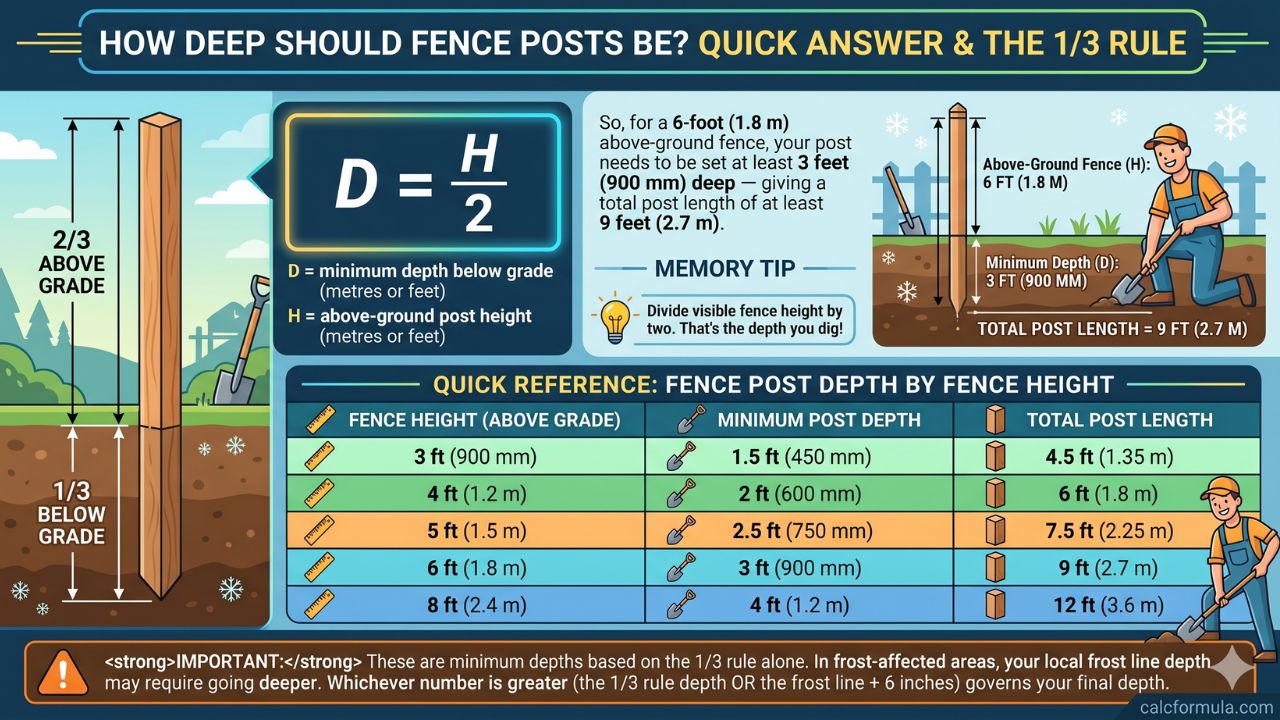
The industry-standard rule of thumb for fence post depth is the 1/3 Rule:
Post depth below grade = at least 1/3 of the total post length (above ground + below ground)
In formula form:
D = H ÷ 2
Where:
- D = minimum depth below grade (metres or feet)
- H = above-ground post height (metres or feet)
So for a 6-foot (1.8 m) above-ground fence, your post needs to be set at least 2 feet (600 mm) deep - giving a total post length of at least 8 feet (2.4 m).
A cleaner way to remember it: buy a post that is 1/3 longer than your intended fence height, and set that extra third into the ground.
Quick Reference: Fence Post Depth by Fence Height
| Fence Height (Above Grade) | Minimum Post Depth | Total Post Length |
|---|---|---|
| 3 ft (900 mm) | 18 in (450 mm) | 4.5 ft (1.35 m) |
| 4 ft (1.2 m) | 2 ft (600 mm) | 6 ft (1.8 m) |
| 5 ft (1.5 m) | 2.5 ft (750 mm) | 7.5 ft (2.25 m) |
| 6 ft (1.8 m) | 2.5-3 ft (750-900 mm) | 8.5-9 ft (2.55-2.7 m) |
| 8 ft (2.4 m) | 3 ft (900 mm) | 11 ft (3.3 m) |
Important: These are minimum depths based on the 1/3 rule alone. In frost-affected areas, your local frost line depth may require going deeper - whichever number is greater (1/3 rule depth or frost line + 6 inches) governs. This is explained fully in the frost line section below.
Use the free Fence Post Depth Calculator at CalcFormula to instantly find the required depth and total post length for any fence height, factoring in both the 1/3 rule and your local frost line.
Frost Line Requirements: Why Depth Below Grade Isn't Just About Stability
In climates where ground temperatures fall below freezing, the soil expands as moisture in it turns to ice. This process - called frost heave - exerts enormous upward pressure on anything embedded in the ground. A fence post set above the frost line will be pushed upward each winter and may not fully return to its original position in spring. After two or three freeze-thaw cycles, posts heave noticeably out of alignment, rails pull loose, and the entire fence begins to rack.
The Frost Line Rule
Post depth must extend at least 150-200 mm (6-8 inches) below the local frost line
If the 1/3 rule gives you a greater depth than this, use the 1/3 rule depth. If the frost line requires going deeper than the 1/3 rule, use the frost line depth. Always use the greater of the two.
Frost Depth by US Region (Approximate)
| Region | Typical Frost Depth |
|---|---|
| Southern US (FL, TX, GA, SC) | 0-150 mm (0-6 in) |
| Mid-Atlantic / Pacific Northwest | 300-450 mm (12-18 in) |
| Midwest / Mountain States | 600-900 mm (24-36 in) |
| Northern Plains / Great Lakes | 900-1,200 mm (36-48 in) |
| Northern Canada / Alaska | 1,200-1,800 mm (48-72 in) |
These are approximations. Frost depth varies significantly with soil type, drainage, vegetation cover, and local microclimates. The authoritative source for your area is your local building authority, who may also require a permit for fence construction above a certain height.
Frost Depth Outside the US
- UK: Ground freezing is uncommon below 450 mm in most regions; post depth of 600 mm is a widely used standard for all fence types.
- Canada: Frost depths vary from 600 mm in southern Ontario to over 2,400 mm in the northern territories. Check provincial building codes.
- Australia / New Zealand: Frost heave is not typically a concern except in alpine areas; the 1/3 rule governs in most locations.
What Affects How Deep Fence Posts Should Be
The 1/3 rule and frost line set the baseline. The following variables can push that number higher - sometimes significantly.
1. Fence Height and Panel Style
Taller fences catch more wind. A solid 8-foot privacy fence presents a significantly larger surface area to wind load than an open picket fence of the same height. The greater the wind load, the deeper and wider the post footing needs to be to resist overturning. In high-wind zones or exposed coastal locations, post depth for a solid 6-foot fence may need to be 900-1,200 mm, not the minimum 750 mm.
2. Post Material
Treated timber posts are the most common choice for residential fencing. Use only ground-contact rated timber (H4 or equivalent in Australia, UC4B in the US) to prevent rot at the critical buried section. Steel posts (galvanised or powder-coated) don't rot but can corrode at the soil line if poorly coated. Concrete posts are extremely durable in the ground but heavier to handle and install. Post material doesn't change the required depth, but it strongly affects long-term performance at that depth.
3. Soil Type
Soil bearing capacity varies widely and directly affects how securely a footing holds a post against lateral (sideways) loads from wind.
| Soil Type | Post Footing Performance | Notes |
|---|---|---|
| Compacted gravel / rocky | Excellent | May need mechanical augering |
| Firm clay | Good | Can become plastic when wet; concrete recommended |
| Sandy / loose soil | Poor | Increase depth by 20-25%; concrete essential |
| Expansive clay | Poor | Heaves when wet; use larger-diameter footings |
| Waterlogged / organic | Very poor | May require engineered footing solution |
In sandy or loose soils, increasing post depth by 200-300 mm beyond the 1/3 rule minimum substantially improves resistance to racking under wind load.
4. Gate Posts and Corner Posts
Gate posts carry dynamic load every time the gate swings - especially heavy or wide gates. Corner posts resist lateral forces from two fence directions simultaneously. Both types should be set 300-450 mm (12-18 inches) deeper than standard line posts, with a larger-diameter concrete footing. A gate post for a 6-foot fence in standard soil should be set at minimum 900-1,050 mm deep. Skimping on gate post depth is the leading cause of sagging gates.
5. Concrete vs. Dry-Setting
Setting posts in concrete provides the most reliable lateral resistance in most soil types and is recommended for all posts over 1.2 m above grade. Using rapid-set concrete eliminates the wait but gives you less time to adjust alignment before the mix stiffens. Dry-pack (dry concrete around the post, wetted in place) is faster for experienced installers but produces a less consistent footing. Gravel-pack only (no concrete) is acceptable in firm, well-draining soils for decorative low fences but is not recommended for privacy fences over 1.2 m or gate posts.
6. Post Spacing
Wider post spacing increases the wind load and dead weight each post must carry. Standard residential fence post spacing is 1,800-2,400 mm (6-8 feet) for timber privacy fences. At maximum spacing, posts should be at or above the upper end of the recommended depth range. The Wood Fence Calculator at CalcFormula lets you input post spacing, fence height, and run length to generate a complete material list including total post count and recommended post lengths.
Step-by-Step: How to Calculate Fence Post Depth
Worked Example 1: Standard 6-Foot Timber Privacy Fence (No Frost)
Location: Southern US (frost depth negligible). Sandy loam soil. Post spacing 2,400 mm. Standard line posts.
Step 1 - Apply the 1/3 Rule Above-ground height = 1,800 mm (6 ft) Minimum depth = 1,800 ÷ 2 = 900 mm (3 ft)
Step 2 - Check against frost line Frost depth ≈ 0-100 mm → 1/3 rule (900 mm) governs.
Step 3 - Adjust for soil type Sandy loam = moderately loose → add 150 mm safety margin. Revised depth = 900 + 150 = 1,050 mm
Step 4 - Determine total post length Above-ground (1,800 mm) + in-ground (1,050 mm) = 2,850 mm → buy 3,000 mm (10 ft) posts
Step 5 - Footing size Footing diameter = 2-3× post width. For a 90 × 90 mm post: footing diameter = 200-250 mm. Use a 200 mm auger and fill with rapid-set concrete.
Worked Example 2: 6-Foot Privacy Fence in Frost Country
Location: Chicago, Illinois. Frost depth ≈ 900-1,000 mm. Standard clay loam soil.
Step 1 - Apply the 1/3 Rule Minimum depth = 1,800 ÷ 2 = 900 mm
Step 2 - Apply the Frost Line Rule Frost depth (1,000 mm) + 150 mm clearance = 1,150 mm
Step 3 - Use the greater depth Frost line depth (1,150 mm) > 1/3 rule depth (900 mm) → use 1,150 mm
Step 4 - Determine total post length 1,800 mm + 1,150 mm = 2,950 mm → buy 3,000 mm (10 ft) posts, set to 1,150 mm depth with 50 mm above grade for the concrete collar.
Key takeaway: In Chicago, the frost line adds 250 mm of depth over the 1/3 rule minimum. The post is the same above-ground height but must be longer and set deeper. Missing this step is why so many fence posts in northern climates heave out of the ground within two winters.
Worked Example 3: Gate Post Calculation
Location: Pacific Northwest. Frost depth ≈ 400 mm. Firm clay soil. Single gate 1,200 mm (4 ft) wide, fence height 1,800 mm (6 ft).
Step 1 - Apply 1/3 Rule for standard post Minimum depth = 900 mm
Step 2 - Apply frost line 400 mm + 150 mm = 550 mm → 1/3 rule (900 mm) governs.
Step 3 - Add gate post premium Gate post: add 300-450 mm beyond line post depth = 900 + 350 = 1,250 mm
Step 4 - Total post length 1,800 mm above + 1,250 mm below = 3,050 mm → buy 3,200 mm posts for gate posts
Step 5 - Footing size For a gate post, use a larger footing - minimum 300 mm diameter concrete footing for a 90 × 90 mm post carrying a 1,200 mm gate.
For a complete material schedule covering posts, rails, boards, and concrete quantities across your full fence run, the Fence Calculator at CalcFormula generates a full itemised list from your fence dimensions and post spacing.
Common Mistakes When Setting Fence Post Depth
❌ Mistake 1: Ignoring the Frost Line
The single most expensive mistake in fence construction in cold climates. A post set at 900 mm in a region with a 1,000 mm frost line will heave. No amount of concrete volume at inadequate depth overcomes seasonal ground movement. Always check your local frost depth before digging the first hole.
❌ Mistake 2: Setting Gate and Corner Posts the Same Depth as Line Posts
Gate and corner posts carry significantly greater loads. Setting them to the same depth as standard line posts almost guarantees premature failure - a sagging gate or a corner post that pulls toward the fence line under tension from the rails.
❌ Mistake 3: Using Concrete as a Substitute for Depth
A wide, shallow concrete footing is not a substitute for proper depth. Concrete anchors the post to the surrounding soil mass, but if that soil mass moves (frost heave, saturation, erosion), the concrete moves with it. Depth below the frost line and below the active soil zone is what prevents heave - not the diameter or volume of the footing alone.
❌ Mistake 4: Not Adding Gravel at the Post Base
Even pressure-treated posts benefit from 100-150 mm of compacted gravel at the base of the hole before the post is set. Gravel improves drainage, prevents the post end from sitting in standing water, and significantly extends post life at the critical below-grade section where rot and corrosion begin.
❌ Mistake 5: Cutting Posts to Height Before Setting
Always set full-length posts first and cut to finished height after concrete has cured. Cutting before setting makes it nearly impossible to recover from minor alignment errors during the pour, and any settling over the first few weeks will change the finished height unpredictably.
❌ Mistake 6: Forgetting to Crown the Concrete Collar
The concrete footing at the top should slope away from the post on all sides - a slight crown that sheds water rather than pooling it at the timber. A flat or dished concrete collar directs water toward the post at exactly the point where it enters the ground, accelerating rot even on treated timber.
❌ Mistake 7: Relying on Online Frost Depth Maps Without Verifying Locally
National frost depth maps are useful guides, but local conditions vary. A shaded north-facing site in the same zip code as a south-facing open yard may have meaningfully different effective frost depths. Your local building department holds the authoritative frost depth requirement for your area and is always the primary reference.
Frequently Asked Questions About Fence Post Depth
Q1: How deep should fence posts be for a 6-foot fence? For a standard 6-foot (1.8 m) privacy fence, the 1/3 rule requires posts to be set at least 2.5-3 feet (750-900 mm) deep in frost-free areas. In regions with frost lines deeper than 750 mm, extend the depth to at least 150 mm below the local frost line. Use the Fence Post Depth Calculator at CalcFormula to get the exact depth for your fence height and location.
Q2: What is the 1/3 rule for fence posts? The 1/3 rule states that one-third of the total post length should be buried below grade. In practical terms, the post depth below ground should equal at least half the above-ground fence height (since 1/3 of the total length equals 1/2 of the above-ground height). So a 6-foot fence needs posts at least 3 feet long in the ground, giving a total post length of 9 feet.
Q3: Does concrete make fence posts stronger at less depth? Concrete improves lateral stability by bonding the post to a larger soil mass, but it does not substitute for adequate depth - particularly in frost-affected areas. In non-frost areas with firm soil, a concrete-set post at minimum 1/3 rule depth performs very well. In frost climates, the concrete footing must also extend below the frost line or the entire footing (post, concrete, and all) will heave seasonally.
Q4: How deep should fence posts be in sandy or soft soil? In sandy, loose, or waterlogged soils, add 200-300 mm (8-12 inches) to the 1/3 rule minimum depth. Sandy soil has low lateral bearing capacity, meaning it resists sideways movement from wind load less effectively than firm clay or compacted gravel. Wider-diameter footings (250-300 mm vs the standard 200 mm) also improve performance in loose soil.
Q5: How deep should metal fence posts be set? Steel and aluminium fence posts follow the same 1/3 rule as timber posts. For chain-link fence posts, a common standard is 600-750 mm deep for fence heights up to 1.5 m, with an increase to 900 mm for taller panels and gate posts. Metal posts don't rot at the soil line the way timber does, but they still need adequate depth to resist wind-induced overturning.
Q6: Do I need a permit to install a fence? Many jurisdictions require a building permit for fences over a certain height - commonly 1.2 m (4 ft) or 1.8 m (6 ft) depending on location, proximity to property boundaries, and whether the fence is in a front or rear yard. Permit requirements also specify post depth in some regions. Check with your local council or building authority before starting work, especially for boundary fences that may involve neighbour notification obligations.
Q7: How much concrete do I need per fence post hole? For a standard 200 mm diameter hole at 900 mm depth, you need approximately 28 litres of concrete per post - roughly two to three 20 kg bags of rapid-set premix. For gate post holes at 300 mm diameter and 1,200 mm depth, allow approximately 85 litres (seven to eight bags). For full fence material quantities including concrete, posts, rails, and boards, use the Wood Fence Calculator at CalcFormula to generate a project-wide material estimate.
Free Fence Post Depth and Material Calculator Tools
Fence Post Depth Calculator - CalcFormula Enter your fence height and local frost depth to get the required post depth, total post length, and minimum footing diameter. Includes adjustments for gate posts and corner posts. The fastest way to confirm your post length before ordering materials.
Wood Fence Calculator - CalcFormula Input fence run length, height, post spacing, and rail configuration to generate a complete material list: total post count, board count, rail count, concrete bags, and estimated cost. Ideal for pre-project planning and quoting.
Fence Calculator - CalcFormula A broader tool covering multiple fence types - timber privacy, picket, chain-link, and post-and-rail. Enter your perimeter, gate count, and fence style to get a full materials schedule including post lengths at correct depth for your fence height.
Summary: How Deep Should Fence Posts Be?
Getting fence post depth right comes down to three checks applied in order:
- Apply the 1/3 rule - post depth equals at least half the above-ground fence height, and the total post is at least 1/3 longer than the above-ground section.
- Check your frost line - if your local frost depth plus 150 mm exceeds the 1/3 rule depth, use the frost line depth instead.
- Adjust for special conditions - gate posts and corner posts need 300-450 mm extra depth; loose or sandy soils need 200-300 mm extra; high-wind or coastal sites should use the upper end of every depth range.
Set posts to these depths in properly sized concrete footings with a drainage gravel base, crown the concrete collar to shed water, and your fence will outlast the posts of every neighbour who skipped the calculation.
Content reviewed against IRC Section R105 (Permits), IRC Appendix G (Swimming Pool Safety - Fence Reference Standards), US Climate Zone frost depth data, and UK BS 8004 (Code of Practice for Earth Retaining Structures). Always verify permit requirements and frost depth specifications with your local building authority before commencing fence construction.