Whether you're building a ground-level deck off your back door or a multi-level entertaining platform, one question trips up almost every DIYer and first-time contractor: How many decking boards do I actually need? Buying too few means a frustrating mid-project trip back to the lumber yard. Buying too many wastes money on boards that warp in the garage. This guide walks you through the exact formula, every variable that affects it, a fully worked example, and the most common mistakes to avoid - so you order right the first time.
Quick Answer: The Decking Calculator Formula (Start Here)
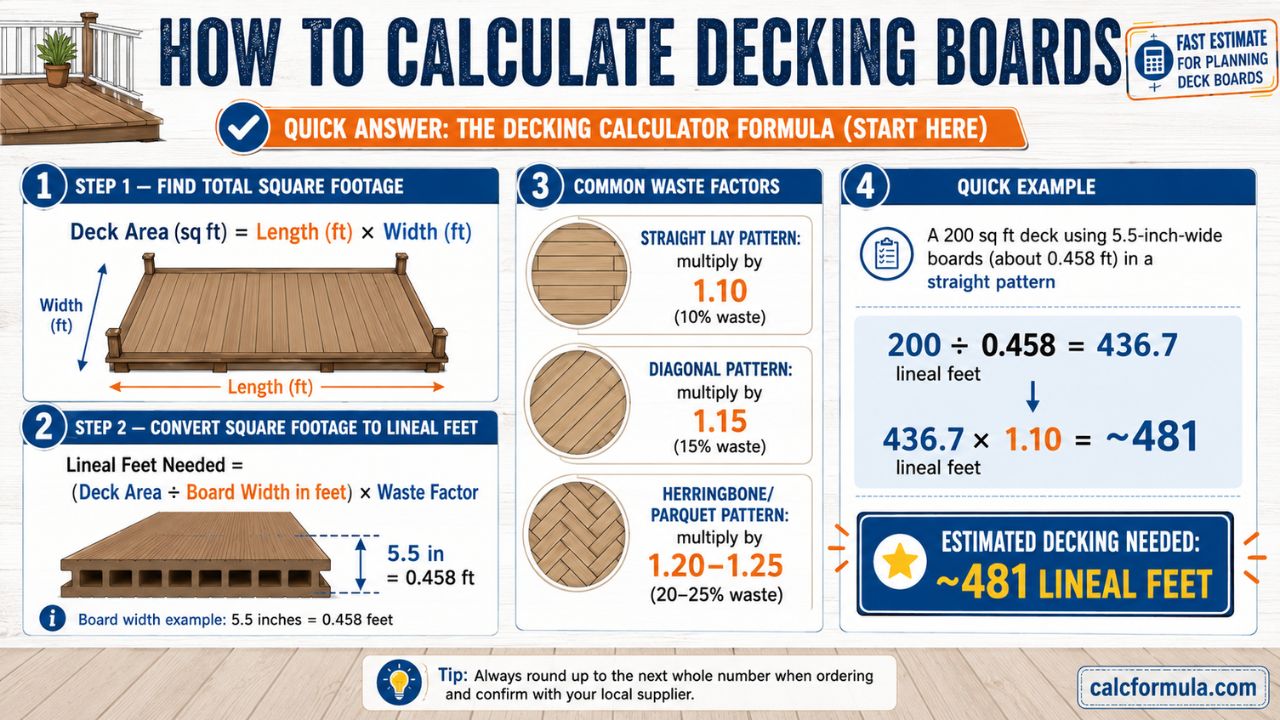
If you need a fast answer, here it is. Converting square footage to lineal feet of decking boards requires two steps:
Step 1 - Find Total Square Footage:
Deck Area (sq ft) = Length (ft) × Width (ft)
Step 2 - Convert Square Footage to Lineal Feet:
Lineal Feet Needed = (Deck Area ÷ Board Width in feet) × Waste Factor
Common waste factors:
- Straight lay pattern: multiply by 1.10 (10% waste)
- Diagonal pattern: multiply by 1.15 (15% waste)
- Herringbone/parquet pattern: multiply by 1.20-1.25 (20-25% waste)
Quick example: A 200 sq ft deck using 5.5-inch-wide boards (about 0.458 ft) in a straight pattern:
200 ÷ 0.458 = 436.7 lineal feet × 1.10 = ~481 lineal feet
Want to skip the manual math entirely? Use the free Decking Calculator at CalcFormula.com - it handles board width, waste factor, and even gap spacing automatically.
What Affects Your Decking Board Calculation (Variables Section)
Understanding why the formula works the way it does helps you catch errors before they cost you money. Here are every variable that feeds into how to calculate decking boards accurately:
1. Deck Shape and Square Footage
Simple rectangular decks are straightforward: length × width. But most real decks aren't perfect rectangles. L-shapes, wrap-around designs, cut corners around posts, and inset steps all need to be broken into smaller rectangles, calculated separately, then added together.
Pro tip: Always measure the actual board-laying surface, not the outer perimeter of the frame. Overhangs are part of the deck structure, but if boards don't reach the outer edge, don't count that space.
2. Board Width (Nominal vs. Actual)
This is one of the biggest sources of ordering errors. Lumber dimensions are listed in nominal sizes, but the actual milled width is always smaller. Here are the most common decking board sizes:
| Nominal Size | Actual Width | Width in Feet |
|---|---|---|
| 2×4 | 3.5 inches | 0.292 ft |
| 2×6 | 5.5 inches | 0.458 ft |
| 5/4×4 | 3.5 inches | 0.292 ft |
| 5/4×6 | 5.5 inches | 0.458 ft |
| 1×4 (composite) | 3.5 inches | 0.292 ft |
| 1×6 (composite) | 5.5 inches | 0.458 ft |
Always use the actual width - not the nominal - in your lineal feet calculation.
3. Gap Spacing Between Boards
Standard practice is to leave a 1/8-inch to 1/4-inch gap between boards for drainage and expansion. This gap effectively increases the functional width of each board-plus-gap unit:
- 5.5-inch board + 1/8-inch gap = 5.625 inches effective coverage
- 5.5-inch board + 1/4-inch gap = 5.75 inches effective coverage
For large decks, gap spacing reduces total board count meaningfully. A Board Foot Calculator can factor in spacing alongside board dimensions when you're pricing out lumber costs by volume.
4. Decking Pattern and Lay Direction
The angle at which boards are laid dramatically affects waste:
- Parallel to joists (standard straight): Lowest waste, 8-12%
- Perpendicular (most common): 8-10% waste standard
- Diagonal (45°): 12-18% waste due to more end cuts
- Herringbone or chevron: 20-25% waste, often more for tight patterns
- Picture frame border: Adds a full perimeter ring of boards; calculate separately
5. Board Length and Available Stock
Boards come in standard lengths: 8 ft, 10 ft, 12 ft, 14 ft, 16 ft, and 20 ft. Your deck's dimensions should ideally align with stock lengths to minimize end cuts. A 12-foot-wide deck run with 12-foot boards wastes almost nothing on length. A 13-foot deck run with 12-foot boards means every single board gets a 1-foot off-cut.
6. Species and Grade
Pressure-treated pine, cedar, redwood, Ipe, Tigerwood, and composite boards all have different standard dimensions and available lengths. Composite boards in particular often come in proprietary widths - check the manufacturer spec sheet, not the label.
7. Post-Finish Considerations
Once you've calculated board quantities, don't forget finishing. Staining and sealing requires knowing the total surface area - both top face and exposed edges. The Deck Stain Calculator takes square footage and translates it into gallons needed based on your stain's coverage rate and the number of coats planned.
Step-by-Step Worked Example: How to Calculate Decking Boards for a Real Deck
Let's walk through a real-world scenario from start to finish.
Project: A 16 ft × 20 ft rectangular deck, using pressure-treated 5/4×6 boards (actual width 5.5 inches), laid diagonally at 45°, with 3/16-inch gaps between boards. Board stock available: 16-foot lengths.
Step 1: Calculate Deck Square Footage
Area = 16 ft × 20 ft = 320 square feet
Step 2: Determine Effective Board Coverage Width
Actual board width = 5.5 inches Gap = 3/16 inch = 0.1875 inches Effective coverage per board = 5.5 + 0.1875 = 5.6875 inches = 0.4740 feet
Step 3: Calculate Base Lineal Feet (No Waste)
Base Lineal Feet = 320 sq ft ÷ 0.474 ft = 675.1 lineal feet
Step 4: Apply Waste Factor for Diagonal Pattern
Diagonal layouts get a 15% waste factor:
675.1 × 1.15 = 776.4 lineal feet
Round up to 780 lineal feet (always round up, never down).
Step 5: Convert Lineal Feet to Board Count
Each board is 16 feet long:
780 lineal feet ÷ 16 ft per board = 48.75 boards
Round up: order 49 boards of 5/4×6×16'.
Step 6: Double-Check with Square Footage
49 boards × 16 ft × 0.458 ft (width) = 358.8 sq ft of coverage
That covers 320 sq ft with ~38 sq ft of buffer - appropriate for a 15% waste factor on a diagonal lay. The math checks out.
Step 7: Price Your Lumber with Board Feet
If your lumber yard prices by board foot (a volume measurement), head to the Board Foot Calculator - enter thickness (1.25 inches for 5/4 stock), width (5.5 inches), and length (16 ft) to get board feet per piece and total project volume pricing.
Step 8: Estimate Stain Needed
Your 320 sq ft deck (top surface) plus approximately 95 linear feet of exposed fascia and rim boards adds up to roughly 350 sq ft of stainable surface for one coat. At a typical semi-transparent stain coverage of 200-300 sq ft per gallon, you'd need 1.5-2 gallons per coat. Use the Deck Stain Calculator to dial in exact gallons based on your stain brand and application method.
Common Mistakes When Calculating Decking Boards (And How to Avoid Them)
Even experienced builders get tripped up by the same errors. Here's what to watch for when learning how to calculate decking boards for your next project:
Mistake 1: Using Nominal Width Instead of Actual Width
A 2×6 is NOT 2 inches by 6 inches. It's 1.5 × 5.5. Using 6 inches in your formula instead of 5.5 inches will cause you to underestimate board count by nearly 10%. Always verify actual dimensions on the manufacturer's spec sheet or by measuring a sample board at the yard.
Mistake 2: Forgetting Gap Spacing Entirely
On a 300 sq ft deck, ignoring even a 1/8-inch gap means you're calculating as if boards are touching. At that scale you can easily be off by 3-5 boards. Small gaps add up across dozens of runs.
Mistake 3: Applying a Flat Waste Factor to a Complex Design
A 10% waste factor makes sense for a simple rectangle with straight boards. A picture-frame border, diagonal field boards, AND a central medallion pattern could push waste past 30%. Break your deck into zones - calculate each pattern area separately, apply the appropriate waste factor to each, then sum.
Mistake 4: Not Accounting for Board Length Efficiency
Ordering 12-foot boards for a 14-foot-wide deck means every board produces a 2-foot off-cut scrap. That's 14% structural waste on top of your cut waste. Before ordering, check whether a slightly longer stock length (say, 16-foot boards ripped to 14 ft) leaves useful off-cuts elsewhere on the project - for stairs, blocking, or fascia.
Mistake 5: Ignoring Moisture Content and Acclimation
Freshly milled pressure-treated lumber can shrink noticeably as it dries. Some contractors intentionally install PT boards tight (no gap) knowing the gap will open as the wood dries. If you're doing this, your lineal feet calculation stays the same, but your sequencing changes. Factor this in before your delivery date.
Mistake 6: Skipping the Stain and Sealer Estimate
Decking boards aren't finished until they're sealed or stained. Plenty of homeowners calculate boards perfectly, then forget to budget for finishing products. After completing your board count, immediately run the numbers through the Deck Stain Calculator so stain is on order before your build is complete.
Tip: Always Add a "Safety Stock" Buffer
No matter how careful your calculation, order at least 5-10% more boards than the formula says - above and beyond your waste factor. Defective boards (splits, knots, warps) exist in every bundle. Having spares on-site means repairs years later are seamless because wood from the same batch will have aged similarly.
FAQ: Calculating Decking Boards
Q1: How do I convert square feet of deck to lineal feet of boards?
Divide total square footage by the board's actual width (in feet), then multiply by your waste factor. For example: 200 sq ft ÷ 0.458 ft (a 5.5-inch-wide board) = 437 lineal feet × 1.10 (10% waste) = 481 lineal feet. For instant results without manual arithmetic, the Decking Calculator does this conversion automatically.
Q2: What's the difference between lineal feet and board feet when ordering decking?
Lineal feet measures the length of a board regardless of its cross-sectional size - it's used to count how many physical boards you need. Board feet measure volume (length × width × thickness ÷ 12) and are used for pricing lumber by the stick. Lumber yards may quote either unit depending on product type; composite decking is typically sold by the lineal foot, while rough hardwood is typically sold by the board foot.
Q3: How much waste should I add for a diagonal deck pattern?
A 45-degree diagonal pattern typically requires 12-18% additional material over a straight lay. Most estimators use 15% as a standard rule of thumb for a pure diagonal field. If you're adding a picture-frame border (which runs perpendicular to the field boards), calculate the border perimeter separately as straight-lay boards, then add your diagonal waste factor only to the interior field area.
Q4: How do I calculate decking boards for an L-shaped or irregular deck?
Break the deck footprint into two or more non-overlapping rectangles. Calculate the square footage of each rectangle separately, then add them together for your total area. Apply your formula to the combined total. For decks with large cut-outs around trees or hot tubs, subtract those areas before calculating.
Q5: Does composite decking use the same calculation as wood?
Yes - the core formula (area ÷ board width × waste factor) is the same. The key difference is that composite boards often come in proprietary widths that differ from standard lumber. Many composite manufacturers also offer hidden fastener systems that require a slightly wider gap, changing your effective coverage width. Always use the manufacturer's spec sheet for actual board dimensions. Also note that composite boards are typically sold in set lengths (12 ft, 16 ft, 20 ft) without the ability to special-order intermediate sizes.
Q6: How do I calculate how much deck stain I need after figuring out board quantities?
Once you know total deck square footage, account for all stainable surfaces: the top face of deck boards, exposed joist ends, fascia, railings, and stairs. Multiply that total surface area by the number of coats planned. Divide by the stain's listed coverage rate per gallon (find this on the can or product data sheet). The Deck Stain Calculator handles this entire calculation - just plug in surface area, coverage rate, and coats.
Q7: What's the most common board size used for residential decks?
The 5/4×6 (actual: 1 inch × 5.5 inches) pressure-treated pine board is by far the most common residential decking board in North America. It's lighter than full 2× dimensional lumber, takes fasteners cleanly, and spans standard 16-inch on-center joist spacing without significant bounce. For premium natural wood decks, 2×6 cedar or redwood is a popular upgrade. Composite decks frequently use a 1-inch × 5.5-inch or 1-inch × 3.5-inch proprietary board depending on the manufacturer system.
Useful Calculators for Your Decking Project
Save time and avoid errors by using these free tools at every stage of your build:
- Decking Calculator - Enter deck dimensions, board size, and layout pattern to get instant lineal feet, board count, and estimated cost.
- Board Foot Calculator - Convert lineal feet to board feet for volume-priced lumber purchasing and job-site material tracking.
- Deck Stain Calculator - Determine how many gallons of stain or sealer you need based on total surface area, coverage rate, and number of coats.
Final Thoughts: Get Your Decking Calculation Right the First Time
Knowing how to calculate decking boards - from raw square footage down to a precise lineal feet order - is a skill that pays dividends on every project. The formula isn't complicated, but the details (actual vs. nominal width, gap spacing, pattern waste, board length efficiency) compound quickly. Miss one and you'll either be short mid-build or staring at an expensive stack of leftovers.
Use the worked example in this guide as your calculation template, apply the right waste factor for your layout, and cross-check your final number with the Decking Calculator before you hit the lumber yard. A few minutes of accurate math now saves hours of frustration - and real money - later.
This guide was written by a certified construction estimator with over 15 years of experience in residential deck building and material takeoff. All formulas are based on standard industry practices used by professional contractors and lumber estimators.