Standing water is a deck's worst enemy. It accelerates rot in wood boards, degrades composite finishes, breeds mold, creates slip hazards, and quietly undermines the framing below the surface before you even notice a problem. Yet one of the most overlooked decisions in deck construction - and one of the most commonly under-specified in DIY builds - is how much slope the deck surface actually needs to shed water effectively.
This guide gives you the exact answer, the full formula, every variable that affects slope calculation, a detailed worked example, the mistakes that lead to pooling water, and answers to the most common questions homeowners and contractors ask about deck drainage slope. Whether you're building from scratch, re-decking over an existing frame, or diagnosing a drainage problem on an existing structure, you'll have everything you need by the end.
Quick Answer: How Much Slope Does a Deck Need for Water Runoff?
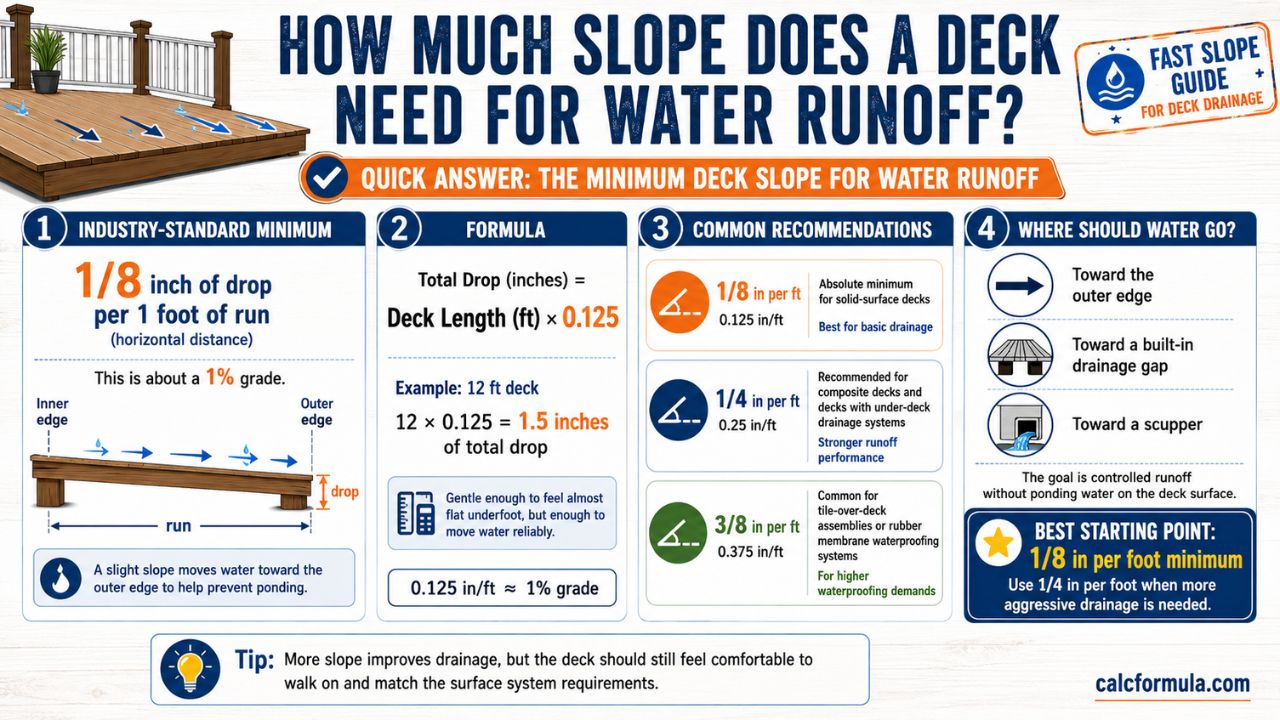
The industry-standard minimum slope for a deck surface is:
1/8 inch of drop per 1 foot of run (horizontal distance)
Written as a formula:
Total Drop (inches) = Deck Length (ft) × 0.125This equals approximately a 1% grade - gentle enough to be imperceptible underfoot, but sufficient to move water reliably toward the outer edge, a built-in drainage gap, or a scupper.
Some codes and manufacturers recommend:
- 1/8 inch per foot (0.125 in/ft): Absolute minimum for solid-surface decks
- 1/4 inch per foot (0.25 in/ft): Recommended for composite decks and decks with under-deck drainage systems
- 3/8 inch per foot (0.375 in/ft): Common for tile-over-deck assemblies or rubber membrane waterproofing systems
Before building, use the free Deck Slope Calculator at CalcFormula.com to instantly find required drop height based on your deck length and target slope ratio - no manual arithmetic needed.
What Affects the Deck Slope Calculation? (Variables Section)
How Much Slope Does a Deck Need for Water Runoff Based on Decking Material?
Not all decking surfaces drain the same way. The gap between boards - or the absence of one - is what primarily determines how much slope is actually required.
Gapped wood and composite decks (standard boards with 1/8-1/4 inch gaps): Water falls through the gaps by gravity regardless of slope. However, surface water that doesn't immediately find a gap still needs somewhere to go. The minimum 1/8 inch per foot applies here, primarily to drain surface pooling near posts, hardware, and tight-fitting areas where gaps are sealed.
Solid-surface composite systems (tongue-and-groove or capped boards with no visible gap): Water has no vertical exit and must travel horizontally to an edge drain or scupper. These systems require a minimum of 1/4 inch per foot - and manufacturers like Trex, TimberTech, and Fiberon often specify this in their installation guides. Always check the manufacturer's current spec before framing.
Tile or paver-over-deck assemblies: Porcelain tile set over a deck membrane system requires 3/8 inch per foot minimum (roughly a 3% grade) to prevent water from backing up under tile edges and into the membrane seams.
Rubber or vinyl waterproof membrane systems: Typically require 1/4 inch per foot minimum, with 1/2 inch per foot preferred on larger decks so water reaches drains before sitting long enough to pond.
Deck Size and Run Length
The longer the distance water must travel to reach a drain or free edge, the more critical proper slope becomes. On a 10-foot deck, 1/8 inch per foot produces 1.25 inches of total drop - that's manageable with standard framing adjustments. On a 30-foot deck, the same slope produces 3.75 inches of total drop, which begins to affect how the deck looks, how furniture sits, and how the ledger board aligns with the house.
For longer decks, some builders drain toward the center via a center ridge (crown), sending water in two directions over a shorter effective run. This halves the required total drop on each side and keeps the visual pitch subtle.
Framing Method: Tapered Joists vs. Shim Plates vs. Angled Ledger
How you achieve slope in the framing matters as much as the slope value itself:
- Tapered rim joists: The rim board is cut at a slight angle so all joists slope uniformly. Precise but labor-intensive.
- Shim plates on post caps: Post-cap hardware is shimmed on the low side to tilt the entire beam. Easy to execute, but requires exact shim calculation.
- Angled ledger installation: The ledger board is mounted to the house at a slight downward pitch away from the structure. Works best for new builds where the ledger height hasn't been fixed yet.
- Tapered sleepers (for over-concrete applications): Pressure-treated sleepers are ripped at a taper so deck boards slope while the concrete slab stays flat.
Local Building Code Requirements
Always check with your local building department. Most U.S. jurisdictions follow the International Residential Code (IRC) and International Building Code (IBC), but local amendments may specify minimum drainage slopes - especially for covered decks, second-story decks over living space, or decks attached to condominiums. Some jurisdictions require engineer-stamped drawings for any deck drainage system that channels water toward neighboring properties.
Drain Direction: Away From the House
Regardless of the slope value used, water should always move away from the structure - never toward the ledger board, band joist, or house wall. This single rule prevents the most common and costly water damage associated with attached decks: moisture infiltration at the ledger connection, which can rot the house rim joist and floor system behind it.
Step-by-Step Worked Example: Calculating Deck Slope for Water Runoff
Project: A 16 ft × 24 ft attached deck using 5/4×6 composite boards with no visible surface gap (a solid-surface system). The deck drains away from the house toward the outer rim board, which has 1-inch drainage gaps at each joist bay.
Step 1: Choose the Slope Standard
Solid-surface composite system → use 1/4 inch per foot (0.25 in/ft) per manufacturer recommendation.
Step 2: Identify the Drainage Run Length
Water drains from the ledger board outward across the 16-foot width of the deck:
Drainage Run = 16 feetStep 3: Calculate Total Required Drop
Total Drop = Run (ft) × Slope Rate (in/ft)
Total Drop = 16 ft × 0.25 in/ft = 4.0 inches
The outer edge of the deck framing must sit 4 inches lower than the ledger height.
Step 4: Verify the Slope as a Percentage Grade
Grade (%) = (Drop ÷ Run) × 100
Grade (%) = (4 inches ÷ 192 inches) × 100 = 2.08%
2.08% is within the acceptable range for this assembly (1-3% is standard for most solid-surface deck systems). The slope will be barely perceptible to occupants walking across it.
Step 5: Determine Beam and Post Height Adjustment
If the ledger is set at 48 inches above grade at the house, the outer beam must be set at:
Outer Beam Height = 48 inches − 4 inches = 44 inches above gradeThis height difference is accomplished by adjusting post height, post-cap shim thickness, or cutting the beam seat at a slight angle, depending on the construction method chosen.
Step 6: Double-Check with the Deck Slope Calculator
Before framing, verify your numbers using the Deck Slope Calculator. Enter the drainage run (16 ft) and your target slope (1/4 inch per foot) to confirm the total drop value and cross-check framing heights - especially useful on decks with irregular shapes where multiple drainage zones run different lengths.
Step 7: Plan Stain and Sealer Application
Once the slope is set and decking is installed, the sloped surface area still needs finishing. Slope doesn't change the square footage calculation for staining, but it does affect how products absorb - the lower end of a sloped deck tends to accumulate more runoff and may need more frequent maintenance coats. Use the Deck Stain Calculator to determine exact gallon quantities for your deck's square footage and number of planned coats before purchasing stain.
Common Mistakes When Calculating and Building Deck Slope
Mistake 1: Building a Perfectly Level Deck
This is the single most common error in DIY deck building. Many first-time builders use a spirit level religiously to make everything perfectly flat - but a perfectly level deck doesn't drain. Water sits in any low spot, around post bases, and along the house wall. The fix is always expensive because you have to shim or re-frame after the deck is built.
The fix: Set your target slope before you set a single post or hang a joist. Mark beam heights on each post accounting for the 1/8 to 1/4 inch per foot drop from the start.
Mistake 2: Sloping the Deck Toward the House
This happens when a builder sets the ledger lower than the outer beam - perhaps to get the deck surface flush with an interior floor level. Water then runs directly toward the house wall and ledger connection. Even with flashing, this setup accelerates deterioration of the house structure.
The rule: Deck always slopes away from the house. If a flush interior-to-exterior transition is required, use a threshold drain at the door or recess the ledger appropriately.
Mistake 3: Not Accounting for Composite Board Crown
Many composite decking boards are manufactured with a slight crown on the top surface - a very slight arch across the width of the board that sheds water to both edges. Some installers assume this crown provides enough drainage and skip framing slope. It doesn't. The crown handles lateral drainage within each board width, but without framing slope, water still ponds along the board ends and between boards longitudinally.
Mistake 4: Applying a Uniform Slope to Multi-Level or Multi-Zone Decks
An L-shaped deck that drains in two different directions needs two separate slope calculations - one for each zone. Applying one slope value across the whole footprint usually means one section is over-sloped and another is under-sloped. Calculate each drainage zone independently using its own run length, and use the Deck Slope Calculator for each zone separately.
Mistake 5: Ignoring Slope on Covered or Roofed Decks
Covered decks actually need more attention to slope, not less. Rain blowing under a roof cover still reaches the deck surface. More importantly, covered decks trap moisture that can't evaporate in direct sun - making proper drainage even more critical. Under-deck waterproof ceiling systems (which collect and drain water falling through the boards) require their own minimum slope specification: typically 1/4 inch per foot for the drainage trough or channel system below the deck.
Mistake 6: Forgetting to Account for Slope in Stair Stringer Height
On an attached deck, changing the outer beam height to achieve slope also changes the stair stringer top-cut height. If you frame the deck with a 4-inch drop from ledger to outer beam, your stair stringers need to account for that adjusted deck surface height - not just the structural deck height. Missing this throws off riser dimensions and can create an uneven bottom step.
Tip: Always finalize your slope calculation before designing stairs.
Pro Tip: Use a Slope Gauge or Digital Level During Framing
A 4-foot digital torpedo level with a slope percentage readout is one of the most useful tools for deck framing. Set your target slope, hold the level against each joist as you hang it, and confirm you're hitting your target before fastening. Catching a joist that's 1/16 inch off at this stage takes seconds to fix; catching it after decking is installed takes half a day.
FAQ: How Much Slope Does a Deck Need for Water Runoff?
Q1: What is the minimum slope required for deck drainage?
The industry-accepted minimum slope for deck water runoff is 1/8 inch of vertical drop per 1 foot of horizontal run. This applies primarily to decks with gapped boards where most water drains through the surface. Solid-surface composite systems, tile-over-deck assemblies, and waterproof membrane systems all require steeper slopes - typically 1/4 inch per foot or more. Always verify the requirement against your specific decking manufacturer's installation guide and local building code.
Q2: How do I calculate how much my deck needs to drop for drainage?
Use this simple formula:
Total Drop (inches) = Deck Run Length (ft) × Slope Rate (in/ft)For a 20-foot deck with the standard 1/8 inch per foot slope:
20 ft × 0.125 in/ft = 2.5 inches total dropFor faster results, the Deck Slope Calculator calculates total drop, grade percentage, and framing height adjustments instantly.
Q3: Will a sloped deck look tilted or feel uncomfortable to walk on?
At the standard 1/8 inch per foot, almost nobody notices the slope. That's a 1% grade - far below the 2% threshold at which most people begin to perceive a tilt underfoot. Even at 1/4 inch per foot (roughly 2%), the slope is at the edge of human perception on a wide-open deck surface. Furniture with adjustable feet handles this range easily. Issues become noticeable only above 3/8 inch per foot, which is why that rate is reserved for tile systems where structural necessity justifies it.
Q4: Does deck slope affect how I apply deck stain or sealant?
The slope itself doesn't change stain coverage calculations, but it does affect application technique. On a sloped deck, stain and water-based sealers tend to run toward the lower edge if applied too generously. Work in manageable sections - applying from the high end toward the low end - and back-brush or back-roll immediately to prevent pooling at board ends. The low-end boards and the outer rim fascia typically absorb more water over time and may require more frequent re-coating. Use the Deck Stain Calculator to plan your gallons before you start.
Q5: What's the difference between deck slope and deck pitch?
In common usage, "deck slope" and "deck pitch" refer to the same thing - the amount of vertical rise or fall over a horizontal distance. Technically, pitch is more often used in roofing (expressed as inches of rise per 12 inches of run, e.g., 4:12), while slope is used in decking and civil grading (expressed as inches of drop per foot of run or as a percentage grade). For deck drainage purposes, the terms are interchangeable. A 1/8-inch-per-foot slope equals a 0.104:12 pitch, or roughly a 1% grade.
Q6: How do I add slope to an existing flat deck that already has drainage problems?
There are three practical approaches depending on how severe the problem is and what the current framing allows:
- Add tapered sleepers over existing joists: Rip pressure-treated 2× material at a slight angle and fasten over the existing joists before re-decking. This works well when re-decking over an existing frame and the frame itself is sound.
- Shim post-beam connections: If the frame is accessible from below and posts sit on adjustable hardware, raising or lowering individual post caps can introduce slope into the frame without rebuilding it.
- Install a deck drainage system: Products like RainEscape or similar under-deck drainage trough systems collect water falling through the boards and channel it to downspouts. These don't fix the surface slope, but they manage water from the underside and protect the space below.
Q7: Do building codes specify how much slope a deck needs for drainage?
Most U.S. model building codes (IRC and IBC) do not specify an exact minimum drainage slope for open deck surfaces - because gapped deck boards inherently drain through the surface. However, codes do regulate waterproof decking assemblies, tile-over-deck systems, and any deck built over living space. In these cases, 2% minimum slope is typically required for the waterproofing membrane. Local amendments vary widely. Always check with your local building or planning department before framing, and verify any covered-deck or over-living-space assemblies with a licensed professional engineer.
Useful Calculators for Your Deck Drainage Project
These free tools take the guesswork out of deck slope planning and finishing:
- Deck Slope Calculator - Enter your deck run length and target slope to instantly calculate total drop, grade percentage, and framing height adjustments for any deck size or drainage configuration.
- Deck Stain Calculator - Calculate exactly how many gallons of stain or sealer you need based on total deck surface area, product coverage rate, and planned number of coats.
Final Thoughts: Get Your Deck Slope Right Before You Frame
The question of how much slope a deck needs for water runoff has a simple answer - 1/8 inch per foot minimum, 1/4 inch per foot for solid-surface systems - but the execution lives in the details. Which direction does water drain? Is the deck attached to the house? What decking product is going on top? How long is the drainage run? Each variable feeds into a framing decision that's far easier to get right before the first post is set than to correct after the last board is screwed down.
Use the formula and worked example in this guide to plan your framing heights, verify your numbers with the Deck Slope Calculator, and avoid the six common mistakes that send homeowners back to the lumber yard for re-framing lumber. A properly sloped deck sheds water reliably for decades - and that means a longer-lasting finish, lower maintenance costs, and a safer surface for everyone who walks on it.
This article was written by a certified deck builder and structural estimator with over 15 years of residential construction experience. All slope standards referenced are based on current IRC guidelines, major composite decking manufacturer installation specifications, and established industry best practice.