Of all the measurements a pipefitter or plumber makes in the field, the rolling offset is the one that trips up even experienced tradespeople most consistently. A simple offset - moving a pipe left or right, or up or down, between two parallel runs - is taught early in any pipefitting program and becomes second nature fast. But as soon as the pipe has to move in both directions simultaneously - rising while shifting sideways, or dropping while traveling forward - you're dealing with a rolling offset, and the math changes completely.
Get a rolling offset calculation wrong and you're cutting pipe to the wrong length, your fittings don't pull up squarely, your hanger spacing is off, and you end up re-cutting on the job. Get it right and the whole run drops in cleanly on the first attempt. This guide gives you the exact formula for how to calculate a rolling offset in pipe installation, explains every variable you need, walks through a complete worked example with both 45° and standard fittings, covers every common mistake in the field, and answers the questions journeymen and apprentices ask most often about rolling offset work.
Quick Answer: The Rolling Offset Formula
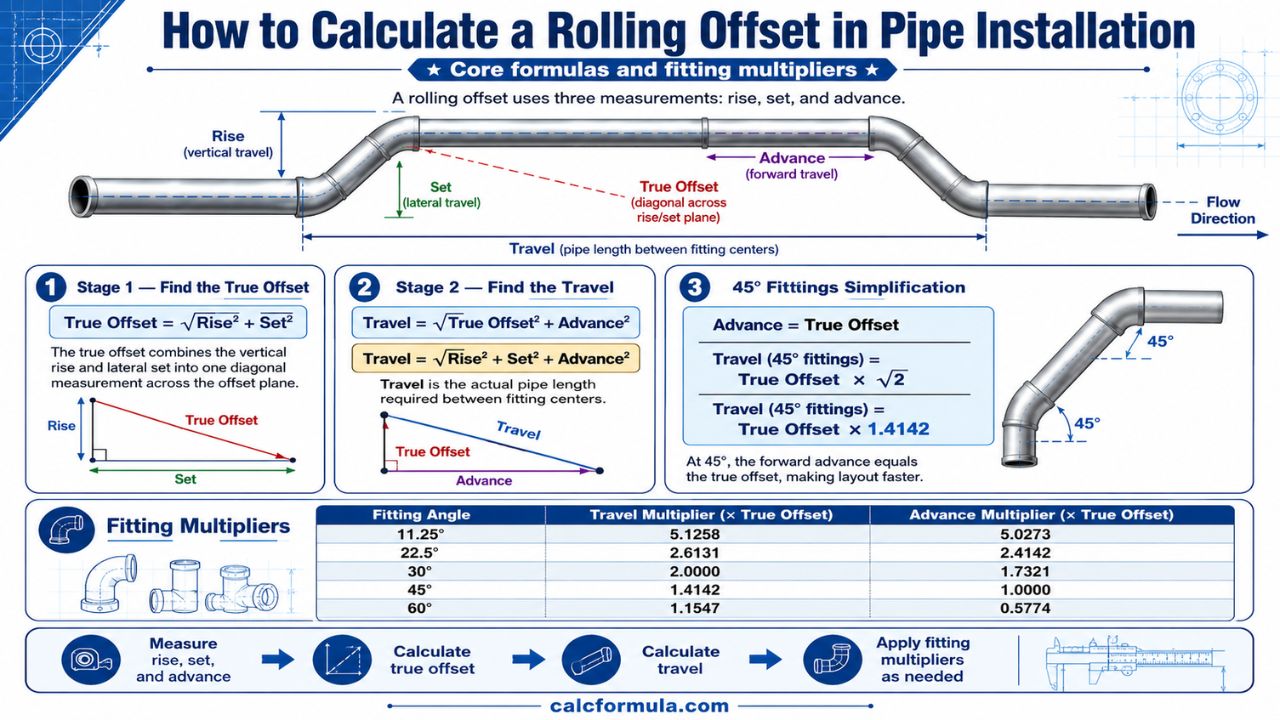
A rolling offset involves three measurements: rise (vertical travel), set (horizontal lateral travel), and advance (forward travel along the pipe run direction). The calculation is a two-stage process.
Stage 1 - Find the True Offset:
True Offset = √(Rise² + Set²)The true offset is the diagonal distance the pipe must travel across a plane perpendicular to the pipe run - combining both the vertical and horizontal side movement into one diagonal measurement.
Stage 2 - Find the Travel (pipe length between fitting centers):
Travel = √(True Offset² + Advance²)Or equivalently, combining both stages into one formula:
Travel = √(Rise² + Set² + Advance²)For 45° fittings, the advance equals the true offset, which simplifies the travel calculation:
Travel (45° fittings) = True Offset × √2 = True Offset × 1.4142Fitting multipliers for other common fitting angles:
| Fitting Angle | Travel Multiplier (× True Offset) | Advance Multiplier (× True Offset) |
|---|---|---|
| 11.25° | 5.1258 | 5.0273 |
| 22.5° | 2.6131 | 2.4142 |
| 30° | 2.0000 | 1.7321 |
| 45° | 1.4142 | 1.0000 |
| 60° | 1.1547 | 0.5774 |
For instant results across all fitting angles and offset configurations, the free Rolling Offset Calculator at CalcFormula.com computes true offset, travel, and advance simultaneously - no trigonometry required on the job site.
What Affects How to Calculate a Rolling Offset in Pipe Installation?
Understanding Rise, Set, and Advance in a Rolling Offset
Before any formula is useful, every variable must be clearly understood and precisely measured in the field. Confusing these three terms is the root cause of the majority of rolling offset errors.
Rise is the vertical distance the pipe must travel between its starting centerline elevation and its ending centerline elevation. If the pipe starts at 10 feet above finished floor and must arrive at 8 feet above finished floor after the offset, the rise is 2 feet (a drop). Rise is always measured plumb - straight up or down - regardless of any lateral movement.
Set is the horizontal lateral distance the pipe must travel perpendicular to its forward run direction. If a pipe running north must arrive at a point 3 feet to the east of its starting centerline, the set is 3 feet. Set is always measured level and perpendicular to the direction of pipe travel.
Advance is the forward distance the pipe travels along its run direction during the offset. For two parallel pipe runs separated by an offset, the advance is the distance between the two parallels measured along the run axis - in other words, the room the fittings take up in the forward direction. The advance is determined either by the physical constraint of the installation (a column, a beam, a duct) or by the fitting angle selected.
The key relationship: for a given true offset and fitting angle, the advance is fixed by trigonometry. You cannot independently choose all three of rise, set, advance, and fitting angle - once you fix three, the fourth is determined.
Fitting Angle Selection and Its Effect on Advance and Travel
The fitting angle chosen for a rolling offset directly controls how much forward advance is required to complete the offset. Steeper fittings (60°) take less advance but create higher flow turbulence. Shallower fittings (22.5°, 11.25°) require more advance distance but produce smoother flow transitions and lower pressure drop. The 45° fitting is by far the most common choice in general plumbing and mechanical piping because it balances advance distance, availability, and hydraulic efficiency.
In confined spaces - between joists, inside a mechanical room with limited forward clearance - a steeper fitting angle reduces the advance and may be the only practical option. In overhead piping or open mechanical rooms, 22.5° fittings are often preferred for their superior flow characteristics. The fitting angle selection must be made before the rolling offset is calculated, because changing the angle changes both the travel length and the advance distance.
Pipe Material and Fitting Takeout
The travel length calculated by the rolling offset formula is the center-to-center distance between the two fittings that make up the offset. The actual cut length of the pipe between those fittings is shorter because the fittings themselves have a socket depth, thread engagement length, or butt-weld bevel that must be accounted for. This subtraction is called takeout (for socket and threaded fittings) or makeup (for threaded connections).
Takeout values by fitting type and pipe size are tabulated in standard pipefitter references and vary by pipe size. For a ½-inch threaded 45° elbow, takeout is approximately 7/16 inch per end. For a 2-inch socket-weld 45° elbow, takeout is the socket depth. The cut pipe length is:
Cut Length = Travel − (Takeout for Fitting 1) − (Takeout for Fitting 2)On large-diameter pipe with deep socket welds or heavily threaded connections, failing to subtract takeout produces pipe that is too long to fit between the fittings - requiring a field cut and rework.
Pipe Run Direction and Orientation
A rolling offset can occur in any orientation - the pipe may be rolling from a horizontal run, from a racked vertical run, or from an angled run. The rise and set measurements are always taken relative to the pipe's true horizontal and vertical planes, not relative to the pipe's travel direction. For racked or inclined runs, project rise and set onto the true plumb and level planes before computing the true offset.
When the pipe run also has a continuous slope for drainage (common in sanitary drain lines, condensate lines, and process piping), the slope contributes to the rise component of the rolling offset. For sloped lines, calculate the grade-related rise over the advance distance first, then add it to or subtract it from the structural rise requirement. The Pipe Slope Calculator calculates the rise contributed by any drainage slope over a given advance distance - critical for integrating slope requirements with rolling offset geometry on drain line installations.
Number of Fittings in the Rolling Offset
A standard rolling offset uses exactly two fittings of the same angle, oriented so their angles combine to redirect the pipe diagonally through the offset and back to parallel. Less commonly, a rolling offset is achieved using three or more fittings - for example, a combination of a 45° and a 22.5° to achieve a specific geometry in a constrained space. Multi-fitting rolling offsets require a more complex geometric analysis and are typically solved by breaking the offset into stages, calculating each stage separately, and chaining the results. For standard two-fitting rolling offsets, the formulas in this guide apply directly.
Step-by-Step Worked Example: How to Calculate a Rolling Offset in Pipe Installation
Project: A 2-inch Schedule 40 steel pipe must navigate around a steel column. The pipe run is traveling east. To clear the column, the pipe must travel 9 inches to the south (set) and 6 inches downward (rise) simultaneously, using 45° standard elbows. The installation uses threaded connections. Takeout for a 2-inch threaded 45° elbow is 1-1/16 inches per end. Calculate true offset, travel, advance, and cut pipe length.
Step 1: List all known values
Rise  = 6 inches (downward)
Set   = 9 inches (southward)
Fitting angle = 45°
Takeout per elbow end = 1-1/16 in = 1.0625 inches
Step 2: Calculate the true offset
True Offset = √(Rise² + Set²)
            = √(6² + 9²)
            = √(36 + 81)
            = √117
            = 10.817 inches
Step 3: Determine the advance (for 45° fittings, advance = true offset)
Advance = True Offset × 1.0000  (for 45° fittings)
Advance = 10.817 inches
This is the forward (eastward) distance the fittings will consume in the pipe run. Confirm this space is available in the field before cutting any pipe.
Step 4: Calculate the travel (center-to-center pipe length)
Travel = True Offset × 1.4142  (for 45° fittings)
       = 10.817 × 1.4142
       = 15.298 inches
Or using the full three-dimension formula as a cross-check:
Travel = √(Rise² + Set² + Advance²)
       = √(36 + 81 + 117)
       = √234
       = 15.297 inches  ✓
Both methods agree: center-to-center travel = 15.30 inches (round to nearest 1/16 = 15-5/16 inches).
Step 5: Calculate the cut pipe length
Two fittings, each contributing one takeout at the pipe connection end:
Total takeout = 2 × 1.0625 = 2.125 inches = 2-1/8 inches
Cut Length = Travel − Total Takeout
           = 15.313 − 2.125
           = 13.188 inches
           = 13-3/16 inches
The pipe between the two 45° elbows cuts to 13-3/16 inches.
Step 6: Verify the fitting orientation
For the fittings to produce the correct rolling offset geometry, both elbows must be rotated so their outlet planes point diagonally - not straight up/down or straight sideways. The angle of rotation (roll angle) from vertical for each fitting is:
Roll Angle = arctan(Set ÷ Rise) = arctan(9 ÷ 6) = arctan(1.5) = 56.3°Each fitting is rotated 56.3° from the vertical plane toward the southward direction. Marking this rotation on the fittings with a chalk line or soapstone before assembly prevents misalignment during make-up.
Step 7: Cross-check advance clearance
Advance = 10.817 inches ≈ 10-13/16 inches. Measure this distance in the field along the pipe run east of the column face to confirm the second fitting lands in accessible space. Verify no obstructions - hangers, supports, other pipes - fall within this advance distance before proceeding. Use the Rolling Offset Calculator to quickly test alternative fitting angles (30° or 22.5°) if the 10-13/16-inch advance is too tight in the available space.
Common Mistakes When Calculating a Rolling Offset in Pipe Installation
Mistake 1: Measuring rise and set from the wrong reference points
Rise and set must be measured between pipe centerlines, not between outside pipe walls or between fitting edges. On large-diameter pipe, the difference between centerline and outside wall measurement can be significant - a 4-inch pipe has a 2-inch radius, so measuring from outside walls on both sides introduces a 4-inch error in the offset dimensions. Always establish centerline marks on both the existing run and the target run before measuring rise and set.
Mistake 2: Forgetting that the advance is not an independent measurement
Many apprentices try to measure rise, set, and advance all independently from the field layout, then apply the travel formula - and get confused when the numbers don't match the fitting angle on hand. The advance is determined by the fitting angle and the true offset, not by an independent field measurement. Measure rise and set from the field. Select your fitting angle. Calculate the required advance from the formula. Then verify that the required advance fits in the available space before cutting.
Mistake 3: Applying a flat offset multiplier to a rolling offset
The standard flat offset travel formula for a 45° offset is simply: Travel = Offset × 1.4142. Many pipefitters apply this directly to the rise or set alone without first computing the true offset. This gives the travel for a single-plane offset, not a rolling offset. The correct approach is always to combine rise and set into a true offset first (√(Rise² + Set²)), then multiply by 1.4142. Applying 1.4142 to the set alone when there is also a rise consistently produces a travel length that is too short.
Mistake 4: Not subtracting fitting takeout from the travel length
The rolling offset formulas give center-to-center distance, not cut pipe length. Every socket, thread, or weld connection has a makeup depth that reduces the actual cut length below the calculated travel. On small pipe (½ inch to 1 inch), takeout per fitting end is small but still meaningful - failing to subtract it leaves pipe that won't seat fully into the fittings. On large-diameter socket-weld pipe (3 inch and above), socket depth can be ¾ inch or more per end - skipping takeout on both ends puts 1.5 inches of excess length into the system that has nowhere to go.
Mistake 5: Ignoring fitting rotation angle during assembly
Calculating the correct travel length is only half the job. If the fittings are not rotated to the correct roll angle before assembly, the pipe lands in the wrong position even with a perfectly correct cut length. The roll angle (arctan of set divided by rise) determines how far each fitting must be rotated from vertical (or horizontal) to direct the pipe diagonally through the true offset plane. Mark the roll angle on each fitting with a permanent marker or soapstone before assembly and verify alignment with a level or angle finder before final make-up.
Mistake 6: Skipping the slope check on drain line rolling offsets
On sanitary drain, storm, or condensate lines where the pipe must maintain a continuous slope for self-cleaning velocity, the rolling offset introduces a rise (or drop) that may work with or against the required slope. A rolling offset that drops the pipe 4 inches over a 12-inch advance while the required slope is only 1/4 inch per foot (0.25 inches over 12 inches) generates far more drop than the slope requires - potentially creating a sagging low point or a section that runs at too steep a grade. Use the Pipe Slope Calculator to verify that the rise component of your rolling offset is consistent with the required drainage slope across the advance distance before cutting any pipe.
Pro Tip: Use the 3-4-5 Triangle Check in the Field
When the rise and set values are multiples of a 3-4-5 right triangle (for example, rise = 6 inches, set = 8 inches → true offset = 10 inches), recognize the Pythagorean triple immediately and skip the square root calculation entirely. Common field-friendly Pythagorean triples for rolling offset work: 3-4-5, 6-8-10, 9-12-15, 5-12-13, and 8-15-17. Memorizing these saves calculator time and provides an instant sanity check on calculated true offsets in the field.
FAQ: How to Calculate a Rolling Offset in Pipe Installation
Q1: What is the difference between a simple offset and a rolling offset in pipefitting?
A simple (or flat) offset moves a pipe in a single plane - either purely vertical or purely horizontal - between two parallel runs. Only one measurement (the offset distance) and one fitting angle determine the travel length. A rolling offset moves a pipe in two planes simultaneously: the pipe travels both vertically and horizontally at the same time to arrive at a new centerline that is offset in both directions. This requires computing a true offset (the diagonal combining rise and set) before applying the fitting multiplier to find travel. Rolling offsets are more common in congested mechanical rooms, pipe racks, and residential installations where obstructions require multi-direction avoidance.
Q2: What does "true offset" mean in a rolling offset calculation?
True offset is the straight-line diagonal distance the pipe must travel perpendicular to the pipe run direction - combining both the vertical rise and the horizontal set into a single measurement. It represents the hypotenuse of the right triangle formed by the rise and the set: True Offset = √(Rise² + Set²). The true offset is what the fitting angle actually works against, which is why it must be calculated before applying any fitting multiplier. Applying a multiplier to rise or set alone - without combining them into the true offset first - is the most common calculation error in rolling offset work.
Q3: How do I calculate a rolling offset with 45° fittings?
For 45° fittings, the advance equals the true offset and the travel equals the true offset multiplied by √2 (1.4142). The steps are: measure rise and set from centerline to centerline; compute True Offset = √(Rise² + Set²); compute Travel = True Offset × 1.4142; subtract fitting takeout from both ends to get cut pipe length; and calculate the fitting roll angle as arctan(Set ÷ Rise) to determine how each fitting must be rotated during assembly. The Rolling Offset Calculator performs all five steps simultaneously for 45° and all other common fitting angles.
Q4: How does fitting angle affect the rolling offset advance distance?
The advance distance is determined by the formula: Advance = True Offset ÷ tan(fitting angle). At 45°, tan(45°) = 1.0, so Advance equals True Offset exactly. At 22.5°, tan(22.5°) = 0.4142, so Advance = True Offset × 2.4142 - more than twice as long. At 60°, tan(60°) = 1.732, so Advance = True Offset × 0.577 - less than the true offset. Steeper fitting angles (larger angle numbers) require less advance space; shallower fitting angles require more advance. When forward space is constrained, choose a steeper fitting angle to reduce advance demand.
Q5: What is fitting takeout and how does it affect rolling offset pipe cut length?
Fitting takeout is the distance from the center of a fitting to the end of its socket, thread, or weld preparation - the amount of pipe that disappears inside the fitting during assembly. The center-to-center travel calculated by the rolling offset formula must have the takeout for each fitting end subtracted to arrive at the actual cut pipe length. Cut Length = Travel - (Takeout at Fitting 1 connection) - (Takeout at Fitting 2 connection). Takeout values are tabulated in pipefitter handbooks by pipe size and fitting type. For threaded fittings, takeout equals thread engagement depth plus the thread makeup allowance. For socket weld fittings, takeout equals the socket depth. Always confirm takeout values from the specific fitting manufacturer's spec sheet for critical installations.
Q6: Can I use the rolling offset formula for pipe that also has a continuous slope for drainage?
Yes, but the slope must be integrated into the rise component carefully. If a drain line must maintain a slope of 1/4 inch per foot and the rolling offset advance is 18 inches (1.5 feet), the slope contributes 1.5 × 0.25 = 0.375 inches of drop over the advance distance. If the rolling offset also requires a structural drop of 4 inches for clearance, the total rise used in the rolling offset formula is 4.375 inches (combining structural and grade drops). Use the Pipe Slope Calculator to compute the grade rise over any advance distance, then add it to the structural rise before computing your true offset.
Q7: How do I mark the roll angle on fittings before assembly?
Calculate the roll angle using: Roll Angle = arctan(Set ÷ Rise). This is the angle each fitting must be rotated from vertical (for primarily vertical offsets) or from horizontal (for primarily lateral offsets) toward the lateral offset direction. In the field, mark a reference line on the fitting hub using a square and soapstone before threading or welding. Many pipefitters use a digital angle finder or a speed square held against the fitting outlet to verify the roll angle during assembly. On threaded pipe, apply pipe dope and make up the fitting past the roll angle mark by the standard thread makeup count, then check alignment. If the fitting seats short of the roll angle, the pipe is too long; if it passes the mark, the pipe is too short.
Useful Calculators for Rolling Offset and Pipe Installation
These free tools cover every step of the rolling offset workflow from field measurement to cut list:
Rolling Offset Calculator - Enter rise, set, and fitting angle to instantly compute true offset, travel length, advance distance, and fitting roll angle for any combination of standard fitting angles from 11.25° to 60°. Eliminates field calculator trigonometry entirely.
Pipe Slope Calculator - Calculate rise, slope percentage, and grade elevation change for any pipe run length and slope specification. Essential for integrating drainage slope requirements with rolling offset geometry on sanitary drain, storm, and condensate piping installations.
Final Thoughts: Master Rolling Offsets and Cut Right the First Time
Knowing how to calculate a rolling offset in pipe installation is one of the marks of a skilled pipefitter - it's the calculation that separates tradespeople who cut once from those who cut twice. The formula is a straightforward two-stage Pythagorean process: combine rise and set into a true offset, then combine the true offset and advance into travel. The complexity isn't in the math - it's in measuring the right dimensions from the right reference points, selecting the correct fitting angle for the available space, subtracting takeout correctly, and marking the roll angle precisely before assembly.
Work through the formulas with the worked example in this guide as your field template, verify your true offset and travel calculations with the Rolling Offset Calculator before cutting, and always confirm that your advance distance fits the actual field conditions before committing to a fitting angle. A rolling offset calculated correctly in 10 minutes saves an hour of rework - and keeps your cut list clean from the first piece to the last.
This article was written by a Licensed Master Plumber and Pipefitter with NCCER instructor credentials and over 20 years of field experience in commercial mechanical, industrial process, and residential plumbing installation. All formulas are consistent with NCCER Pipefitting curricula, the Mechanical and Plumbing Code (IMC/IPC), and standard pipefitter trade reference tables.