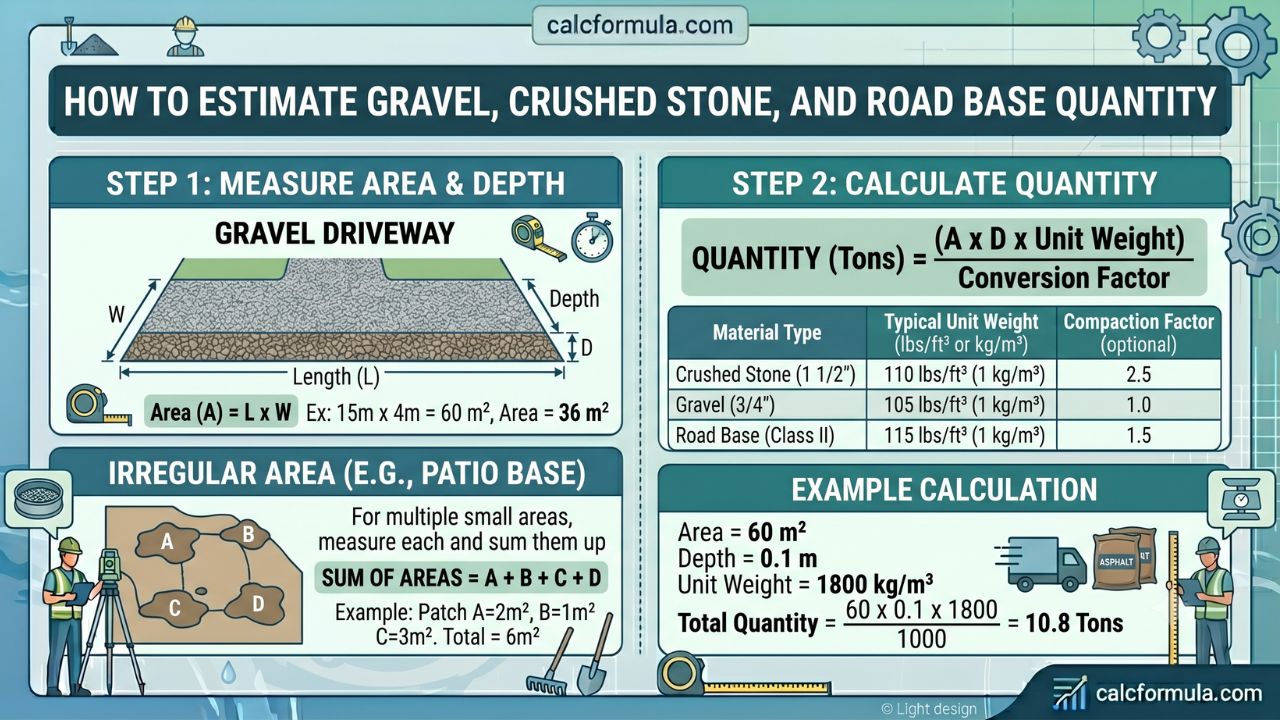
Estimating gravel, crushed stone, and road base starts with one core problem: material is sold by weight (tons) but placed by volume (cubic yards). Converting between the two accurately requires knowing the area to be covered, the required depth, and the bulk density of the specific material.
Get any one of these wrong and your order will be short or wasteful. This guide covers the volume-to-weight conversion chain used across pea gravel, crushed stone, limestone screenings, road base aggregate, and river rock estimates.
It explains every variable in the formula, walks through a complete worked example, and flags the assumptions and limitations that field conditions routinely expose. Whether you are estimating a driveway, a drainage swale, a compacted sub-base, or a decorative bed, the math here applies before you open any calculator.
What This Estimate Measures
A gravel or aggregate quantity estimate produces three connected outputs: volume (how much space the material must fill), weight in tons (how suppliers price and deliver it), and optionally coverage area (how far a known quantity will spread at a target depth). Each output depends on inputs that are measured differently on site.
Quantities This Guide Covers
- Area (sq ft / sq yd): The horizontal footprint to be covered - measured from drawings or field dimensions.
- Depth (in / ft): The design thickness of the aggregate layer - specified by the engineer, drainagecriteria, or road-base design standard.
- Volume (cu ft / cu yd): The product of area and depth - what you physically need to fill or place.
- Bulk density (lb/cu yd): The weight per unit volume of the loose or compacted aggregate - varies by material, gradation, and moisture.
- Tonnage (short tons): The weight unit suppliers use for pricing and delivery tickets.
- Compaction factor: The ratio of loose volume to compacted volume - affects how much material to order above the design volume.
Main Formula
The full estimation chain from site dimensions to tons ordered runs through three sequential formulas. Each is shown below in both plain-text and rendered form.
Step 1 - Calculate Volume in Cubic Feet
Plain text: Volume (cu ft) = Length (ft) × Width (ft) × Depth (ft)
Display form:
Where:
- = volume in cubic feet
- = length in feet
- = width in feet
- = depth in feet (convert inches to feet by dividing by 12)
Step 2 - Convert Cubic Feet to Cubic Yards
There are exactly 27 cubic feet in one cubic yard (). Suppliers quote price and delivery in cubic yards or tons, not cubic feet.
Step 3 - Convert Volume to Weight (Tons)
Where:
- = weight in short tons
- = volume in cubic yards
- = bulk density of the material in pounds per cubic yard (lb/yd³)
- = pounds per short ton (US)
Combined Single Formula
This collapses all three steps into one expression. The denominator is fixed. Only (bulk density) changes between material types. Typical bulk density values used in estimation are shown in the table below - always verify against your supplier's specification sheet, because actual values vary by gradation, moisture, and source rock.
| Material | Typical Bulk Density (lb/yd³) | Approx. Tons per Cubic Yard | Notes |
|---|---|---|---|
| Pea Gravel | 2,500 - 2,800 | 1.25 - 1.40 | Smooth, rounded; lower compaction ratio |
| Crushed Stone (#57, #67) | 2,700 - 3,000 | 1.35 - 1.50 | Angular; voids reduce bulk density vs. solid rock |
| Limestone (Crushed) | 2,600 - 2,900 | 1.30 - 1.45 | Varies with source; denser than granite in bulk |
| Road Base / Crusher Run | 2,800 - 3,200 | 1.40 - 1.60 | Well-graded fines; compacts significantly |
| River Rock (Decorative) | 2,400 - 2,700 | 1.20 - 1.35 | Large void ratio; smooth surface lowers interlocking |
Source ranges compiled from FHWA aggregate material guides and common supplier specifications. Confirm with your specific supplier's SDS or material data sheet before finalizing an order.
Unit Conversion Notes
Unit errors are the most common source of large estimation mistakes. The conversions below are the ones most frequently applied incorrectly in aggregate estimates.
Inches to Feet (Depth Conversion)
Depth is almost always specified in inches on plans and quoted in inches by contractors, but the volume formula requires feet. Forgetting this conversion inflates the answer by a factor of 12.
Example: A 4-inch road base layer = . Using 4 ft instead of 0.333 ft would multiply the volume estimate by 12.
Cubic Feet to Cubic Yards
This is a cube with sides of exactly 3 ft. Aggregate calculators work in cubic yards because that is the unit used by quarries, ready-mix plants, and landscaping suppliers in the United States.
Pounds to Short Tons
All US aggregate pricing and hauling tickets use short tons. Do not confuse with metric tons () or long tons (). The difference between short and metric ton is about 10% - enough to affect a budget or cause a material shortage.
Square Feet to Square Yards
If your area is in square yards and depth is in feet, multiply area (sq yd) × depth (ft) directly - the result is in cubic yards with no further conversion needed. Most users measure in feet, so this shortcut is less commonly used.
Bulk Density: lb/cu ft vs. lb/cu yd
Some supplier sheets list density in lb/cu ft; others list lb/cu yd. To convert:
Example: Crushed stone listed at = .
Quick Conversion Reference
| Convert From | To | Multiply by |
|---|---|---|
| Inches | Feet | ÷ 12 |
| Cubic feet | Cubic yards | ÷ 27 |
| Pounds | Short tons | ÷ 2,000 |
| lb/ft³ | lb/yd³ | × 27 |
| Square feet | Square yards | ÷ 9 |
| Metric tons | Short tons | × 1.1023 |
Worked Example
Scenario: A gravel driveway, 120 ft long and 12 ft wide, requires a 6-inch compacted road base (crusher run) layer. The supplier's bulk density is listed at . A 10% waste and over-excavation allowance is required by the project specification. How many tons should be ordered?
Step-by-Step Solution
Step 1 - Convert depth to feet
Step 2 - Calculate volume in cubic feet
Step 3 - Convert to cubic yards
Step 4 - Convert supplier density to lb/yd³
Step 5 - Calculate base tonnage
Step 6 - Apply 10% waste/safety allowance
Result: Order 43.6 short tons of crusher run. Rounding up to the nearest half-ton delivery increment, you would order 44 tons. This covers the design volume plus a 10% buffer for material lost to edge trimming, subgrade irregularities, and hauling spillage.
Waste, Density, Compaction, and Safety Margin
The base formula calculates design volume. Field placement always requires ordering more. The adjustment factors below are the most relevant for aggregate work - none of them are universal constants. Site conditions can change any of these results significantly.
Compaction Factor
When road base or crusher run is compacted with a plate compactor or roller, the loose volume shrinks. The compaction factor accounts for how much extra loose material must be placed to achieve the design (compacted) thickness. A commonly allowed range is 10-15% additional volume for well-graded crusher run, but this depends on the specific gradation, moisture content at placement, and the number of compaction passes. Always check your state DOT or local specification for required compaction ratios.
Where is the compaction factor (e.g., for 10% over-order, for 15%). Pea gravel and river rock do not compact significantly - their is typically close to to . Road base and crusher run commonly use to .
Waste Allowance
Waste comes from multiple sources: material lost from the truck tailgate during delivery, edge spillage when spreading, and trimming irregularities at borders or curbs. A 5-10% waste allowance is commonly applied on top of the design volume for typical residential and light commercial aggregate work. For irregular shapes or sloped areas, some estimators use 15%. Site conditions can change the result - a tight urban delivery site will lose more to spillage than an open field pad.
Bulk Density Variation
Bulk density is not a fixed number. It changes with:
- Moisture content: Wet aggregate is heavier per cubic yard. A material that tests at dry may be when delivered saturated after rain.
- Gradation: Gap-graded materials (like #57 stone) have more air voids and lower bulk density than well-graded materials (like crusher run).
- Source rock: Granite-based crushed stone is denser than limestone-based stone at the same gradation.
Check the supplier's bulk density figure on the material specification sheet - do not rely solely on the generic values in this guide or in any calculator's default setting.
Coverage Calculation (Reverse Direction)
If you know how many tons you have (from a delivery ticket or budget constraint) and need to find how deep that material will cover a given area, reverse the formula:
Multiply by 12 to get depth in inches.
Common Mistakes
- Using depth in inches without converting to feet. Entering 6 inches as "6" in the depth field when the formula expects feet produces a result 12 times too large. Always divide inch depths by 12 before calculating, or confirm that the calculator handles the conversion internally.
- Using the wrong bulk density. Applying a generic density (such as 1.35 tons/yd³ for "gravel") to road base material that actually compacts at 1.55 tons/yd³ underestimates the order by nearly 15%. Always use the supplier's actual figure, or at minimum use the material-specific range in the table in Section 2.
- Ordering to design volume only, with no compaction or waste buffer. The design depth represents compacted thickness. The loose material ordered must exceed the design volume to account for compaction shrinkage. Road base ordered at exactly the design volume will finish short after rolling.
- Estimating irregular areas as a single rectangle. A curved driveway, an L-shaped pad, or a drainage swale with varying width cannot be accurately estimated as one rectangle. Break irregular shapes into sub-rectangles or triangles and sum the volumes. For complex curves, an area measurement from a plan or field survey is more accurate.
- Confusing short tons with metric tons. Supplier invoices in the US use short tons (2,000 lb). If a project specification was written using metric units and lists density or tonnage in metric tons, the conversion is . Ignoring this adds roughly 10% error to any weight-based calculation.
- Using the same depth for sloped areas without adjustment. On a sloped surface, the vertical depth of material is not the same as the perpendicular layer thickness. For steep slopes, the placed depth along the slope exceeds the vertical specification. On mild residential slopes (under 5%), the difference is usually negligible; on steep cut-and-fill slopes it can be material.
- Assuming all gravel is the same density. Pea gravel (rounded, uniform size, high void ratio) and road base (angular, well-graded, low void ratio) have meaningfully different bulk densities. Swapping one density value for another on a large project produces a significant tonnage error. Each material in a multi-layer estimate must use its own density.
- Not accounting for subgrade variation. If the subgrade is uneven, the actual depth of fill varies across the area. An average depth applied over the total area may be accurate enough for rough estimates, but where subgrade irregularity is significant, a grid-based volume calculation or survey data is needed.
Which Calculator to Use
The calculators below cover the main aggregate materials. Select the one that matches your specific material - different calculators may use different default densities and output formats.
| If you need to estimate… | Use this calculator | Why |
|---|---|---|
| Decorative fill for garden beds, pathways, or play areas with small, rounded stone | Pea Gravel Calculator | Uses pea gravel bulk density; optimized for landscape depth inputs |
| Drainage fill, pipe bedding, or base aggregate using angular crushed aggregate | Crushed Stone Calculator | Accounts for angular stone density; supports ASTM gradation size selection |
| Limestone aggregate for driveways, parking areas, or agricultural roads | Limestone Calculator | Uses limestone-specific density; may include screenings and dust options |
| Compacted sub-base for driveways, parking pads, or light-duty road construction | Road Base Calculator | Includes compaction factor input; designed for crusher run and graded aggregate base |
| Decorative large stone for dry creek beds, retaining wall drainage, or water features | River Rock Calculator | Uses river rock bulk density range; accounts for higher void ratios |
Estimate Limitations
The volume-to-weight formula is mathematically exact for a rectangular area with uniform depth and known density. Real jobsite conditions introduce deviations that the formula cannot capture on its own. Final estimates should always be checked against project drawings, local requirements, supplier specifications, and site conditions.
📐 Irregular or Non-Rectangular Areas
The formula assumes a rectangle. Curved edges, tapered widths, and non-orthogonal shapes require decomposition into simpler shapes or area measurement from scaled drawings. Overestimation or underestimation by 10-20% is common when eyeballing an irregular footprint.
🏗️ Subgrade Preparation Not Included
The estimate covers material quantity only. It does not account for subgrade grading, proof-rolling, geotextile fabric, or undercutting soft spots - all of which affect the actual depth and volume of aggregate placed.
💧 Moisture Effects on Weight
Bulk density values from supplier sheets are typically at a standard moisture content. Material delivered after heavy rain can weigh 3-8% more per cubic yard. Delivery tickets are by weight; an unexpectedly wet load delivers less volume than expected.
🔄 Compaction Results Vary
Compaction ratios depend on equipment type, number of passes, lift thickness, and moisture content at time of compaction. A field-applied compaction factor of 10% may be too low or too high depending on these variables. DOT specifications typically define required compaction density (e.g., 95% Modified Proctor), not a single factor.
🧱 Single-Layer Assumption
Most calculators estimate one material layer at one depth. Multi-layer designs (sub-base plus base plus surface aggregate) must be estimated as separate calculations with the correct density for each layer.
📦 Delivery Increments
Suppliers deliver in fixed truck loads (commonly 10-24 tons per load). The calculated tonnage must be rounded up to the next delivery increment. Ordering 37.4 tons may mean paying for 40 tons depending on the supplier's minimum haul policy.
Frequently Asked Questions
How do I convert cubic yards of gravel to tons?
Multiply cubic yards by the bulk density in lb/yd³, then divide by 2,000. For crushed stone at : $10\,\text{yd}^3 \times 2{,}835 \div 2{,}000 = 14.2\,\text{tons}$. The key variable is density - using the wrong density is the most common error in this conversion.
Can I use the same calculator for pea gravel and road base?
The formula is the same, but the default density must match the material. Pea gravel and road base have meaningfully different bulk densities. If a calculator has a density field, enter the supplier's actual value. If the density is hard-coded, use the calculator designed for your specific material to avoid a 10-15% error in the tonnage output.
Why does the calculator give volume in cubic yards instead of cubic feet?
Quarries, landscape suppliers, and ready-mix plants in the United States price, quote, and deliver aggregate in cubic yards or tons. Cubic feet is used in the intermediate volume calculation, but the final output is converted to cubic yards () to match supplier units. If your supplier quotes in cubic meters, multiply cubic yards by 0.7646.
My area is not a rectangle. How do I handle that?
Break the area into rectangles and triangles, calculate each volume separately, and add them. For a triangle, area = $\frac{1}{2} \times base \times height$. For circular areas (such as a round patio), area = . Sum all sub-areas, then apply the uniform depth to get total volume. For very irregular shapes, obtain the actual area from site survey data or CAD drawings.
How much does compaction change how much material I need to order?
For road base and crusher run, compaction typically reduces volume by 10-20% from the loose-placed state to the finished compacted depth. This means you must order 10-20% more than the design (compacted) volume to end up with the right thickness after rolling. The exact ratio depends on the gradation, moisture, and compaction effort. Smooth, round aggregates like pea gravel compact very little and typically need only a 3-5% over-order for this factor.
What is the difference between #57 stone, crusher run, and road base?
#57 stone is a single-size (nominal ¾-inch) angular crushed stone with large voids - it does not compact tightly. Crusher run (also called "road base" or "dense-graded aggregate") is a blend of angular crushed stone and fine particles that interlocks and compacts well. Road base is the functional application - it is almost always crusher run or a similarly well-graded material. The density and compaction behavior of these materials differ, and they must not be used interchangeably in a quantity estimate.
The supplier's density is listed in lb/ft³ but the calculator asks for lb/yd³. How do I convert?
Multiply lb/ft³ by 27. Example: . Some suppliers also list density in kg/m³; convert to lb/yd³ by multiplying kg/m³ by 1.6856.
How accurate is a calculator estimate compared to what I actually use on site?
A calculator estimate using accurate dimensions and the correct density is typically within 5-10% of actual material used when the subgrade is reasonably uniform and the area is regular in shape. Accuracy drops significantly with irregular areas, variable subgrade depth, or estimated (rather than measured) dimensions. The estimate is a planning and ordering tool - it does not replace a takeoff from engineered drawings for formal bid purposes.
Related Calculators
- Pea Gravel Calculator - Estimate volume and tonnage for small, rounded decorative gravel used in landscaping, pathways, and drainage beds.
- Crushed Stone Calculator - Estimate volume and tonnage for angular crushed aggregate (ASTM #57, #67, #8) used in drainage, pipe bedding, and structural fill.
- Limestone Calculator - Estimate volume and tonnage for crushed limestone aggregate used in driveways, agricultural roads, and base layers.
- Road Base Calculator - Estimate compacted volume and tonnage for well-graded crusher run or dense-graded aggregate base used in driveways, parking areas, and light road construction.
- River Rock Calculator - Estimate volume and tonnage for large, smooth decorative stone used in dry creek beds, retaining wall drainage, and water feature installations.
References
The following sources inform the formulas, density ranges, and terminology used in this guide. Consult them directly for specification-grade data or when working on engineered projects.
- ASTM International - Standard Specifications for Aggregate Gradation: ASTM C33 / C33M - Standard Specification for Concrete Aggregates covers fine and coarse aggregate gradations for concrete. ASTM D2940 / D2940M - Standard Specification for Graded Aggregate Material for Bases or Subbases covers graded aggregate materials used for highway and airport base or subbase layers.
- Federal Highway Administration (FHWA) - Pavement Design and Materials Guidance: Bases and Subbases for Concrete Pavements provides pavement base and subbase guidance relevant to layer thickness, support, drainage, and compaction assumptions for road-related projects.
- NIST Handbook 44 - Specifications, Tolerances, and Other Technical Requirements for Weighing and Measuring Devices: NIST Handbook 44 Current Edition provides background for commercial weighing-device requirements used when reconciling estimated tonnage with aggregate delivery tickets.
- State and Local Department of Transportation (DOT) Standard Specifications: FHWA State Specifications Index links to state DOT specification pages. Use the applicable state or local standard before finalizing specification-driven road base or aggregate subbase estimates.
- Supplier Material Safety Data Sheets (SDS) and Technical Data Sheets: The most reliable source of bulk density for a specific aggregate product is the supplier's own data sheet. Request density, gradation, absorption, and compaction information from the local quarry, landscape supplier, or aggregate producer before ordering large quantities.
- National Stone, Sand & Gravel Association (NSSGA): National Stone, Sand & Gravel Association publishes aggregate industry resources useful for understanding how source rock, gradation, processing, and application affect aggregate behavior in estimation work.
This guide is a calculation reference. All estimates should be reviewed against project drawings, applicable local standards, supplier specifications, and actual site conditions before material is ordered. Calculator outputs are approximations based on the inputs provided - they are not a substitute for engineered takeoffs on projects requiring formal specifications.