⚡ Quick Answer
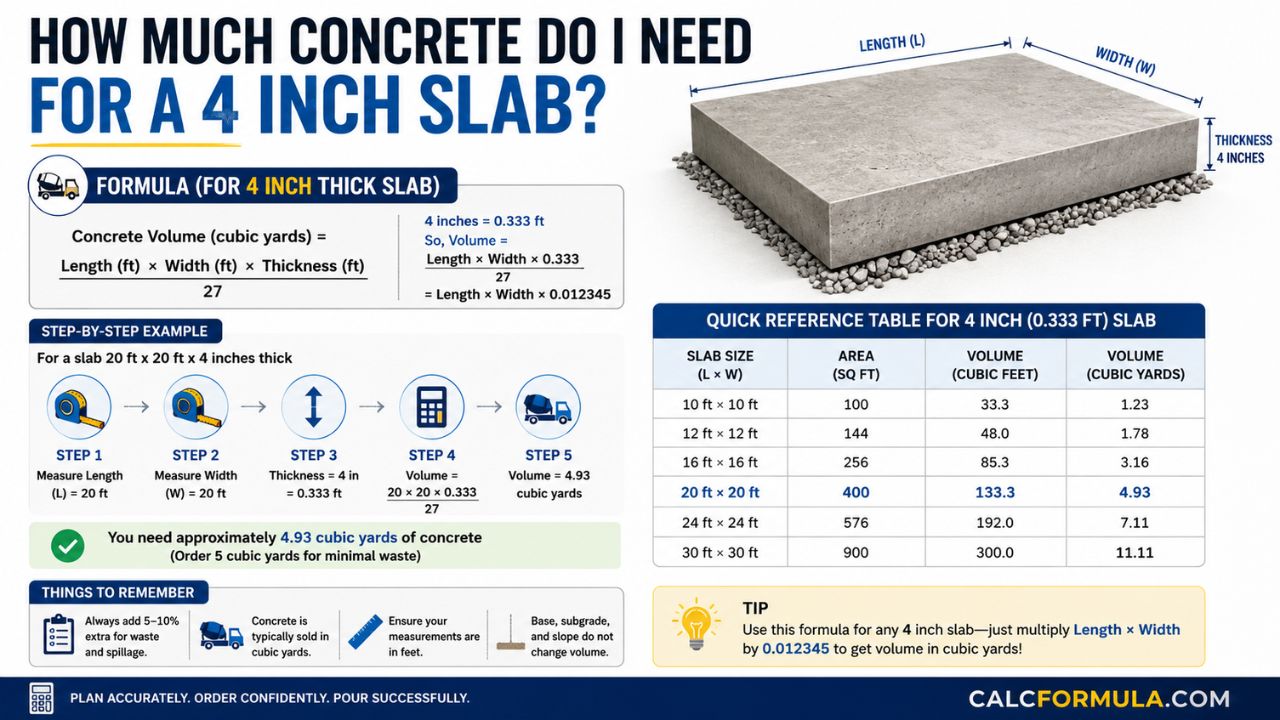
To find how much concrete you need for a 4 inch slab, multiply the length × width to get square footage, then multiply by 0.333 ft (4 inches converted to feet) to get cubic feet. Divide by 27 to convert to cubic yards. Add 5–10% for waste.
$$\text{Cubic Yards} = \frac{\text{Length (ft)} \times \text{Width (ft)} \times 0.333}{27}$$
Example: A 10 × 12 ft slab at 4 inches = 1.48 cubic yards of concrete before waste.
Estimating how much concrete you need for a 4 inch slab is one of the most common questions before pouring a patio, garage floor, driveway apron, or sidewalk. The core calculation is straightforward — you are finding the volume of a rectangular box. What makes this estimate useful is applying the right unit conversions, choosing the correct mix, and accounting for the realities of ordering bagged or ready-mix concrete.
A 4 inch thickness (0.333 ft) is the standard residential slab depth for non-load-bearing surfaces. For slabs carrying vehicle loads, a 6 inch depth is more typical. Use the Concrete Calculator for fast totals or the Cement Calculator to verify mix proportions for site-batched work.
How a 4 Inch Slab Calculation Works — Diagram
The diagram shows the three dimensions that drive every 4 inch slab estimate: length, width, and thickness. The slab thickness is fixed at 4 inches in this case, which converts to exactly 0.333 feet. The subgrade below the slab is not part of the concrete volume — it is a separate earthwork item. The dashed lines inside the slab represent typical wire mesh or rebar, which do not change the concrete volume estimate but do affect reinforcement ordering.
In the worked math, length and width are always entered in the same unit (feet). When mixing feet and inches — for example, a slab that is 10 ft 6 in long — convert everything to decimal feet before multiplying. 10 ft 6 in = 10.5 ft. Entering mixed units is the single most common source of over- or under-ordering concrete.
The Concrete Volume Formula for a 4 Inch Slab
📐 Core Formula
$$\text{Cubic Yards} = \frac{L \times W \times T}{27}$$
- L = Length in feet
- W = Width in feet
- T = Thickness in feet — for a 4 inch slab, T = 4 ÷ 12 = 0.333 ft
- 27 = number of cubic feet in one cubic yard
With waste factor (5–10%): Multiply the raw result by 1.05 to 1.10. Ready-mix is typically ordered to the nearest 0.25 cubic yard; always round up.
For bags (80 lb bag yields ≈ 0.60 cu ft):
$$\text{Bags} = \frac{L \times W \times 0.333}{0.60}$$
Converting 4 Inches to Feet — Why It Matters
The single most important unit conversion in this calculation is thickness. Concrete thickness is usually described in inches on drawings, but volume formulas require feet. Entering 4 instead of 0.333 for thickness produces a result that is 12 times too large. Always divide inch thickness by 12 before using it in the formula.
| Thickness (inches) | Thickness (feet) | Common Use |
|---|---|---|
| 2 in | 0.167 ft | Thin overlays, repair toppings |
| 3 in | 0.250 ft | Lightweight path slabs (light use only) |
| 4 in | 0.333 ft | Residential patios, sidewalks, garage floors (foot traffic + light loads) |
| 5 in | 0.417 ft | Heavier residential driveways |
| 6 in | 0.500 ft | Commercial driveways, vehicle-loaded slabs |
| 8 in | 0.667 ft | Heavy equipment pads, industrial floors |
Step-by-Step Worked Example: 12 × 20 Ft Patio Slab at 4 Inches
🧮 Worked Example
Inputs:
- Length: 20 ft
- Width: 12 ft
- Thickness: 4 inches = 0.333 ft
- Waste allowance: 5%
Step 1 — Volume in cubic feet:
$$20 \times 12 \times 0.333 = 79.92 \text{ cu ft}$$
Step 2 — Convert to cubic yards:
$$79.92 \div 27 = 2.96 \text{ cu yd}$$
Step 3 — Add 5% waste:
$$2.96 \times 1.05 = 3.11 \text{ cu yd}$$
Step 4 — Round up to nearest 0.25 cu yd for ordering:
Order 3.25 cubic yards of ready-mix concrete.
If using 80 lb bags (yield ≈ 0.60 cu ft each):
$$\frac{79.92 \times 1.05}{0.60} = 140 \text{ bags}$$
Key assumption: The subgrade is flat and compacted to a consistent 4 inch depth across the full slab area. Any low spots in the subgrade will increase actual concrete consumption. Verify final quantities against site conditions and supplier delivery minimums.
Cubic Yards vs. Bags: Which Should You Order?
For slabs up to about 1 cubic yard (roughly a 9 × 9 ft area at 4 inches), bagged concrete is practical. Above that threshold, ready-mix concrete from a batch plant is almost always faster, more consistent, and cheaper per cubic yard. The table below shows typical breakeven points based on slab size.
| Slab Size (4 in thick) | Cubic Yards | 80 lb Bags Needed | Recommended Method |
|---|---|---|---|
| 4 × 4 ft | 0.20 | ~12 | Bagged mix |
| 6 × 6 ft | 0.44 | ~27 | Bagged mix |
| 10 × 10 ft | 1.23 | ~72 | Bagged or small ready-mix load |
| 12 × 16 ft | 2.37 | ~138 | Ready-mix recommended |
| 14 × 20 ft | 3.46 | ~201 | Ready-mix (min load applies) |
| 20 × 30 ft (garage) | 7.41 | ~430 | Ready-mix only |
| 24 × 40 ft | 11.85 | ~688 | Ready-mix only (multiple trucks) |
Bag yields vary by manufacturer. The 0.60 cu ft figure is typical for standard 80 lb bags, but always check the manufacturer’s technical data sheet for the actual yield, especially for specialty or fiber-reinforced mixes. Some 80 lb bags yield as little as 0.45 cu ft for high-strength mixes. Under-estimating bag yield is a common source of running short mid-pour.
Adjustment Factors That Change Your Concrete Estimate
Waste and over-pour: A 5% waste allowance is commonly applied for flat slabs with clean formwork. Increase this to 8–10% for slabs with irregular perimeters, curved edges, or uneven subgrade. Over-excavation or soft spots that require additional concrete to achieve the design thickness will increase consumption beyond any formula result.
Subgrade variation: If the subgrade is not graded to a consistent 4 inch depth below finish grade, actual slab thickness will vary. A subgrade that dips by just 0.5 inches across a 20 ft span can add several extra cubic feet to actual concrete placed. Always verify subgrade elevation with a string line or laser level before ordering.
Irregular or non-rectangular shapes: For L-shaped, T-shaped, or curved slabs, break the area into simple rectangles and calculate each separately, then sum. For curved sections, use the actual arc area, not a rectangular approximation. The Concrete Calculator supports area inputs directly, which avoids manual shape decomposition.
Ready-mix minimum loads: Most batch plants have a minimum delivery of 1 cubic yard, and some charge short-load fees below 3–4 yards. Check minimum quantities with your supplier before finalizing your order. It is generally better to order 0.25–0.50 yards extra than to run short during a pour — adding material mid-pour risks cold joints and inconsistent finish.
Common Mistakes When Calculating Concrete for a 4 Inch Slab
❌ Entering thickness in inches, not feet
Using 4 instead of 0.333 for the thickness multiplies the result by 12. Always divide inch thickness by 12 first.
❌ Forgetting to add a waste factor
Ordering the exact calculated volume leaves no room for subgrade variation, spills, or form overfill. Always add at least 5%.
❌ Not converting mixed feet-and-inches dimensions
A slab listed as 14 ft 6 in must be entered as 14.5 ft — not 14.6 or 14 — before multiplying.
❌ Assuming all 80 lb bags yield 0.60 cu ft
High-strength or specialty bags can yield 0.45–0.55 cu ft. Verify with the manufacturer’s data sheet for the specific product being used.
❌ Measuring the slab on top of existing concrete
If adding a topping over existing concrete, only the new topping thickness goes into the formula — not the full structural slab depth.
❌ Not accounting for thickened edges or footings
Many slab designs include thickened perimeter edges (8–12 in deep) or turn-down footings. These additional volumes must be calculated separately and added to the flat slab total.
❌ Rounding cubic yards down instead of up
Ready-mix is ordered in 0.25 yd increments. Always round up to the next 0.25 yd. Rounding down to save money risks running short before the pour is finished.
❌ Ignoring subgrade high and low spots
Assuming a perfectly flat subgrade when it is actually variable leads to under-ordering. For uneven ground, measure actual depth at multiple points and use the average — not the design depth alone.
Which Calculator to Use
| Your Need | Use This Calculator | Why |
|---|---|---|
| Find total cubic yards or bags for a rectangular slab, footing, column, or circular pad | Concrete Calculator | Handles multiple shapes, unit conversions, and waste factors in one step |
| Estimate cement, sand, and aggregate quantities for a site-batched or custom mix — or verify mix proportions before ordering | Cement Calculator | Breaks concrete volume into constituent materials by mix ratio; useful for bagged cement or manual batching |
Limitations of a Concrete Volume Estimate
⚠️ What This Calculation Does Not Know
- Actual subgrade elevation — measured depth varies across the pour area; the formula uses a single design thickness.
- Real bag yield — varies by mix type and manufacturer; always verify from the product data sheet.
- Thickened edges, haunches, or turn-down footings — these add volume beyond the flat slab formula.
- Concrete shrinkage, air content, or slump — these affect yield slightly but are typically within the waste allowance for residential work.
- Supplier minimum load requirements — your batch plant may require 1 yd minimum, or charge short-load fees below 3–4 yards.
- Irregular or non-planar subgrades — for sloped slabs, calculate at the average slab thickness along the slope.
- Reinforcement volume displacement — for most residential slabs, rebar and mesh displace less than 0.5% of the volume; this is within normal waste tolerance.
Final quantities should always be confirmed against project drawings, actual field measurements, supplier delivery data, and manufacturer product specifications before ordering.
Frequently Asked Questions
How many cubic yards of concrete do I need for a 10×10 slab at 4 inches?
A 10 × 10 ft slab at 4 inches thick requires: $10 \times 10 \times 0.333 \div 27 = 1.23$ cubic yards before waste. With a 5% waste factor, order 1.30 cubic yards (rounded up to 1.50 yd for a typical ready-mix minimum). For bags, that is approximately 72 standard 80 lb bags.
How many bags of concrete do I need for a 4 inch slab?
Divide your total cubic feet of concrete by the bag yield (0.60 cu ft for most 80 lb bags). For example, a 12 × 12 slab at 4 inches = $12 \times 12 \times 0.333 = 47.95$ cu ft ÷ 0.60 = 80 bags. Add 5–10% for waste, giving you 84–88 bags. Round up to the next full pack or pallet for ordering.
Is 4 inches thick enough for a driveway?
A 4 inch slab is the minimum for residential driveways used by standard passenger vehicles. For trucks, SUVs over 4,000 lbs, or RVs, a 5–6 inch thickness with proper reinforcement is more appropriate. The formula for a 6 inch driveway uses T = 0.500 ft instead of 0.333 ft, which increases concrete volume by 50% for the same footprint. Check local building department requirements for minimum slab thickness before finalizing design.
How do I calculate concrete for an L-shaped slab at 4 inches?
Split the L-shape into two rectangles. Calculate the cubic yards for each rectangle separately using the formula, then add the two results. For example, if one section is 10 × 8 ft and the other is 6 × 5 ft: Section A = $10 \times 8 \times 0.333 \div 27 = 0.987$ cu yd; Section B = $6 \times 5 \times 0.333 \div 27 = 0.370$ cu yd. Total = 1.36 cu yd before waste.
What does a cubic yard of concrete weigh?
Normal-weight concrete weighs approximately 3,900–4,050 lbs per cubic yard (roughly 145–150 lbs per cubic foot), depending on aggregate type and moisture content. Lightweight concrete mixes can be 25–35% lighter. This weight figure matters for load calculations on elevated slabs or for truck load planning, but it does not change the volume estimate formula. Always confirm density with your ready-mix supplier for load-critical applications.
Should I use the Concrete Calculator or the Cement Calculator?
Use the Concrete Calculator when you are ordering ready-mix or pre-bagged concrete and need total cubic yards or bag count. Use the Cement Calculator when you are batching concrete on-site from separate materials (cement bags, sand, and aggregate) and need to know how many bags of Portland cement plus how much aggregate to purchase for a given mix ratio such as 1:2:3 or 1:2:4.
How much extra concrete should I order for a 4 inch slab?
A 5% overage is standard for flat residential slabs with clean, well-built formwork and a graded subgrade. Increase to 8–10% for slabs with irregular perimeters, variable subgrade depth, remote pours where short-loading is costly, or any slab where running short mid-pour would create a cold joint. Never order less than what the formula gives you — the risk of a cold joint from running out of concrete mid-pour outweighs the cost of slightly excess material.
Can I use this formula for a sloped slab at 4 inches?
Yes, with one adjustment. On a sloped slab, the design thickness perpendicular to the surface is still 4 inches, but the slab area measured in plan view (from above) is what goes into the formula — not the slope surface area. For typical residential slopes (1–2% grade), the difference is less than 1% and falls within the waste factor. For steeper slabs, use the plan area, not the slope length.
References
- NIST Handbook 44 — Specifications, Tolerances, and Other Technical Requirements for Weighing and Measuring Devices
Reference for measurement standards and unit consistency used when converting concrete volume, bag yield, weight, and delivery quantities. - ASTM C94/C94M — Standard Specification for Ready-Mixed Concrete
Covers ready-mixed concrete production and delivery requirements, including ordering, batching, mixing, delivery, slump, and yield-related requirements. - ASTM C150/C150M — Standard Specification for Portland Cement
Defines Portland cement types and cement classification used in concrete mix design and material specification. - ACI 302.1R — Guide to Concrete Floor and Slab Construction
Reference for concrete slab construction, including slab thickness, subgrade preparation, jointing, finishing, curing, and floor construction practices. - Manufacturer Product Data Sheets — Bagged Concrete Mix
Use the specific product data sheet for bag yield, water requirements, strength rating, placement method, and mixing instructions before purchasing bagged concrete. - NRMCA CIP 31 — Ordering Ready Mixed Concrete
Practical guidance for ordering ready-mixed concrete, including mix requirements, supplier communication, delivery planning, and project-specific ordering details. - NRMCA Checklist for Ordering and Scheduling Ready Mixed Concrete
Use when confirming ready-mix supplier requirements such as delivery timing, mix design options, job access, minimum quantities, and scheduling details. - Local ready-mix supplier technical specifications
Confirm minimum load quantities, short-load fees, mix availability, delivery tolerances, admixture options, and site access requirements with the supplier before ordering.