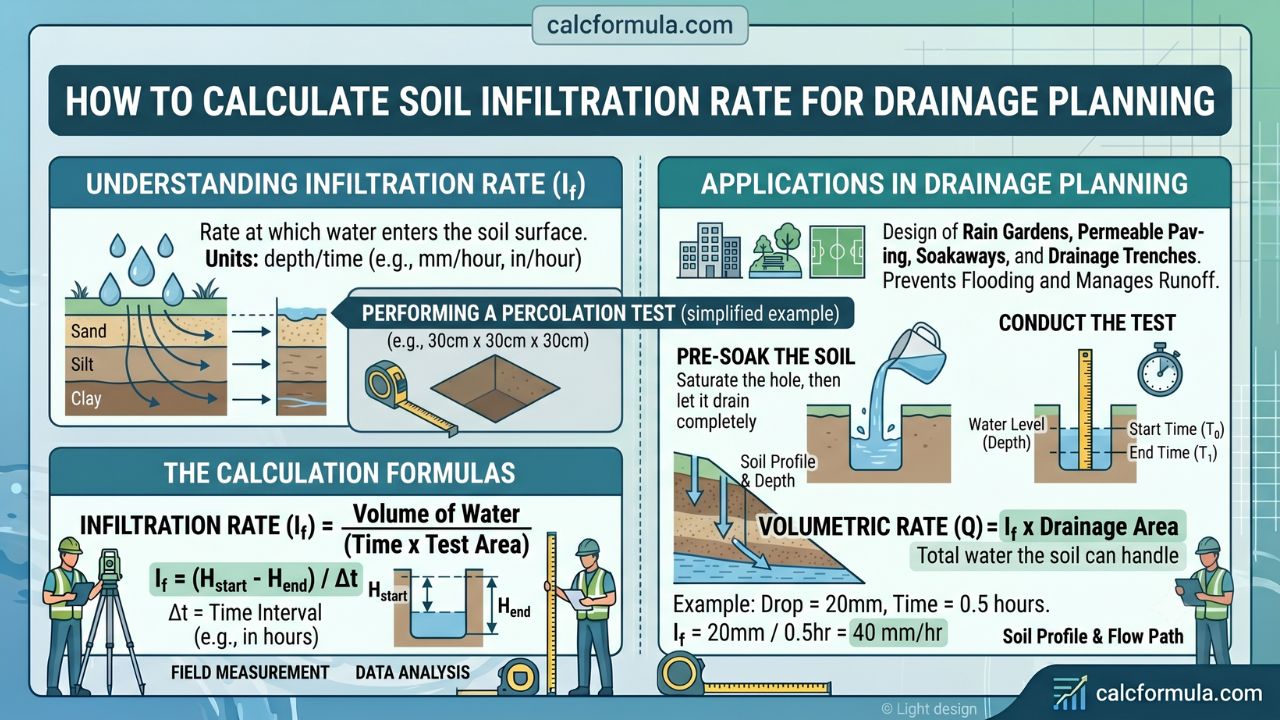
Soil infiltration rate measures how quickly water moves downward through the soil surface into the ground, expressed in inches per hour (in/hr) or millimetres per hour (mm/hr). In drainage planning, this value drives every downstream calculation: it tells engineers and contractors whether stormwater will soak in fast enough to prevent ponding, whether a soakaway or French drain can handle the design storm, and how large a detention basin needs to be.
A site with a high infiltration rate - say, a loose sandy loam at 1.0 in/hr - can rely on surface absorption, while a silty clay at 0.05 in/hr demands engineered conveyance. The Soil Infiltration Rate calculator quantifies that core value. From it, the Drainage Fall and Channel Slope calculators translate the result into physical gradients and pipe or channel geometries that carry away the water the soil cannot absorb. All three tools work together across a typical drainage design workflow.
What Infiltration Rate Physically Means on Site
The diagram above shows three functional zones. At the top, surface water - whether from rainfall or irrigation - pools briefly before beginning to move downward. The topsoil layer, with its relatively open pore structure, accepts water at the measured infiltration rate. The subsoil and restrictive layers slow that movement further. At the base, a drainage pipe carries away excess water the soil cannot absorb, falling toward an outlet at a gradient determined by the drainage fall calculation.
The critical connection is this: infiltration rate tells you how much water per unit time the soil will accept. Any rainfall intensity that exceeds that rate becomes runoff or surface ponding. Your drainage channel slope and pipe fall must be sized to convey that excess volume safely off the site. All three calculators address different parts of the same water-balance problem.
What the Calculation Measures
The infiltration rate is a flux measurement - volume of water per unit area per unit time, simplified to a depth-per-time unit because depth × area = volume. Common field tests produce a value in inches per hour (in/hr) in US customary practice or millimetres per hour (mm/hr) in metric practice.
Drainage planning also depends on two geometry measurements: fall (the vertical drop in feet or millimetres along a drainage run) and channel or pipe slope (dimensionless ratio or percentage). Together these three measurements - infiltration rate, fall, and slope - form the quantitative backbone of any surface or subsurface drainage scheme.
Core Formulas
Formula Callout - Infiltration & Drainage Slope
1. Horton's Infiltration Equation (field estimate)
- f(t) = infiltration rate at time t (in/hr or mm/hr)
- fc = final (saturated) infiltration rate - the steady-state floor (in/hr)
- f0 = initial infiltration rate when soil is dry (in/hr)
- k = decay constant (hr-1), soil-specific
- t = elapsed time (hr)
- e = Euler's number ≈ 2.718
2. Simple Percolation / Double-Ring Test Result
- Δh = drop in water level in the ring (inches or mm)
- Δt = time interval of the reading (hours or minutes - keep units consistent)
3. Drainage Fall
- Slope = dimensionless ratio (ft/ft) or divide percent slope by 100
- Run = horizontal pipe or channel length (ft)
- Fall = vertical drop over the run (ft)
4. Channel / Pipe Slope
- S = slope ratio (dimensionless, ft/ft or m/m)
- Rise = vertical difference between inlet and outlet invert elevations (ft or m)
- Run = horizontal distance (ft or m)
Unit Conversions for Infiltration and Drainage Work
Infiltration tests often record water drop in inches per minute from a stopwatch-timed ring test, while drainage design software wants inches per hour or millimetres per hour. Slope can be expressed as a ratio, a percentage, or inches of fall per foot of run. Keeping these straight prevents large calculation errors.
| Convert From | Convert To | Operation | Example |
|---|---|---|---|
| in/min | in/hr | × 60 | 0.02 in/min × 60 = 1.2 in/hr |
| in/hr | mm/hr | × 25.4 | 0.5 in/hr × 25.4 = 12.7 mm/hr |
| mm/hr | in/hr | ÷ 25.4 | 25.4 mm/hr ÷ 25.4 = 1.0 in/hr |
| % slope | ft/ft ratio | ÷ 100 | 1.5% ÷ 100 = 0.015 ft/ft |
| ft/ft ratio | in/ft (fall per foot run) | × 12 | 0.015 × 12 = 0.18 in/ft |
| inches (fall) | feet (fall) | ÷ 12 | 3 in ÷ 12 = 0.25 ft |
Worked Example: Double-Ring Test to Drainage Slope
Step-by-Step Worked Example
Site: Residential backyard, proposed soakaway trench, silty loam soil.
Given Inputs
- Double-ring test water drop: Δh = 0.9 inches over Δt = 30 minutes
- Drainage trench run (horizontal): 40 ft
- Minimum pipe slope required by local code: 1%
Step 1 - Convert test result to in/hr
Step 2 - Apply a design safety factor
Field tests are point measurements. A commonly applied factor of 0.5 (halving the measured rate) accounts for soil variability and clogging over time:
Step 3 - Calculate drainage fall for the 40 ft trench at 1% slope
Step 4 - Confirm slope as ratio and inches per foot
Results Summary
- Design infiltration rate: 0.9 in/hr - silty loam, suitable for a soakaway trench
- Required trench outlet fall: 0.40 ft (4.8 in) over 40 ft run
- Pipe slope: 0.12 in/ft - confirms self-cleansing velocity is achievable
Assumption note: The 0.5 safety factor is commonly used in residential soakaway design but varies by local authority. Some jurisdictions specify 0.25. Always check project drawings, supplier specifications, and local drainage authority requirements before finalising the design infiltration rate.
Typical Infiltration Rates by Soil Type
The table below lists commonly referenced steady-state infiltration rates () by USDA soil texture class. These are general guidance values. Actual site rates depend on compaction history, organic matter content, moisture state at time of test, and whether a restrictive layer exists within the drainage zone. Always use measured field values where available, and verify against project geotechnical or percolation test reports.
| USDA Soil Texture Class | Typical (in/hr) | Typical (mm/hr) | Drainage Planning Implication |
|---|---|---|---|
| Sand | 2.0 - 8.0 | 51 - 203 | High absorption; soakaway/infiltration trench usually viable |
| Loamy Sand | 1.0 - 3.0 | 25 - 76 | Generally good; verify depth to water table |
| Sandy Loam | 0.5 - 1.5 | 13 - 38 | Moderate; soakaway sizing critical |
| Loam | 0.25 - 0.75 | 6 - 19 | Moderate-slow; drainage pipe likely needed |
| Silt Loam | 0.10 - 0.50 | 3 - 13 | Slow; pipe drainage generally required |
| Clay Loam | 0.05 - 0.15 | 1.3 - 3.8 | Very slow; soakaway generally not viable |
| Clay | 0.01 - 0.05 | 0.3 - 1.3 | Negligible infiltration; full engineered drainage required |
Reference ranges derived from USDA Natural Resources Conservation Service (NRCS) soil texture hydraulic properties. Site conditions can change the result significantly. Always verify against field-measured values and project geotechnical data.
Drainage Slope Requirements by Application
Once infiltration rate confirms how much water the soil cannot handle, the drainage slope determines whether a pipe or channel can carry away the excess at self-cleansing velocity. The table below shows typical minimum slope values by drainage type. These are commonly referenced minimums - local codes, project drawings, or authority requirements may specify different values, and actual slope should be checked against pipe diameter and design flow rate.
| Drainage Application | Typical Min Slope (%) | Fall per 100 ft run (in) | Notes |
|---|---|---|---|
| Roof drainage / downpipe | 1.0% | 12 in | Min for horizontal discharge to drain |
| French drain / soakaway feed | 0.5% - 1.0% | 6 - 12 in | Matched to soil infiltration capacity |
| Perforated subdrain pipe | 0.2% - 0.5% | 2.4 - 6 in | Verify velocity for sediment transport |
| Roadside swale / open channel | 0.5% - 2.0% | 6 - 24 in | Check erosion at upper end of range |
| Stormwater main (urban) | 0.5% min (varies) | 6 in | Local authority / DOT specification governs |
| Sports field subsurface drain | 0.3% - 0.5% | 3.6 - 6 in | Combined with drainage aggregate layer |
Safety Factors and Adjustment Values
Raw field test results are rarely used directly in design. Several adjustments are commonly applied, though the exact factor depends on jurisdiction, system type, and level of conservatism required. Always check project drawings, local drainage authority requirements, and supplier specifications before selecting a factor.
- Test-to-design reduction factor (0.2 to 0.5): Applied to the measured infiltration rate to account for long-term clogging, biofilm accumulation in aggregate, and seasonal variation. A factor of 0.5 is common in UK BRE Digest 365 soakaway design; some US state stormwater manuals use 0.25. Check local guidance.
- Soil variability allowance: A single ring test represents a small area. Where soil maps indicate variable texture, multiple tests at different locations and depths are commonly required. The design rate is typically taken as the geometric mean or the most conservative test result.
- Depth to water table: Infiltration-based systems require a minimum separation between the base of the system and the seasonally high water table - commonly 1.0 m (3.3 ft) in many jurisdictions. Check local requirements; this limit is not captured in the infiltration rate value alone.
- Slope tolerance on pipe installation: Excavation and pipe-laying tolerances of ±5 mm per 3 m are commonly allowed. On very flat gradients (below 0.5%), this tolerance can effectively negate the design slope. Verify actual installed invert elevations against survey data.
- Compaction effect on infiltration: Construction traffic can reduce infiltration rates in the top 300 mm by 50-90% compared to undisturbed soil. Where the design relies on surface or near-surface infiltration, post-construction scarification or decompaction may be needed.
Common Calculation Mistakes to Avoid
✗ Using minutes instead of hours
Recording Δt in minutes but treating the result as in/hr overstates the rate by 60×. Always convert: multiply in/min × 60 to get in/hr before entering the calculator.
✗ Testing only the topsoil
Double-ring tests at the surface can record high rates through organic topsoil while a clay hardpan at 400 mm depth controls actual drainage. Test at the intended installation depth of the drainage system.
✗ Skipping the safety factor
Using the raw measured rate as the design infiltration rate ignores long-term clogging and variability. Apply the reduction factor required by local drainage guidance before sizing the system.
✗ Confusing fall with slope
Fall is a vertical distance (ft or mm). Slope is a dimensionless ratio or percentage. Entering fall directly into a slope field, or vice versa, produces incorrect pipe grades. Use the Drainage Fall and Channel Slope calculators separately for each value.
✗ Ignoring the drainage run length
A 1% slope on a 10 ft run produces only 1.2 in of fall - barely enough to drain a short connection. On a 200 ft run it produces 24 in. Always calculate fall over the actual pipe or channel length, not an assumed or approximate distance.
✗ Testing during dry, cracked soil conditions
Desiccation cracks in clay soils create macro-pores that give artificially high infiltration rates during dry weather. Tests should be conducted when soil moisture is close to field capacity, or initial readings discarded until the rate stabilises.
✗ Not checking water table separation
A measured infiltration rate of 0.8 in/hr is useless if the seasonal high water table sits at 200 mm below the proposed soakaway base. Infiltration rate and water table depth must both satisfy local requirements simultaneously.
✗ Using a single test for a variable site
One double-ring test point represents a small area. On a site with filled ground, backfilled trenches, or mixed soil types, a single test can be highly unrepresentative. Multiple tests at different locations and depths are normally required for a reliable design value.
Which Calculator to Use for Each Task
| Design Need | Use This Calculator | Why |
|---|---|---|
| Determine whether the soil can absorb stormwater without a pipe drain | Soil Infiltration Rate | Converts field test measurements (water drop over time) into a design infiltration rate in in/hr or mm/hr; applies safety factor |
| Find the vertical drop (fall) a pipe must achieve over a given horizontal run | Drainage Fall | Takes slope percentage and run length as inputs; outputs the required fall in feet or inches for setting pipe invert elevations |
| Calculate the slope percentage or ratio between two invert elevations | Channel Slope | Takes rise and run as inputs; confirms whether a proposed pipe or channel grade meets minimum slope requirements for self-cleansing velocity |
| Size a soakaway or infiltration trench based on soil absorption capacity | Soil Infiltration Rate → then Drainage Fall | First establish the design rate; then use it with the fall calculator to confirm feed pipe grades to the soakaway |
| Check that an existing drainage channel meets gradient requirements | Channel Slope | Input surveyed invert levels and channel length to verify slope ratio and flag any flat spots |
Calculation Limitations and Warnings
⚠ Limitations - What These Calculators Do Not Account For
- Spatial variability: A single infiltration test value represents one point. Soil type, compaction, and layering vary across a site. The calculator cannot substitute for multiple field tests or a site-specific geotechnical investigation.
- Long-term clogging: Infiltration rates decline over time as fine particles, biofilm, and organic matter accumulate. The calculator uses a single input value and does not model performance degradation over the system's design life.
- Seasonal water table fluctuation: The water table can rise above the base of a soakaway system during wet periods, reducing effective infiltration. The calculator does not account for groundwater depth or seasonal variation.
- Pipe capacity and velocity: Drainage Fall and Channel Slope confirm gradient only. They do not calculate flow velocity, pipe capacity (Manning's equation), or whether the pipe diameter is adequate for the design flow. A separate hydraulic calculation is needed.
- Irregular terrain: The slope calculators assume a uniform grade between two points. Actual site terrain may include humps, sags, or variable cross-falls that require profile survey data and are not captured in a single slope value.
- Regulatory compliance: Local drainage authorities, state DOTs, and building codes may specify minimum infiltration rates, required safety factors, water table separation distances, or minimum pipe slopes that differ from general guidance. Always verify against applicable local requirements and project drawings.
- Contaminated or fill ground: Infiltration-based drainage should not be used in contaminated ground without specialist assessment. The calculators do not account for ground contamination risk.
Frequently Asked Questions
What units should I enter into the Soil Infiltration Rate calculator?
The calculator accepts either inches per hour (in/hr) or millimetres per hour (mm/hr) depending on your unit setting. If your field test recorded water drop in inches over a time in minutes, convert first: multiply the in/min result by 60 to get in/hr. For example, a 0.4 in drop over 20 minutes = 0.02 in/min × 60 = 1.2 in/hr.
What is the difference between , , and the design infiltration rate?
is the initial rate when soil is dry - typically much higher than the long-term value. is the final, saturated steady-state rate after prolonged wetting. The design infiltration rate used for soakaway or drainage sizing is usually multiplied by a reduction factor (commonly 0.5 or 0.25) to account for clogging and variability. Use the Soil Infiltration Rate calculator with the measured from your field test and apply the required safety factor.
How do I convert percent slope to the inputs needed for the Drainage Fall calculator?
The Drainage Fall calculator takes slope as a decimal ratio (ft/ft) or as a percentage. If your design specifies a 1.5% slope, enter 1.5% or 0.015 as the slope, then enter the horizontal run length. The calculator outputs fall = slope × run. For example: 0.015 × 80 ft = 1.2 ft of fall.
How do I know if my measured infiltration rate is good enough for a soakaway?
Most guidance documents require a minimum measured infiltration rate of around 0.2 in/hr (5 mm/hr) before a soakaway is considered viable - and that is the raw measured rate, before the safety factor is applied. At the design rate (after the safety factor), the soakaway must be sized to fully drain within 24 hours after the design storm. Check your local drainage authority or stormwater manual for the specific acceptance threshold and sizing method that applies to your project.
Can I use the Channel Slope calculator for both open swales and closed pipes?
Yes. The Channel Slope calculator calculates rise ÷ run and expresses the result as a ratio or percentage. That formula applies equally to a pipe invert elevation difference and a swale thalweg grade. For open channels, also check that the resulting velocity does not cause erosion (typically above 2.0-2.5 ft/s for unlined swales), which requires a separate hydraulic calculation beyond the slope calculation.
My site is very flat - the fall calculator gives less than 2 inches over the whole pipe run. Is that enough?
Very flat gradients below 0.5% (0.005 ft/ft) are problematic because installation tolerances - typically ±5 mm per 3 m of pipe - can effectively eliminate the design fall or create reverse grades. On flat sites, consider increasing pipe diameter (which reduces required velocity for self-cleansing), using larger-diameter aggregate backfill, or raising the upstream invert elevation to create more workable fall. Always verify final installed invert levels by as-built survey.
Does the Soil Infiltration Rate calculator size the soakaway for me?
No. The Soil Infiltration Rate calculator determines the design infiltration rate (in/hr). Sizing a soakaway - calculating the required surface area or volume to drain a design storm of a given return period - is a separate step that requires the design rainfall depth, catchment area, and a sizing formula such as that in BRE Digest 365 or your local stormwater manual. The infiltration rate value from this calculator is the critical input to that sizing procedure.
How does compaction from construction traffic affect infiltration rate?
Construction vehicle trafficking can compact the upper 300-500 mm of soil, reducing macroporosity and cutting infiltration rates by 50-90% compared to undisturbed values. If your infiltration tests were conducted on undisturbed or restored soil but the construction sequence will involve heavy equipment working over the drainage area, the design infiltration rate should reflect post-construction conditions. Some projects include a post-compaction test after site works are complete, or specify deep-tine aeration of drainage areas as a contractual requirement.
References
- ASTM D3385 - Standard Test Method for Infiltration Rate of Soils in Field Using Double-Ring Infiltrometer
ASTM International standard for field measurement of soil infiltration rate using a double-ring infiltrometer. - ASTM D5093 - Standard Test Method for Field Measurement of Infiltration Rate Using a Double-Ring Infiltrometer with a Sealed-Inner Ring
ASTM International standard for measuring low infiltration rates in field soils using a sealed-inner-ring double-ring infiltrometer. - USDA NRCS - National Engineering Handbook, Part 630 Hydrology, Chapter 7: Hydrologic Soil Groups
Reference for hydrologic soil groups, soil texture behavior, and drainage-related soil classification used in runoff and infiltration estimates. - FHWA Hydraulic Design Series No. 5 - Hydraulic Design of Highway Culverts
Federal Highway Administration reference for culvert hydraulics, drainage slope, pipe gradient, and public works drainage design. - NIST SP 811 - Guide for the Use of the International System of Units (SI)
Reference for unit usage and conversions, including inches to millimetres, feet to metres, and slope-related unit handling. - NIST Handbook 44 - Specifications, Tolerances, and Other Technical Requirements for Weighing and Measuring Devices
Reference for measurement standards where field measurement accuracy, device tolerance, and unit consistency matter. - BRE Digest 365 - Soakaway Design
UK soakaway design reference covering infiltration testing, soakaway sizing, rainfall design values, and safety factor application. - State DOT Drainage Manuals
State Departments of Transportation publish drainage design manuals specifying minimum pipe slopes, design storm return periods, infiltration testing requirements, and local public works criteria.