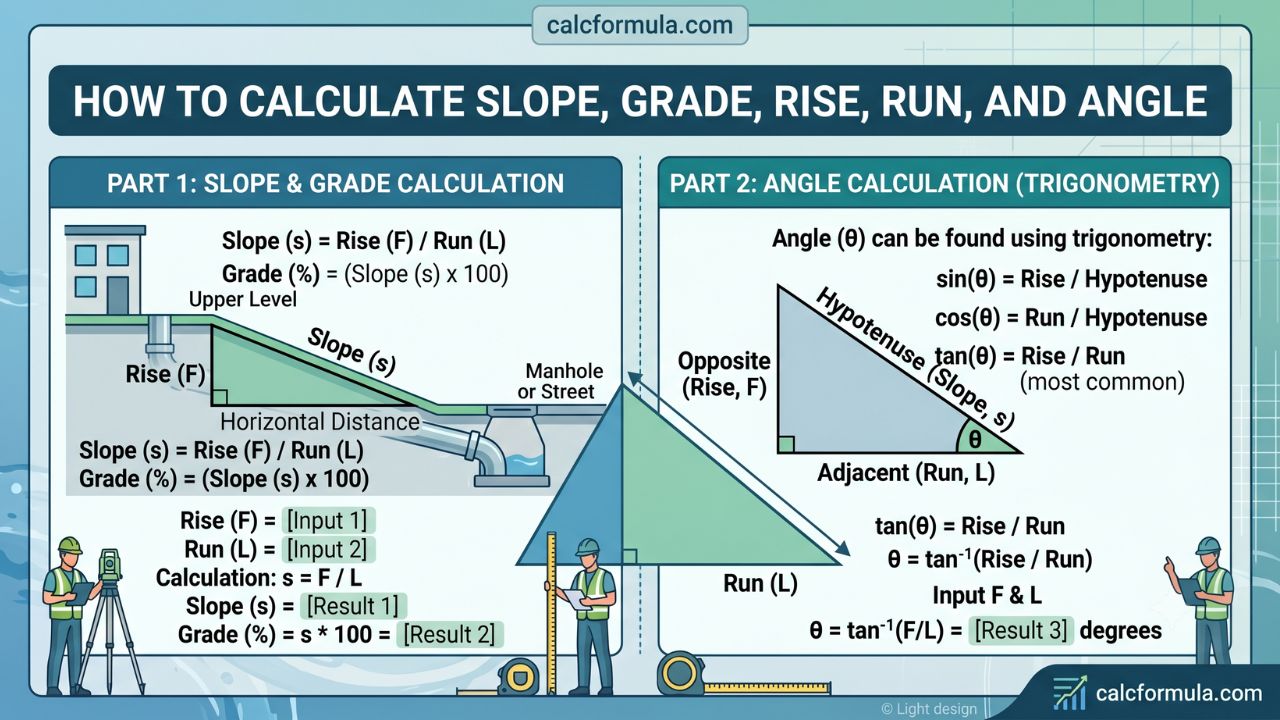
Slope describes how steeply a surface rises or falls over a measured horizontal distance. In construction, the same physical relationship is expressed in four interchangeable formats depending on the trade and specification: percent grade (used in site grading and road design), a rise-to-run ratio (used in ramp layout and accessibility compliance), an angle in degrees (used in structural and survey work), and fall in inches per foot (used in drainage and plumbing).
Every format is derived from two field measurements - vertical rise and horizontal run - using straightforward arithmetic. The Percent Slope Calculator, Grade Slope Calculator, Slope Per Foot Calculator, and Ramp Slope Calculator on this site each accept different input combinations and return results in the unit most useful for a specific construction task, removing the manual conversion step and reducing unit-mismatch errors in the field. Always verify computed values against project drawings, local grading specifications, and field measurements before finalising layout stakes or ordering materials.
The Rise, Run, and Slope Relationship
The diagram shows a right triangle formed by three construction measurements. The run is the horizontal distance measured at ground level - it is always measured flat, not along the slope surface. The rise is the vertical height gained or lost between the two endpoints. The slope length (hypotenuse) is the actual distance along the sloped surface, which is always longer than the run. The angle at the base describes the tilt from horizontal in degrees.
Every slope format - percent grade, ratio, degrees, and inches per foot - is derived from these two values. Confusing slope length with horizontal run is one of the most common field measurement errors; when stakes are set along a hillside, the tape measures slope length, not true horizontal run. Use a level, digital inclinometer, or transit to confirm the horizontal component before entering values into any calculator.
What Each Slope Measurement Captures
Slope calculations always involve the same two primary inputs - vertical rise and horizontal run - but the output format changes depending on which trade or specification is driving the work. Percent grade expresses rise as a percentage of run: a 5% grade rises feet for every feet of horizontal distance.
A ratio (e.g., 1:12 or 1:20) states how many horizontal units correspond to one vertical unit; this format dominates ADA ramp specifications and handrail drawings. Degrees convert the ratio into an angle using an arctangent function and appear frequently in survey benchmarks, cut-slope geotechnical reports, and equipment tilt ratings.
Inches per foot - sometimes called slope per foot or fall per foot - states how many inches the surface drops in each foot of horizontal distance; plumbers, drain tile contractors, and concrete flat-work crews use this format daily. All four representations carry identical geometric information; converting between them is pure arithmetic, not an approximation.
Core Formulas for Slope, Grade, and Angle
Formula Reference - Slope, Grade & Angle
| What You Want | Formula | Units |
|---|---|---|
| Percent Grade | Grade (%) = (Rise ÷ Run) × 100 | Rise and Run in same unit (ft or in) |
| Rise from Grade | Rise = Run × (Grade% ÷ 100) | ft or in; must match Run unit |
| Run from Grade | Run = Rise ÷ (Grade% ÷ 100) | ft or in; must match Rise unit |
| Angle (degrees) | θ = arctan(Rise ÷ Run) | Degrees; use arctan on calculator |
| Slope Per Foot | Fall = Rise(in) ÷ Run(ft) | Inches per foot (in/ft) |
| Slope Length | L = √(Rise² + Run²) | Same unit as Rise and Run |
| Ramp Ratio | 1 : (Run ÷ Rise) - e.g., 1:12 | Unitless; both in same unit |
Variable notes: Rise = vertical height change (ft or in). Run = true horizontal distance - not slope length. Grade% = percent slope. θ = angle from horizontal. arctan = inverse tangent function (tan⁻¹ on most calculators). All rise and run values must use the same unit before computing; convert inches to feet by dividing by 12, or feet to inches by multiplying by 12.
Converting Between Slope Formats
Site plans, accessibility codes, and drainage specs each use a different slope format. Converting between them is straightforward once the relationship between percent grade, angle, ratio, and inches per foot is understood.
The key identity is: , where is the angle in degrees. For the small grades common in construction (under 30%), percent grade and the tangent are nearly proportional, so approximate mental-math conversions work for rough checks. For ramp design and code compliance, use exact formulas or a dedicated calculator.
| Percent Grade (%) | Angle (degrees) | Rise:Run Ratio | Inches per Foot | Typical Use |
|---|---|---|---|---|
| 0.5% | 0.29° | 1:200 | 0.06 in/ft | Minimum positive drainage on flat slabs |
| 1% | 0.57° | 1:100 | 0.12 in/ft | Paved parking areas, accessible routes |
| 2% | 1.15° | 1:50 | 0.24 in/ft | Roadway cross-slope, sidewalks, lawns |
| 4.17% | 2.39° | 1:24 | 0.5 in/ft | ADA maximum running slope for accessible routes |
| 8.33% | 4.76° | 1:12 | 1.0 in/ft | ADA maximum ramp slope (with handrails) |
| 10% | 5.71° | 1:10 | 1.2 in/ft | Typical driveway upper range, forested trails |
| 20% | 11.31° | 1:5 | 2.4 in/ft | Steep residential grading, embankments |
| 33.3% | 18.43° | 1:3 | 4.0 in/ft | Typical stable cut/fill slope for soil |
| 100% | 45° | 1:1 | 12.0 in/ft | 45-degree angle; rise equals run |
To convert percent grade to degrees: . To convert degrees to percent grade: . To convert percent grade to inches per foot: multiply percent grade by (since one foot = 12 inches, and Grade% ÷ 100 × 12 = Grade% × 0.12). For example, a 5% grade equals inches per foot of fall.
Worked Example: Driveway Slope From Two Elevations
✎ Step-by-Step Worked Example
Scenario: A concrete driveway apron starts at the street curb and runs to the garage slab. The surveyor's notes show the curb elevation is 102.40 ft and the garage slab elevation is 104.75 ft. The horizontal distance between the two points (measured on the grade plan) is 28 ft. Find the percent grade, angle, and fall in inches per foot.
Step 1 - Find the Rise
The garage is higher than the street, so slope is uphill toward the garage (positive grade).
Step 2 - Calculate Percent Grade
An 8.39% grade is within the typical 2-10% range for residential driveways; check local municipality limits, which commonly cap driveways at 8-12%.
Step 3 - Calculate Angle in Degrees
Step 4 - Calculate Fall in Inches per Foot
Equivalently: Rise(in) ÷ Run(ft) = (2.35 × 12) ÷ 28 = 28.2 ÷ 28 ≈ 1.007 in/ft.
Step 5 - Calculate Slope Length (if needed for forming)
The slope surface is about 1.1 inches longer than the horizontal run - relevant when ordering form lumber or calculating surface area for sealing.
Result Summary
Percent grade: 8.39% | Angle: 4.80° | Fall: 1.01 in/ft | Slope length: 28.10 ft
What can change this result: If the horizontal distance was measured along the sloped surface (tape on the ground) rather than horizontally, the true run is slightly shorter and the grade slightly higher. Confirm the horizontal distance from the grade plan, not a field tape run up the slope.
Typical Slope Requirements by Application
| Application | Typical Grade Range | Common Format Used | Notes |
|---|---|---|---|
| ADA accessible ramp | ≤ 8.33% (1:12 max) | Ratio (1:12) | ADA 2010 §405.2; verify with local AHJ |
| Concrete / asphalt parking lot | 1%-5% | Percent grade | Min. 1% for drainage; cross-slope ≤ 2% for ADA |
| Residential driveway | 2%-12% (varies by municipality) | Percent grade | Check local zoning; icy climates prefer ≤ 8% |
| Roadway (local street) | 0.5%-8% | Percent grade | FHWA / state DOT governs; max varies by design speed |
| Positive drainage - lawn / grade | 2%-5% away from structure | Percent grade | IRC R401.3 minimum 6 in. drop in 10 ft (5%) |
| Drain tile / sewer pipe | 0.5%-2% (1/8 - 1/4 in/ft) | Inches per foot | IPC requires min. ¼ in/ft for 3-in pipe |
| Cut / fill embankment slope | 1.5:1 to 3:1 (H:V) | H:V ratio | Depends on soil classification; geotech report governs |
| Concrete flat work - interior slab | 0.5%-1.5% | Inches per foot | Confirm with project drawings; floor flatness specs may apply |
These ranges are commonly referenced in design guidelines and codes but are not universal. Actual requirements depend on the applicable building code, local municipal ordinances, geotechnical conditions, design speed (for roads), and the specific structure being built. Always compare calculated grades against the approved project drawings and authority-having-jurisdiction (AHJ) requirements before grading or forming.
Slope Measurement Adjustments and Field Factors
Calculated slope values are only as accurate as the measurements fed into them. Several field conditions can shift the true grade away from the computed value:
- Tape slope vs. horizontal distance: Measuring along a sloped surface overstates the run. For a 10% grade, a 50-ft tape run along the slope yields a horizontal distance of about 49.75 ft - a small but measurable difference. Use a level line or subtract for steep grades.
- Instrument setup error: A level rod misread by ¼ inch at 50 ft changes grade by 0.04% - negligible for rough grading, but meaningful for drainage structures. Confirm rod readings with a two-way check.
- Compaction settlement: Freshly graded fills settle after compaction, particularly in clay-rich soils. Build in a slight over-grade when fills are planned, and recheck grades after initial compaction.
- Frost heave and seasonal movement: In freeze-thaw climates, subgrade movement can alter final surface grades on slabs and pavement. Design grades should account for long-term surface stability, not just placement-day elevations.
- ADA cross-slope tolerance: ADA guidance allows a maximum cross-slope of 2.0% on accessible routes. Field tolerances during concrete paving are commonly held to ±0.5%, so a design cross-slope of 1.0%-1.5% provides a buffer against overrun. Check project specs for the tolerance actually required.
Common Slope Calculation Mistakes
⚠ Mistake 1
Using Slope Length Instead of Horizontal Run
Taping up a hillside gives slope length, not horizontal run. Plugging slope length into the formula overstates percent grade. On a 10% grade over 100 ft, the slope length is about 100.5 ft - small here, but the error grows with steepness. Always use the plan-view horizontal distance.
⚠ Mistake 2
Mixing Units - Feet for Rise, Inches for Run (or Vice Versa)
If rise is in inches and run is in feet, the formula yields a result 12 times too large or too small. Always convert both values to the same unit before calculating. The Slope Per Foot Calculator accepts inches for rise and feet for run by design - other formulas do not.
⚠ Mistake 3
Confusing a 1:12 Ratio with 12% Grade
A 1:12 ramp ratio means 1 unit of rise per 12 units of run, which equals 8.33% grade - not 12%. This error leads ramp builders to form a slope that is 44% steeper than code allows. Always convert ratio to percent using: Grade% = (1 ÷ 12) × 100.
⚠ Mistake 4
Treating Percent Grade as an Angle Directly
A 10% grade is NOT a 10-degree angle. 10% grade equals . Only at 100% grade (1:1 slope) does percent grade equal 45 degrees. Applying percent grade as degrees to equipment tilt-limit tables is a safety error.
⚠ Mistake 5
Reading Elevation from an Unreliable Benchmark
If the benchmark elevation used to set grade stakes has shifted (frost heave, vehicle impact, settlement), all derived grades will be systematically off. Always verify benchmark elevation against a second known point or project survey control before starting grading work.
⚠ Mistake 6
Applying Ramp Ratio to the Entire Landing-to-Landing Run
ADA allows maximum 30 ft of ramp run between landings, not unlimited. Calculating that a 1:12 ramp will span a 4-ft rise (48-ft run) in one shot violates the 30-ft limit. Check both slope ratio and maximum run length independently.
⚠ Mistake 7
Forgetting Positive-Drainage Minimum on Flat-Looking Areas
A "flat" slab or parking lot still needs a minimum positive drainage slope, typically 1%-2%. Calculating to dead-flat (0% grade) because the site appears level results in standing water, freeze-thaw damage, and potential liability. Always design to a confirmed minimum, then verify with a level during placement.
⚠ Mistake 8
Calculating Cut/Fill Slope Ratio Without a Soils Report
Defaulting to a 2:1 or 3:1 H:V cut slope based on visual assessment without a geotechnical evaluation can result in slope failure. Slope stability depends on soil classification, cohesion, groundwater, and surcharge. A geotechnical engineer must specify embankment and cut slopes on projects where failure risk exists.
Choosing the Right Slope Calculator
| What You Need to Find | Use This Calculator | Why It Fits |
|---|---|---|
| Grade as a percentage from two elevations or rise and run | Percent Slope Calculator | Returns Grade% directly; accepts elevation pairs or rise + run inputs. Best for site grading, road design, and drainage plan review. |
| Grade expressed as a decimal ratio, or converting angle to grade | Grade Slope Calculator | Handles grade-as-ratio and degree-to-grade conversions. Useful for roadway design, survey work, and equipment specifications referencing decimal grade. |
| Fall in inches per foot for drainage pipe, concrete flat work, or plumbing | Slope Per Foot Calculator | Accepts rise in inches and run in feet; outputs in/ft directly. Eliminates the manual unit-conversion step for drain tile and concrete crews. |
| Ramp slope ratio (1:12, 1:20, etc.) and ADA compliance check | Ramp Slope Calculator | Calculates 1:n ratio, required run for a given rise, and flags whether the result meets common accessibility thresholds. Designed for concrete ramp and curb-cut layout. |
What These Calculations Do Not Account For
⚠ Estimate Limitations - Read Before Using Results in the Field
- Irregular terrain: These formulas compute slope between two discrete points. A surface with intermediate high or low spots may drain correctly at the endpoints but pond in the middle. Check intermediate elevations on complex sites.
- Horizontal vs. slope-distance measurement: Field tapes laid along a slope return slope distance, not horizontal run. For grades above 5%, the difference is measurable. Use a level rod, digital level, or corrected horizontal distance from a transit survey.
- Soil type and stability: No slope calculation in this guide addresses soil stability, angle of repose, cohesion, or groundwater. Cut/fill slopes must be engineered independently by a geotechnical professional.
- Code version and jurisdiction: ADA figures cited here are based on the 2010 ADA Standards. Local building codes, state DOT specifications, or project-specific requirements may impose stricter or different limits. Always confirm against the code of record for your project.
- Instrument and construction tolerance: Calculated grades are mathematical outputs. Actual graded or formed slopes carry a construction tolerance - typically ±0.1% to ±0.5% depending on the application. For grade-sensitive work (drain structures, ADA paths), verify final grades with a level after construction.
- Compaction and settlement: Fill areas may settle after compaction, changing finished grades. Design grades should factor in expected long-term settlement, especially in clay soils or areas with organic material.
- Drawing dimensions take precedence: Project drawings, civil grading plans, and engineer-of-record specifications supersede any calculator result. Use these calculators for verification, layout assistance, and preliminary checks - not as a substitute for approved construction documents.
Frequently Asked Questions
What is the difference between percent grade and degree of slope?
Percent grade is rise divided by run, multiplied by 100. Degree of slope is the angle from horizontal calculated as . The two are related by trigonometry, not a simple multiplier. At low slopes (under 10%), they are numerically close but never equal. At 100% grade (1:1 slope), the angle is exactly 45°. At 10% grade, the angle is about 5.71°, not 10°. Always use the correct conversion formula rather than treating them as interchangeable.
How do I convert a 1:12 ramp ratio to percent grade?
Divide the rise value (1) by the run value (12), then multiply by 100: . A 1:20 ramp is . To reverse the process - finding the ratio from a known percent grade - divide 100 by the grade: a 4% grade gives , so the ratio is 1:25. Use the Ramp Slope Calculator to verify ratio, run length, and ADA compliance in one step.
What does "slope per foot" mean, and how is it calculated?
Slope per foot - also called fall per foot - expresses how many inches a surface drops for each foot of horizontal distance. The formula is: $\text{Fall (in/ft)} = \text{Rise (inches)} \div \text{Run (feet)}$. For a drain pipe that drops 3 inches over 24 feet: in/ft, which is inch per foot. Plumbing codes commonly require a minimum of inch per foot (0.25 in/ft) for 3-inch and smaller drain lines. Use the Slope Per Foot Calculator when working in these units to avoid manual inch-to-foot conversion errors.
How do I find rise if I only know the run and the percent grade?
Rearrange the percent grade formula: . For a 6% grade over a 40-foot run: ft, or 28.8 inches. This is useful when staking out a grade line - you know the horizontal distance from the plan and the design grade, and you need to calculate how much the elevation changes to set a grade stake or form height.
How is slope length different from horizontal run, and when does it matter?
Horizontal run is the flat, plan-view distance between two points. Slope length (hypotenuse) is the distance measured along the surface: . At a 5% grade, the slope length over 100 ft of run is about 100.12 ft - a negligible difference. At a 30% grade, slope length is about 104.4 ft over the same 100-ft run - a 4.4-ft difference that matters when ordering form lumber, calculating surface area for waterproofing, or specifying anchor bolt spacing on a slope.
Which calculator should I use for site drainage - Percent Slope or Slope Per Foot?
For open-surface drainage (parking lots, lawns, swales, gutters), the Percent Slope Calculator matches the format used in civil grading plans and stormwater calculations, where grade is expressed as a percentage. For underground piping (drain tile, sewer laterals, footing drains), the Slope Per Foot Calculator matches the format used in plumbing codes and pipe installation specs, where fall is expressed in inches per foot. Both describe the same physical slope - the choice depends on which format your specification or inspector requires.
Does percent grade change if I measure in metric (meters) instead of feet?
No. Percent grade is a dimensionless ratio - it is the same number whether you use feet, meters, or any consistent unit. A rise of 1 m over a run of 20 m gives , identical to 1 ft over 20 ft. Only the slope per foot unit is unit-specific; in metric, the equivalent is "mm per meter" or "mm/m." The calculators on this site use imperial units; convert inputs to feet and inches first if measuring in metric.
What is the minimum slope required to drain a concrete slab?
There is no single universal minimum - it depends on the application and applicable code. For exterior slabs adjacent to buildings, the 2021 IRC (R401.3) requires the ground surface to slope away from the foundation a minimum of 6 inches within the first 10 feet, which equals a 5% grade. For interior slabs pitched to a floor drain, 1%-2% is commonly specified. For ADA-compliant exterior hardscape, cross-slope cannot exceed 2% in any direction. Always confirm against the project specification and local code; the Percent Slope Calculator can verify whether your proposed grade meets the stated requirement.
References
- U.S. Department of Justice - 2010 ADA Standards for Accessible Design, Section 405 (Ramps) and Section 406 (Curb Ramps). Governs maximum running slope (8.33%), cross-slope (2%), and landing requirements for ramps in public accommodations and commercial facilities. ada.gov
- Federal Highway Administration (FHWA) - Roadway Design Controlling Criteria, including design speed, maximum grade, cross slope, stopping sight distance, and related roadway design criteria. fhwa.dot.gov
- International Residential Code (IRC) 2021 - Section R401.3, Drainage: minimum ground slope away from foundation walls. Published by the International Code Council (ICC). codes.iccsafe.org
- International Plumbing Code (IPC) 2021 - Section 704, Slope of Drainage Pipe: minimum slope requirements for horizontal drain lines by pipe diameter. Published by the International Code Council (ICC). codes.iccsafe.org
- NIST - Unit Conversion References, National Institute of Standards and Technology guidance for SI units, conversion factors, and unit notation. nist.gov
- OSHA 29 CFR 1926 Subpart P - Excavations, Appendix B, Sloping and Benching: provides soil classification and maximum allowable slopes for excavation walls by soil type. osha.gov
- State DOT Design Manuals - Individual state departments of transportation publish roadway design criteria specifying maximum/minimum grades for local, collector, and arterial roads. Consult the applicable state DOT manual for project-specific grade limits.
Read Also:
- Construction Material Estimate Limits: Waste, Density, and Compaction
- How to Estimate Asphalt Tonnage for Driveways and Patches
- How to Calculate Drainage Fall and Pipe Slope
- How to Calculate Concrete Volume for Slabs, Columns, and Stairs
- How to Estimate Gravel, Crushed Stone, and Road Base Quantity
- Read More Constructions Guide