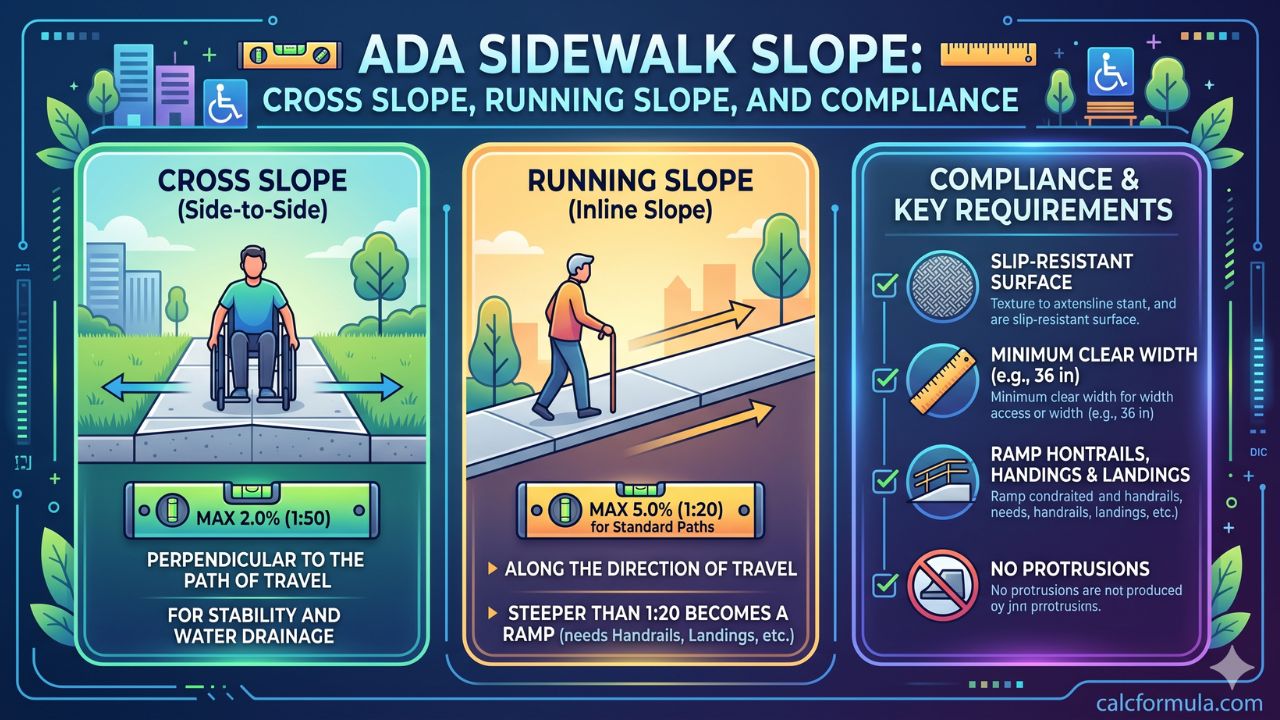
If you design, build, inspect, or maintain public walkways, understanding ADA sidewalk slope requirements is not optional - it is the law. The Americans with Disabilities Act (ADA) sets precise slope limits for pedestrian paths of travel to ensure people who use wheelchairs, walkers, canes, or other mobility aids can travel safely and independently.
This guide breaks down every slope requirement you need to know: running slope, cross slope, how to measure each one, and the fastest way to check whether your project is in compliance.
What Is ADA Sidewalk Slope?
Slope, in the context of accessible design, refers to the ratio of vertical rise to horizontal run along a walking surface. ADA Standards for Accessible Design - codified in the 2010 ADA Standards (§402) and based on the U.S. Access Board's guidelines - regulate slope in two perpendicular directions on any accessible route:
- Running slope - measured parallel to the direction of travel.
- Cross slope - measured perpendicular (across) the direction of travel.
Both measurements must remain within specific thresholds for a sidewalk to qualify as an accessible route under ADA law. Exceeding either limit can create barriers that prevent or endanger wheelchair users and others with mobility impairments.
📐 Quick Reference - ADA Slope Limits
Running Slope: maximum 1:20 (5%)
Cross Slope: maximum 1:48 (2.08%)
Ramp Running Slope: maximum 1:12 (8.33%)
Running Slope: Definition & ADA Limits
Running slope is the slope of a walking surface measured in the same direction a pedestrian travels - think of it as the "uphill/downhill" grade of a sidewalk.
ADA Running Slope Requirement
Under ADA Standards §403.3, the running slope of an accessible route (sidewalk) shall not exceed 1:20, which equals 5%. This means for every 20 inches of horizontal distance, the surface may rise or fall no more than 1 inch.
When a pedestrian route must follow the natural grade of a site and the running slope exceeds 5%, that portion of the route must be treated as a ramp and must comply with all ramp requirements - including handrails, landings, and edge protection (§405).
Why Running Slope Matters
- A slope greater than 5% requires additional physical effort from manual wheelchair users, increasing the risk of tipping backward on the way up or losing control on the way down.
- Power wheelchair users may struggle with traction and battery drain on sustained grades above 5%.
- Ambulatory individuals with balance disorders, arthritis, or low stamina are also significantly affected by steep running slopes.
Running Slope Percentage Reference Table
| Slope Ratio | Slope % | Rise per 12″ Run | ADA Status |
|---|---|---|---|
| 1:50 | 2.0% | 0.24″ | ✅ Compliant |
| 1:20 | 5.0% | 0.60″ | ✅ Max Allowed (Sidewalk) |
| 1:12 | 8.33% | 1.00″ | ⚠️ Ramp Required |
| 1:8 | 12.5% | 1.50″ | ❌ Non-Compliant |
Cross Slope: Definition & ADA Limits
Cross slope (also called transverse slope) is the slope measured perpendicular to the direction of travel - the side-to-side tilt of a walkway surface as you walk along it.
ADA Cross Slope Requirement
ADA Standards §403.3 limits cross slope on accessible routes to a maximum of 1:48, approximately 2.08%. In practical terms: for every 48 inches of width, the surface may only slope 1 inch from one side to the other.
This seemingly small percentage has a major impact. A cross slope steeper than 2% causes a wheelchair to drift to the downhill side, forcing the user to constantly fight the chair's tendency to veer off course. On a crowded sidewalk or near a road, this can be genuinely dangerous.
Why Cross Slope Is the Most Common Violation
Cross slope violations are far more common than running slope violations. Here's why:
- Drainage design: Engineers often deliberately pitch sidewalks toward the street curb to drain rainwater. A 2% pitch drains well - and also perfectly matches the ADA limit. Anything steeper becomes a problem.
- Pavement settling: Over time, soil settling and tree root growth can distort even compliant concrete, creating localized cross-slope failures.
- Driveway cuts: Where sidewalks cross driveways, the apron can impose steep cross slopes that were never ADA-evaluated.
- Construction tolerances: Even well-intentioned contractors sometimes allow finished surfaces to exceed 2% cross slope due to poor measurement or finishing techniques.
Cross Slope at Curb Ramps
Curb ramps and blended transitions are subject to their own slope rules. The flared sides of curb ramps (§406.3) may have a slope no steeper than 1:10 (10%), while the main ramp surface must not exceed 1:12 (8.33%) in running slope and 1:48 (2.08%) in cross slope.
How to Measure Sidewalk Slope
Accurate slope measurement is essential for both design verification and compliance inspection. There are several methods used in the field:
1. Digital Level or Smart Level
A digital level is the most practical tool for field inspections. Place the level on the walking surface in the direction you want to measure and read the percentage or degree directly from the display. To measure cross slope, orient the level perpendicular to the travel direction; for running slope, align it parallel.
2. Slope Gauge / Smartlevel App
Many ADA inspectors use dedicated slope gauges (such as the Slope-Tester Pro) or smartphone apps with inclinometers to quickly survey large areas. These are useful for initial screening, though a calibrated digital level provides more accurate final readings.
3. Rise Over Run Calculation
If you have survey data or physical measurements, you can calculate slope using the simple formula:
Slope % = (Rise ÷ Run) × 100
For example, if a 10-foot section of sidewalk rises 4 inches vertically, the slope is: (4 ÷ 120) × 100 = 3.33% - within the 5% ADA limit.
Free Slope Calculators for ADA Compliance
Manual calculations are prone to error, especially on complex sites with varying grades. Use these free online tools to quickly verify whether your sidewalk meets ADA slope standards:
🔢 Sidewalk Slope Calculator
Enter your rise and run measurements to instantly calculate the sidewalk's slope percentage and ratio. The calculator flags whether the result is ADA-compliant for both running slope and cross slope, saving you time on every site inspection.
Use the Sidewalk Slope Calculator →
📊 Percent Slope Calculator
Need to convert a slope ratio to a percentage, or find the rise given a known run and slope? This general-purpose percent slope calculator handles it all - ideal for designers checking ADA compliance on ramps, sidewalks, and curb cuts alike.
Use the Percent Slope Calculator →
Both tools are free, mobile-friendly, and require no sign-up. Whether you are checking a single measurement on a clipboard in the field or running numbers back at the office, these calculators take the guesswork out of ADA slope compliance. Try the sidewalk slope calculator first for sidewalk-specific guidance, or use the percent slope calculator whenever you need to work between ratios and percentages.
Sidewalks vs. Ramps: Key Differences
One of the most important distinctions in ADA accessible design is knowing when a sloped walking surface becomes a ramp in the eyes of the law - because ramps trigger an entirely separate set of requirements.
| Feature | Accessible Sidewalk | ADA Ramp |
|---|---|---|
| Max Running Slope | 1:20 (5%) | 1:12 (8.33%) |
| Max Cross Slope | 1:48 (2.08%) | 1:48 (2.08%) |
| Handrails Required? | No | Yes (if rise > 6″) |
| Landings Required? | No | Yes (top and bottom) |
| Edge Protection Required? | No | Yes |
| Min Width | 36 inches clear | 36 inches clear |
The takeaway: if your "sidewalk" has a running slope between 5% and 8.33%, it must be redesigned as a ramp with all associated features. Slopes exceeding 8.33% are not permitted for ramps, period - the path must be regraded or a different route provided.
Common ADA Slope Violations & How to Fix Them
Violation 1: Cross Slope at Driveway Aprons
Problem: Where a sidewalk crosses a driveway, the sloped apron creates a cross slope often exceeding 5-8%. Wheelchair users veer dangerously toward the road.
Fix: Install a raised crosswalk across the driveway opening or redesign the apron geometry to maintain a level path of travel through the sidewalk zone. The driveway slopes to and from the sidewalk; the sidewalk itself stays level.
Violation 2: Running Slope Following Natural Grade
Problem: A sidewalk on a hillside follows the existing 7-9% natural slope of the land without a ramp or handrail system.
Fix: Either regrade the site to achieve a maximum 5% running slope, or officially classify the steeper segment as a ramp and retrofit it with compliant handrails, landings, and edge protection. Use the sidewalk slope calculator to determine the minimum run length needed to keep rise within compliant limits.
Violation 3: Settlement and Heaving
Problem: Once-compliant sidewalk panels have shifted due to tree roots or soil settlement, creating cross slopes well above 2%.
Fix: Slab grinding can correct minor uplift. For panels that have subsided unevenly, mudjacking (slabjacking) or full-panel replacement is often required. After correction, resurvey with a digital level and verify compliance using a percent slope calculator.
Violation 4: Excessive Slope at Curb Ramp Sides
Problem: The flared sides of a curb ramp exceed 10%, or the ramp itself has a cross slope above 2%.
Fix: Widen the curb ramp landing or reduce the length of the flare. The running slope of the ramp face must not exceed 8.33%, and cross slope on the ramp must stay at or below 2.08%.
ADA Sidewalk Slope Compliance Checklist
Use this checklist during design review, construction inspection, or facility evaluation:
- ☐ Running slope does not exceed 1:20 (5%) anywhere along the accessible route.
- ☐ Cross slope does not exceed 1:48 (2.08%) across the full width of the path.
- ☐ All sections with running slope > 5% are treated as ramps with compliant handrails and landings.
- ☐ Ramp running slope does not exceed 1:12 (8.33%).
- ☐ Curb ramp flares do not exceed 1:10 (10%) slope.
- ☐ Sidewalk cross slope at driveway crossings is ≤ 2.08%.
- ☐ Slopes have been measured with a calibrated digital level in both directions.
- ☐ Calculations have been verified using the sidewalk slope calculator.
- ☐ Settled or heaved panels have been identified and scheduled for repair.
- ☐ All accessible routes maintain a minimum clear width of 36 inches.
Frequently Asked Questions
What is the maximum ADA slope for a sidewalk?
The maximum running slope for an ADA-compliant sidewalk is 1:20, or 5%. Any slope steeper than this requires the path to be classified and constructed as a ramp. The maximum cross slope is 1:48, approximately 2%, measured perpendicular to the direction of travel.
What is the difference between running slope and cross slope?
Running slope is measured parallel to the direction of travel - it is the slope you walk up or down. Cross slope is measured perpendicular to travel - the side-to-side tilt of the surface. ADA standards limit running slope to 5% and cross slope to 2% for accessible sidewalks.
How do I convert a slope ratio to a percentage?
Divide 1 by the run value in the ratio, then multiply by 100. For example, 1:20 = (1 ÷ 20) × 100 = 5%. You can also use the free percent slope calculator to convert between ratios and percentages instantly.
Can a sidewalk have a 2% cross slope for drainage?
Yes - and in fact this is the standard design approach. A 2% cross slope drains rainwater effectively while staying exactly at the ADA cross slope limit of 1:48 (2.08%). Engineers typically design for precisely 2% to maximize drainage without exceeding ADA requirements.
What slope is required for ADA ramps?
ADA ramps must not exceed a running slope of 1:12 (8.33%). The cross slope of the ramp surface must not exceed 1:48 (2.08%). Ramps with a rise greater than 6 inches must have handrails on both sides and level landings at the top and bottom.
How do I check if my sidewalk is ADA compliant for slope?
Measure the running slope and cross slope with a calibrated digital level at multiple points along the path. Then enter your rise and run values into the sidewalk slope calculator to instantly see whether your measurements are within ADA limits.
What happens if a sidewalk fails ADA slope requirements?
Non-compliant slopes must be corrected as part of maintaining an accessible path of travel. Depending on severity, remediation may include grinding raised panels, mudjacking settled slabs, regrading the sub-base, or full replacement. For running slopes between 5% and 8.33%, the section must be reclassified and retrofitted as a compliant ramp.
Do ADA slope rules apply to private property?
ADA Title II applies to state and local governments, and Title III applies to places of public accommodation (stores, offices, restaurants, etc.). Most private properties that are open to the public must comply with ADA accessible route requirements, including slope limits. Purely private residential property is generally not covered, though state and local building codes may impose similar standards.
Final Thoughts
ADA sidewalk slope compliance comes down to two numbers: 5% running slope and 2% cross slope. Getting those numbers right at every point on every accessible route is what separates a truly accessible environment from one that merely looks the part.
Whether you are a civil engineer reviewing grading plans, a contractor finishing concrete, or a facility manager auditing an existing campus, precise measurement and calculation are your best tools. Bookmark the sidewalk slope calculator and the percent slope calculator to keep ADA compliance math at your fingertips - every time, on every project.
Have questions about a specific ADA slope situation? Drop a comment below or contact a certified accessibility consultant (CASp) in your area.