If you've ever looked at a zoning report and seen a number like "FAR 1.5" sitting next to a parcel of land, you've run into one of the most influential - and most misunderstood - numbers in property development. Floor Area Ratio quietly determines how big a building is allowed to be on a given lot, which means it affects everything from a developer's pro forma to whether your home addition needs a variance.
This guide breaks down what Floor Area Ratio actually means, how it's calculated, what counts toward it (and what doesn't), and how to use it to figure out the maximum buildable square footage on a piece of land before you ever talk to an architect or planner.
What Is Floor Area Ratio?
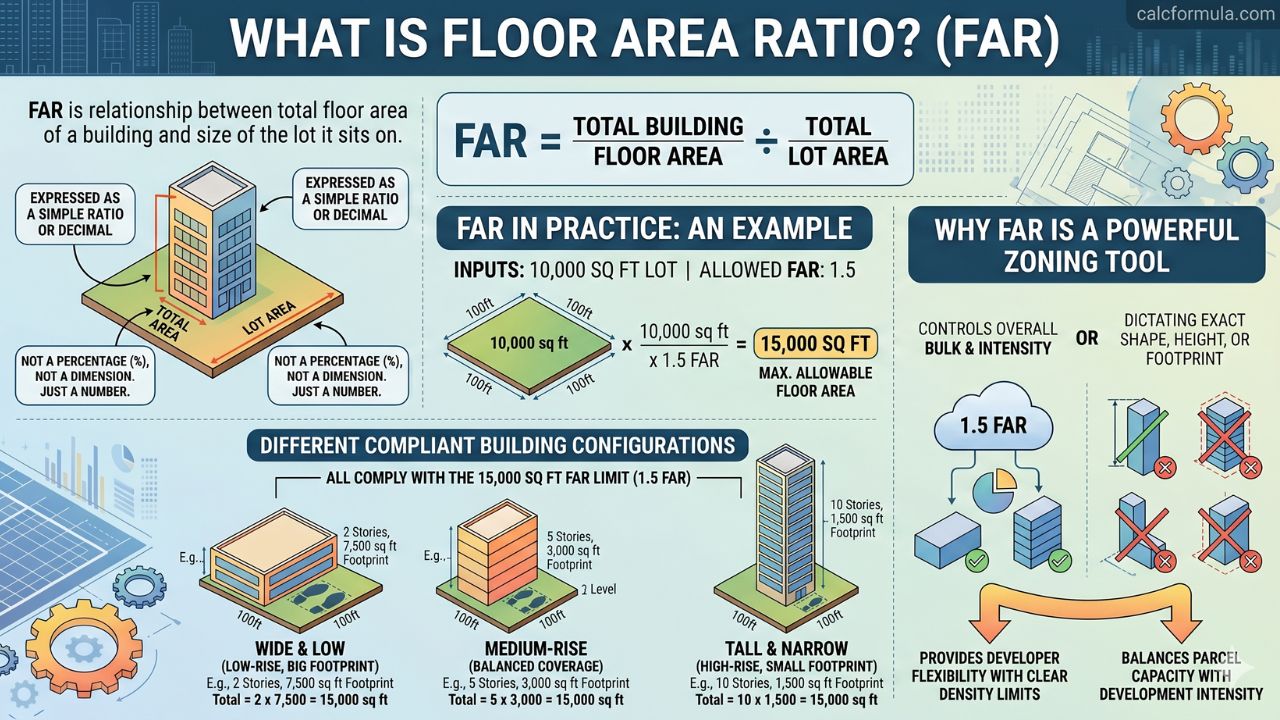
Floor Area Ratio, almost always abbreviated as FAR, is the relationship between the total floor area of a building and the size of the lot it sits on. It's expressed as a simple ratio or decimal - not a percentage, not a dimension, just a number.
The basic formula is:
FAR = Total Building Floor Area ÷ Total Lot Area
So if a lot is 10,000 square feet and the zoning code allows a FAR of 1.5, the maximum allowable floor area for any building on that lot is 15,000 square feet - regardless of how that square footage is arranged across one floor or several.
This is what makes FAR such a powerful zoning tool. A single number controls the overall bulk and intensity of development on a parcel without dictating the exact shape, height, or footprint of the building. A developer could build a single-story structure covering most of the lot, or a tall, narrow building covering a small footprint - as long as the total floor area doesn't exceed the FAR limit.
The Floor Area Ratio Formula in Practice
The math itself is simple once you have two numbers: the lot area and the total floor area of the building (existing or proposed).
FAR = Building Floor Area ÷ Lot Area
You can also rearrange this formula to solve for the maximum buildable area, which is usually what people actually need:
Maximum Floor Area = Lot Area × Allowed FAR
A Quick Example
Let's say a parcel measures 8,000 square feet, and the zoning district allows a FAR of 2.0.
Maximum allowable floor area = 8,000 sq ft × 2.0 = 16,000 square feet
That 16,000 square feet could be distributed across two 8,000-square-foot floors, four 4,000-square-foot floors, or any other combination - as long as the total stays at or under 16,000.
If you're working with an irregular lot or you're not entirely sure of your exact square footage to begin with, it's worth running the numbers through a Square Footage Calculator first to get an accurate lot area before applying the FAR formula. Getting that starting number right matters more than people expect - a small error in lot size gets multiplied directly into your maximum buildable area.
Why FAR Matters for Zoning
Floor Area Ratio shows up in zoning codes because it gives planning departments a way to control the overall density and bulk of development without micromanaging every architectural detail. A few reasons FAR is used so widely:
- It controls density indirectly. Higher FAR generally means more people, more traffic, and more demand on infrastructure for a given parcel.
- It's flexible for design. Unlike a strict height limit or setback rule, FAR allows architects some freedom in how the allowed bulk is arranged.
- It scales with lot size. A larger lot automatically gets a larger allowance, which keeps the rule proportional across different parcel sizes in the same zone.
Different zoning districts within the same city often have very different FAR limits. A dense downtown commercial zone might allow a FAR of 5.0 or higher, while a low-density residential zone might cap it at 0.5 or less. This is one reason it's worth checking the specific FAR for your parcel's zoning designation rather than assuming a number based on a neighboring property - even lots that look similar can fall into different zones with very different allowances.
What Counts Toward Floor Area Ratio (and What Doesn't)
This is where Floor Area Ratio gets genuinely tricky, and it's also where most miscalculations happen. The "total floor area" in the FAR formula isn't always the same as the gross square footage you'd see on a real estate listing.
Generally, the following are typically included in FAR calculations:
- Floor area of all habitable stories, measured to the exterior walls
- Mezzanines and interior balconies above a certain size threshold
- Enclosed accessory structures, in many jurisdictions
The following are commonly excluded, though this varies significantly by jurisdiction:
- Basements and below-grade floor area (often excluded entirely or partially)
- Attics and crawl spaces that don't meet minimum ceiling height requirements
- Parking structures, in many zoning codes - especially underground or structured parking
- Unenclosed porches, balconies, and decks
- Mechanical penthouses and rooftop equipment areas
Because these exclusions vary so much from one municipality to another, the single most important step in any FAR calculation is reading the actual zoning code definition for your jurisdiction - not relying on a general rule of thumb. A basement that counts toward FAR in one city might be completely excluded in another, and that difference alone can swing your buildable area by thousands of square feet on a larger project.
How to Calculate Floor Area Ratio for Your Property
Here's a practical sequence for working through a FAR calculation, whether you're evaluating a property for purchase, planning an addition, or just trying to understand what's possible on a lot you already own.
1. Confirm the Lot Area
Pull your lot's exact dimensions from a survey, plat map, or county assessor's record - don't estimate from a satellite image. If you need to convert irregular dimensions or multiple measurements into a single square footage figure, a Square Footage Calculator makes quick work of this, especially for lots that aren't simple rectangles.
2. Look Up the Zoning District and Its FAR Limit
Identify which zoning district your parcel falls under and find the maximum FAR allowed for that district. This information is usually published in the zoning ordinance or available through the local planning department's online GIS mapping tool.
3. Calculate the Maximum Allowable Floor Area
Multiply your lot area by the allowed FAR:
Maximum Floor Area = Lot Area × FAR
This gives you the theoretical ceiling for total floor area on the lot - the number every design has to fit under.
4. Determine What Counts Toward That Total
Read the zoning code's specific definition of "floor area" for FAR purposes. Make a list of what's included and excluded for your jurisdiction, since this directly affects how much usable space you can actually design into the building.
5. Calculate the Floor Area of Your Existing or Proposed Building
Add up the floor area of each story that counts toward FAR, based on the definitions you identified in step 4. For an existing building, this might come from as-built drawings; for a proposed building, it comes from your design plans.
6. Divide to Get Your FAR
Once you have both numbers, divide the building's countable floor area by the lot area:
FAR = Building Floor Area ÷ Lot Area
Compare this result to the maximum allowed FAR for the zoning district. If your number is at or below the limit, the proposal is consistent with the zoning code on this particular metric. If it exceeds the limit, you'll need to either reduce the floor area, look into a variance or special permit process, or reconsider the design.
A Floor Area Ratio Calculator is useful at this stage too - once you've worked out your lot area and building floor area, it lets you quickly check the resulting FAR and compare it against the zoning limit without redoing the arithmetic by hand every time you adjust the design.
A Worked Example
Let's put the whole process together with a realistic scenario.
A property owner has a 6,500-square-foot lot in a zoning district with a maximum FAR of 1.0. They want to know how much floor area they can build.
Step 1 - Lot area: 6,500 sq ft (confirmed from the assessor's plat map)
Step 2 - Zoning FAR limit: 1.0
Step 3 - Maximum floor area: 6,500 sq ft × 1.0 = 6,500 sq ft
Now suppose the existing house on the lot has 2,400 square feet of floor area that counts toward FAR, and the owner wants to add a second-story addition of 1,800 square feet.
Step 5 - Proposed total floor area: 2,400 sq ft + 1,800 sq ft = 4,200 sq ft
Step 6 - Resulting FAR: 4,200 sq ft ÷ 6,500 sq ft = 0.65
Since 0.65 is below the 1.0 maximum, the proposed addition fits within the zoning district's FAR limit - at least on this metric. (Other zoning requirements, like height limits, setbacks, and lot coverage, would still need to be checked separately, since FAR is only one piece of the overall zoning picture.)
Common Mistakes When Calculating Floor Area Ratio
A few errors come up repeatedly, even among people who are generally comfortable with the math:
- Using gross building square footage from a listing instead of the floor area definition specific to the zoning code
- Forgetting to exclude or include basements based on the local rule, which can dramatically change the result on properties with finished lower levels
- Assuming the FAR limit is the same across an entire city, when it often varies block by block depending on the zoning district
- Not accounting for existing floor area when calculating how much additional space an addition can add - FAR applies to the total building, not just the new portion
- Mixing up lot area and buildable area, especially on parcels with easements, setbacks, or unbuildable portions that still count toward the lot area for FAR purposes
Most of these come down to the same root cause: treating FAR as a purely mathematical exercise without first confirming the definitions in the actual zoning ordinance that applies to the property.
Frequently Asked Questions
What does a FAR of 1.0 mean?
A FAR of 1.0 means the total floor area of a building can equal the total area of the lot. On a 5,000-square-foot lot, that's a maximum of 5,000 square feet of floor area - which could be a single-story building covering the whole lot, or a smaller-footprint building with multiple floors.
Is a higher FAR always better for a property owner?
A higher FAR generally allows for a larger building, which can increase a property's development potential and value. However, other zoning limits - height restrictions, setbacks, parking requirements, and lot coverage - also apply, so a high FAR doesn't automatically mean a large building is achievable on a given lot.
Does FAR include garages and basements?
It depends entirely on the local zoning code. Some jurisdictions exclude basements and parking areas from FAR calculations, while others include some or all of that space. Always check the specific floor area definition in your local zoning ordinance rather than assuming.
How do I find the FAR for my property?
The FAR limit is set by the zoning district your property falls under, which is typically listed in the local zoning ordinance or available through your city or county's online zoning map and GIS tools. The planning department can also confirm the applicable FAR for a specific parcel.
Final Thoughts
Floor Area Ratio is one of those zoning concepts that looks intimidating as a number but is actually fairly approachable once you understand the formula and, more importantly, what your specific jurisdiction counts as "floor area." The calculation itself is simple division and multiplication - the real work is in confirming your lot size, finding the correct FAR limit for your zoning district, and applying the right definitions for what counts toward the total.
Get those three pieces right, and you'll have a clear, accurate picture of what's buildable on a property - before you invest time and money into a design that doesn't fit the zoning.