Waterlogged yards, wet basements, soggy foundation edges, and standing water after every rain event - all of these are symptoms of the same underlying problem: surface water and subsurface groundwater with nowhere to go. A properly designed French drain intercepts that water before it reaches your foundation, collects it through a perforated pipe bedded in gravel, and directs it under gravity to a safe outlet. When correctly designed and installed, a French drain can eliminate chronic drainage problems that surface grading alone cannot fix.
But a French drain that is sized too small, sloped incorrectly, backfilled with the wrong gravel, or installed without a filter fabric fails quickly - clogging with sediment, running at insufficient velocity to stay clear, or simply not collecting enough water to matter. The difference between a French drain that works for thirty years and one that clogs in three is entirely in the design details. This guide covers every design decision you need to make: pipe diameter, minimum slope, gravel type and depth, trench dimensions, filter fabric selection, and outlet requirements - with a complete worked example and the most common mistakes to avoid.
Quick Answer: How to Design a French Drain (Core Specifications)
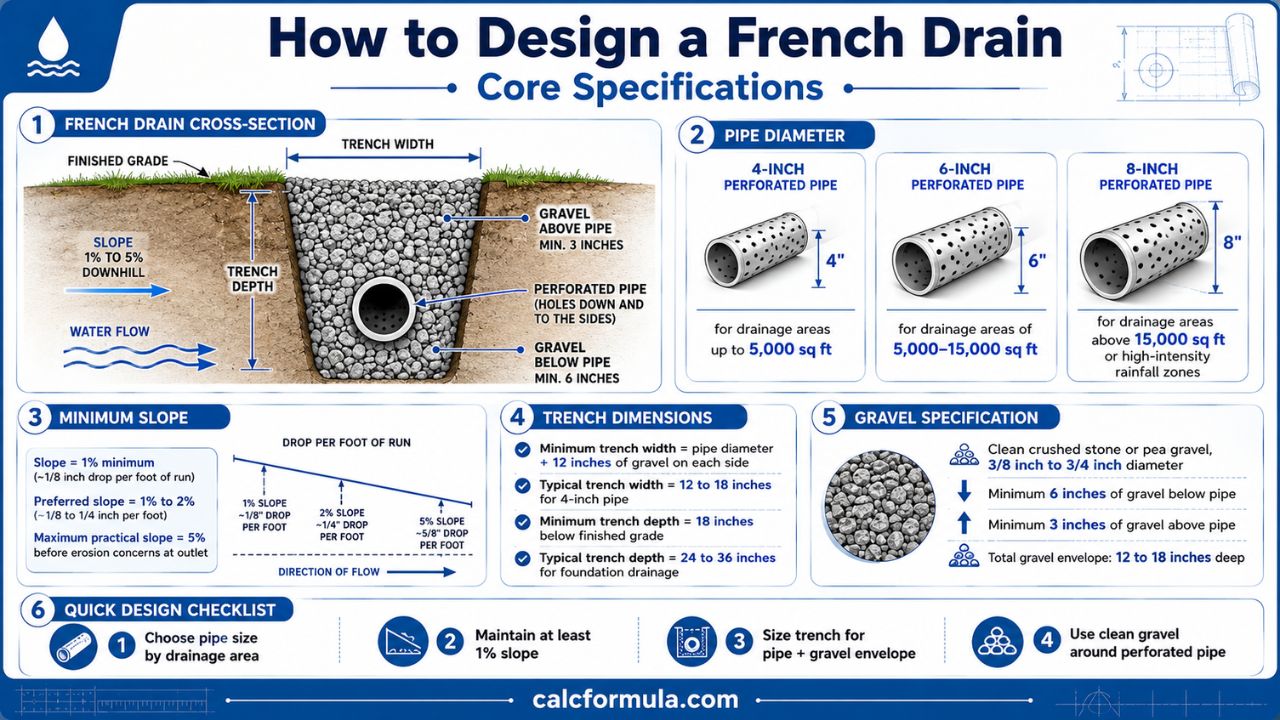
For most residential French drain applications, the minimum acceptable design specifications are:
Pipe diameter:
4-inch perforated pipe for drainage areas up to 5,000 sq ft
6-inch perforated pipe for drainage areas of 5,000–15,000 sq ft
8-inch perforated pipe for drainage areas above 15,000 sq ft or high-intensity rainfall zones
Minimum slope:
Slope = 1% minimum (1/8 inch drop per foot of run)
Preferred slope = 1% to 2% (1/8 to 1/4 inch per foot)
Maximum practical slope = 5% before erosion concerns at outlet
Trench dimensions:
Minimum trench width = pipe diameter + 12 inches of gravel on each side
Typical trench width = 12 to 18 inches for 4-inch pipe
Minimum trench depth = 18 inches below finished grade
Typical trench depth = 24 to 36 inches for foundation drainage
Gravel specification:
Clean crushed stone or pea gravel, 3/8 inch to 3/4 inch diameter
Minimum 6 inches of gravel below pipe
Minimum 3 inches of gravel above pipe
Total gravel envelope: 12 to 18 inches deep
For instant calculation of pipe capacity, gravel volume, and slope requirements for your specific drainage area and trench dimensions, use the free French Drain Calculator at CalcFormula.com before finalizing any design decision.
What Affects How You Design a French Drain? (Variables Section)
Designing a French Drain Around Drainage Area and Rainfall Intensity
The drainage area is the total land surface that sheds water toward the French drain - including roof area if downspouts discharge near the drain, lawn area, driveway area, and any upslope area that drains toward the problem zone. Accurately defining the drainage area is the first and most critical design step because it directly determines pipe size and gravel depth.
Rainfall intensity varies significantly by region. In the arid Southwest, a 10-year storm event might produce 1 inch of rain in an hour. In the Gulf Coast, Mississippi Valley, or Pacific Northwest, the same design storm event can produce 3-4 inches per hour. A French drain designed for low-intensity rainfall in a dry climate will be chronically undersized if the same homeowner relocates and installs the same system in a high-intensity rainfall zone.
The design flow rate through the French drain (in gallons per minute) can be estimated using the Rational Method:
Q = C × i × A ÷ 96.23Where:
- Q = peak flow rate (GPM)
- C = runoff coefficient (0.35-0.45 for lawn; 0.70-0.90 for pavement; 0.75-0.95 for roofs)
- i = rainfall intensity (inches per hour) for your design storm
- A = drainage area (square feet)
This design flow rate determines the minimum pipe capacity required.
Pipe Diameter and Flow Capacity
Perforated corrugated HDPE pipe (commonly called "drain tile" or "perf pipe") is the standard choice for residential French drains. It is available in 3-inch, 4-inch, 6-inch, 8-inch, 10-inch, and 12-inch diameters. Solid PVC Schedule 40 perforated pipe is used where structural loading or longevity demands are higher.
The hydraulic capacity of a drain pipe at a given slope is governed by Manning's equation for full-pipe flow:
Q = (1.49 / n) × A × R^(2/3) × S^(1/2)Where:
- Q = flow capacity (cubic feet per second)
- n = Manning's roughness coefficient (0.013 for HDPE corrugated pipe; 0.011 for smooth PVC)
- A = cross-sectional area of pipe (square feet)
- R = hydraulic radius = A/P where P = wetted perimeter (feet)
- S = slope (ft/ft, not percentage)
For practical residential design, the following pipe capacity table (at 1% slope) simplifies selection:
| Pipe Diameter | Capacity at 1% Slope | Capacity at 2% Slope |
|---|---|---|
| 4-inch HDPE | ~45 GPM | ~64 GPM |
| 6-inch HDPE | ~135 GPM | ~191 GPM |
| 8-inch HDPE | ~290 GPM | ~410 GPM |
| 4-inch PVC | ~55 GPM | ~78 GPM |
| 6-inch PVC | ~160 GPM | ~226 GPM |
Design the pipe for no more than 50% of full-pipe capacity during the design storm - this reserve capacity accounts for partial clogging over time and peak intensity bursts above the design storm. If the design storm requires 40 GPM, select pipe with at least 80 GPM full-pipe capacity.
Slope Design for a French Drain
Slope is the engine that moves water through the system. Too little slope and water sits in the pipe, sediment accumulates, the system loses capacity over months, and eventually backs up. Too much slope and outlet erosion becomes a problem. The minimum self-cleaning velocity in a drain pipe is approximately 2 feet per second - the velocity at which sediment particles are entrained and carried out of the pipe rather than settling.
For HDPE corrugated perforated pipe, 1% slope (0.01 ft/ft) achieves self-cleaning velocity when the pipe is flowing at half capacity or more. A slope of 0.5% (1/16 inch per foot) is marginal and not recommended for any French drain system expected to carry sediment-laden groundwater. A slope of 0.25% or less will silt up within a few seasons regardless of filter fabric quality.
The required drop over a French drain run is:
Total Drop (inches) = Run Length (ft) × Slope (%) × 0.12For a 1% slope:
Total Drop = Run Length (ft) × 0.12 inches per footA 100-foot French drain at 1% slope must drop 12 inches from inlet to outlet. Verify the available elevation difference between the start of the drain and the outlet before finalizing route and slope. The Pipe Slope Calculator calculates required drop, slope percentage, and grade for any French drain run length and target slope - essential verification before trenching begins.
Gravel Type, Gradation, and Depth
The gravel envelope around the perforated pipe serves two functions: it allows water to enter the pipe quickly from the surrounding soil, and it acts as a first-stage filter to prevent fine soil particles from entering and clogging the pipe perforations. Clean, angular crushed stone or rounded pea gravel in the 3/8-inch to 3/4-inch size range is the standard specification for both functions.
Why gravel size matters critically:
Gravel that is too fine (smaller than 3/8 inch) has high surface area and capillary tension, holds moisture, and compacts over time - reducing permeability. Sand is never appropriate as drain backfill. Gravel that is too coarse (larger than 1.5 inches) has large void spaces that allow fine soil particles to migrate through and clog the pipe perforations directly, especially in silty or sandy soils.
Gravel volume calculation for the trench:
Gravel Volume (cubic yards) = (Trench Length × Trench Width × Gravel Depth) ÷ 27Multiply by 1.15 to account for compaction and void space settlement (15% swell factor for crushed stone).
For accurate gravel quantity and cost estimation before ordering materials, the Pea Gravel Calculator converts trench dimensions directly into tons, cubic yards, and bags of gravel needed - accounting for the shape and depth of the gravel envelope.
Geotextile Filter Fabric
Filter fabric (geotextile) wraps the entire gravel-and-pipe assembly to prevent fine soil particles from migrating into the gravel envelope from the surrounding native soil. Without filter fabric, even properly sized gravel clogs with silt within 3-7 years in loam, clay, or silty soils - often sooner in areas with high groundwater velocity.
The standard specification for French drain filter fabric is a non-woven geotextile with an Apparent Opening Size (AOS) between 0.15 mm and 0.30 mm (US sieve sizes #50 to #100). This opening range is fine enough to stop most silt and clay particles while remaining permeable enough to pass water without restriction.
Filter fabric is installed as a continuous wrap: line the trench walls and bottom with fabric, fold it over the completed gravel fill at the top, and staple or pin the overlap before installing topsoil or sod. Fabric that is draped only over the top of the gravel - not lining the trench walls - provides minimal protection against lateral silt migration.
Exception: Gravel-wrapped sock pipe - perforated pipe pre-wrapped in a filter fabric sock - provides some protection in sandy or gravelly soils but is generally not sufficient in clay-heavy or silty soils. In those conditions, full trench fabric lining is required regardless of whether sock pipe is used.
Outlet Design and Termination
Every French drain needs a positive outlet where water exits the system. The three standard outlet options for residential designs are:
Daylighting to a slope or swale: The pipe exits the ground at a lower elevation and discharges to a vegetated slope, drainage swale, or roadside ditch. This is the preferred option when topography allows. The outlet should be protected with a rodent guard or flap gate to prevent animals from nesting in the pipe and surface water from backing up.
Connection to a storm sewer: In some municipalities, French drains can legally connect to the public storm sewer system via a catch basin or cleanout. Verify with the local public works department before designing for this outlet - many jurisdictions prohibit it.
Dry well or infiltration basin: Water is discharged into a subsurface dry well filled with gravel, where it infiltrates the native soil. This option works only in soils with adequate permeability (percolation rate under 30 minutes per inch). In clay-heavy soils, a dry well simply fills up and backs water into the French drain, defeating the system entirely.
Step-by-Step Worked Example: Designing a French Drain for a Residential Yard
Project: A 4,500 sq ft residential backyard in the mid-Atlantic region consistently floods after rainfall. The lot is predominantly lawn (C = 0.40). The local 10-year design storm produces 2.5 inches of rain per hour. The available outlet is a roadside swale 85 feet from the low point of the yard. Available elevation drop from the inlet location to the swale is 14 inches. Soil is clay loam.
Step 1: Calculate design flow rate using the Rational Method
Q = C × i × A ÷ 96.23
Q = 0.40 × 2.5 × 4,500 ÷ 96.23
Q = 4,500 ÷ 96.23
Q = 46.8 GPM
Step 2: Size the pipe for 50% capacity rule
Required full-pipe capacity = 46.8 × 2.0 = 93.6 GPM minimum
From the capacity table at 1% slope: 4-inch HDPE carries only 45 GPM at full capacity - insufficient. 6-inch HDPE carries 135 GPM at 1% slope - adequate with margin. Select 6-inch perforated HDPE.
Step 3: Verify available slope
Available slope = Drop ÷ Run = 14 inches ÷ (85 ft × 12 in/ft)
               = 14 ÷ 1,020
               = 0.0137 ft/ft = 1.37%
1.37% exceeds the 1% minimum. The available topography supports the design. Use the Pipe Slope Calculator to confirm: enter 85-foot run and 14-inch total drop to verify the 1.37% grade before any excavation.
Step 4: Determine trench dimensions
For 6-inch pipe in clay-loam soil with full fabric lining:
Trench width  = 6 inches (pipe) + 6 inches (gravel each side) = 18 inches
Trench depth  = 6 inches (gravel below) + 6 inches (pipe) + 6 inches (gravel above) + 12 inches (cover) = 30 inches
Set bottom of trench at 30 inches below finished grade. Slope trench bottom uniformly at 1.37% from inlet to outlet using a laser level or string line.
Step 5: Calculate gravel volume
Gravel envelope depth = 6 + 6 + 6 = 18 inches = 1.5 feet
Trench length = 85 feet
Trench width = 1.5 feet (18 inches)
Gravel Volume = 85 × 1.5 × 1.5 = 191.25 cubic feet
             = 191.25 ÷ 27 = 7.08 cubic yards
Add 15% for settlement: 7.08 × 1.15 = 8.14 cubic yards of 3/8-3/4 inch clean crushed stone.
The Pea Gravel Calculator confirms this as approximately 12.2 tons of gravel at a standard 1.5 tons per cubic yard density - useful when ordering from a supplier who prices by the ton.
Step 6: Specify filter fabric and installation
Non-woven geotextile, AOS = 0.21 mm (US #70 sieve), installed as full trench liner. Fabric width required: 2 × trench depth + trench width + 12 inches overlap = 2 × 2.5 + 1.5 + 1.0 = 7.5 feet per linear foot of trench. Order a 9-foot-wide roll for this application.
Step 7: Design the outlet
Outlet daylights into the roadside swale at the toe of a vegetated slope. Install a 6-inch plastic flap gate at the pipe end to prevent rodent access and back-flooding. Place 6 square feet of riprap (6-inch diameter stones) at the outlet point to prevent erosion from the discharge velocity.
Common Mistakes When You Design a French Drain
Mistake 1: Insufficient slope - the most common failure mode
More French drains fail from inadequate slope than from any other design error. A 0.5% slope looks reasonable on paper but does not maintain self-cleaning velocity in a perforated pipe carrying silty groundwater. The result is progressive silt accumulation that reduces capacity by 50% or more within 3-5 years. Always survey the available elevation drop from inlet to outlet before finalizing the design route. If the natural topography doesn't provide at least 1% slope over the required run, redesign the route to find a path with adequate fall, or plan for a sump pump at the low point.
Mistake 2: Using the wrong gravel - sand, decomposed granite, or fine crushed stone
Many homeowners and even some contractors substitute whatever aggregate is cheapest or most available for the specified 3/8-3/4 inch clean stone. Decomposed granite compacts and seals around the pipe perforations within one season. Fine masonry sand washes into the pipe and creates a concrete-like plug over time. Even 1/4-inch pea gravel is borderline - it packs tightly in clay soil conditions and significantly reduces the permeability of the gravel envelope. Specify and inspect the gravel delivery before installation. The stone should be clean (washed, no fines), angular or rounded, and uniformly sized between 3/8 and 3/4 inch.
Mistake 3: Omitting or incorrectly installing filter fabric
Installing fabric only on top of the gravel rather than as a full trench liner is the single most common installation error. Fabric on top protects against surface soil migration but does nothing to stop fine soil from migrating laterally through the trench walls into the gravel envelope - which is where the majority of silt entry occurs in clay-loam and silty soils. Line all four sides of the trench (both walls, bottom, and top) and overlap the fabric at least 12 inches at the seam before backfilling.
Mistake 4: Installing perforated pipe with holes facing up instead of down
This surprises many homeowners but is critical: the perforations in a French drain pipe should face downward, not upward. Water rises through the gravel by hydrostatic pressure and enters the pipe through the lower perforations. Perforations facing up collect surface runoff and fine particles from the gravel surface, accelerating clogging. Pre-slotted or double-row perforated pipes should have the slots or holes positioned in the lower half of the pipe during installation.
Mistake 5: No cleanout access for future maintenance
Even a perfectly designed French drain accumulates sediment over years. Without cleanouts installed at the inlet and at directional changes, the only way to restore a clogged system is to excavate and replace it entirely. Install a 6-inch cleanout riser at the inlet end and at any horizontal bends greater than 45°, capped at grade with a screw-top cleanout plug. This allows periodic flushing with a drain cleaning machine or high-pressure water jet to restore full capacity.
Mistake 6: Discharging to an inadequate or illegal outlet
A French drain that moves water from a wet backyard to a foundation, a neighbor's property, or a non-approved storm connection creates new problems worse than the original drainage issue. Always confirm that the outlet is: at a lower elevation than the system inlet; legally compliant (your property or an approved public drainage feature); capable of receiving the design flow without erosion; and free from potential back-flooding during high-water events in the receiving swale or ditch.
Pro Tip: Install a Silt Sock at the Inlet
At the upstream end of the French drain where surface runoff first enters the trench, install a pre-fabricated silt sock or sediment trap before the water reaches the gravel. This captures the highest concentration of fine particles before they enter the gravel envelope and dramatically extends the service life of the system. A simple 12-inch diameter perforated riser filled with 1-inch washed stone serves as an effective inlet silt trap on residential systems.
FAQ: How to Design a French Drain
Q1: What size pipe should I use for a French drain?
For most residential applications covering areas up to 5,000 square feet, 4-inch perforated HDPE pipe is the standard minimum. For drainage areas between 5,000 and 15,000 square feet, or in regions with high-intensity rainfall (2+ inches per hour design storm), 6-inch pipe is recommended. Always size based on the calculated peak flow rate, not just area - use the Rational Method (Q = C × i × A ÷ 96.23) to find required capacity, apply a 50% reserve factor, and select pipe whose full-capacity GPM at your design slope exceeds the requirement. The French Drain Calculator sizes pipe based on drainage area, rainfall intensity, and slope automatically.
Q2: What is the minimum slope for a French drain to work properly?
The minimum slope for a functional French drain is 1%, equivalent to 1/8 inch of drop per foot of run. At 1% slope, a 4-inch or 6-inch perforated pipe achieves sufficient velocity to remain self-cleaning under normal operating conditions. The preferred design slope is 1-2%, which provides a meaningful margin above the self-cleaning threshold and accommodates minor variations in trench bottom grade during installation. Slopes below 0.5% (1/16 inch per foot) are not recommended for any perforated pipe drainage system regardless of gravel quality or fabric installation. Use the Pipe Slope Calculator to verify that your available elevation drop achieves at least 1% across the full drain run before committing to a route.
Q3: How deep should a French drain be installed?
Depth depends on the application. For surface water interception (yard drainage, curtain drains above a foundation), a depth of 18-24 inches below finished grade is typically sufficient. For foundation drainage and basement waterproofing applications, the drain must be installed below the bottom of the footing - typically 36-48 inches deep or more depending on foundation depth. For agricultural tile drainage, depth varies with crop root zone and frost depth requirements. The pipe should always be bedded in at least 6 inches of clean gravel and covered with at least 3-6 inches of gravel above the pipe crown before filter fabric is folded over and topsoil or sod is placed.
Q4: What is the difference between a French drain and a curtain drain?
Both use perforated pipe in a gravel trench to intercept and redirect water, but they serve different purposes and are positioned differently. A French drain is typically installed in a low area or along a foundation to collect water that has already accumulated. A curtain drain (also called an interceptor drain) is installed across a slope uphill of the area to be protected - its purpose is to intercept groundwater and surface runoff before it reaches the foundation or low area. In practice many installations combine both: a curtain drain uphill plus a collection French drain at the foundation. The design calculations for pipe size, slope, and gravel are identical for both.
Q5: How much gravel does a French drain need?
A standard residential French drain trench requires a gravel envelope that extends at least 6 inches below the pipe, wraps 6 inches on each side, and covers at least 3-6 inches above the pipe. For a typical 4-inch pipe in an 18-inch wide trench with a total gravel depth of 18 inches, gravel volume calculates as: Trench Length × 1.5 ft wide × 1.5 ft deep ÷ 27 cubic feet per yard, plus 15% for compaction. For a 100-foot drain, that's approximately 8.9-9.3 cubic yards or 13-14 tons of clean crushed stone. The Pea Gravel Calculator converts your exact trench dimensions into cubic yards and tons so you order precisely what you need.
Q6: Can I use landscape fabric instead of geotextile filter fabric for a French drain?
No. Standard landscape fabric (woven polypropylene designed to suppress weeds) has much larger opening sizes than the geotextile specified for drainage applications and allows fine silt and clay particles to pass through into the gravel envelope. It also degrades faster under hydrostatic pressure and wet conditions than purpose-made drainage geotextile. Always specify a non-woven geotextile with an AOS between 0.15 and 0.30 mm (US #50 to #100 sieve). This specification is found on the product data sheet and is the definitive filter performance criterion - not weight, thickness, or brand name.
Q7: How long does a properly designed French drain last?
A French drain designed and installed to the specifications in this guide - correct pipe size, 1%+ slope, 3/8-3/4 inch clean gravel, full trench geotextile lining, correctly oriented perforations, and proper outlet - should last 30-50 years with minimal maintenance. The most common cause of premature failure is root intrusion from trees planted near the drain line (plant trees at least 10-15 feet from any drain run), followed by silt migration through improperly installed or under-specified filter fabric. Periodic flushing through inlet cleanouts every 10-15 years extends service life further. Systems installed without filter fabric in clay or silty soils typically lose 50-70% of capacity within 5-10 years regardless of all other design details.
Useful Calculators for French Drain Design
These free tools support every design and material calculation step in your French drain project:
French Drain Calculator - Enter drainage area, rainfall intensity, pipe diameter, and slope to calculate design flow rate, pipe capacity, and whether your selected pipe and slope combination meets the design requirement. Covers 4-inch through 12-inch HDPE and PVC pipe options.
Pea Gravel Calculator - Convert trench length, width, and gravel depth into cubic yards, tons, and bags of gravel needed for the drainage envelope. Supports multiple aggregate types and includes the compaction/swell factor adjustment.
Pipe Slope Calculator - Calculate required elevation drop, slope percentage, and grade change for any French drain run length and target slope. Essential for verifying that available topography supports the 1%+ minimum slope before trenching begins.
Final Thoughts: Design a French Drain That Works for Decades, Not Just Seasons
The core principles behind how to design a French drain are straightforward: size the pipe for peak flow with a reserve margin, maintain at least 1% slope from inlet to outlet, wrap the gravel envelope in proper geotextile filter fabric, use clean angular crushed stone of the correct gradation, orient perforations correctly, and always design to a real outlet. Skip any of these elements and the system will fail - usually quietly and slowly, in ways that are expensive to diagnose and even more expensive to fix after the trench is backfilled.
Verify your pipe size and slope requirements with the French Drain Calculator, calculate your gravel order precisely with the Pea Gravel Calculator, and confirm your available grade with the Pipe Slope Calculator before any equipment arrives on site. A French drain designed correctly from the start is one of the most reliable and low-maintenance drainage solutions available - and it begins with getting the numbers right.
This article was written by a Licensed Civil Engineer and Drainage Design Specialist (PE) with over 17 years of experience designing residential, commercial, and agricultural drainage systems. All specifications are consistent with AASHTO drainage design guidelines, ASTM D4751 geotextile standards, and current stormwater management best practices.